
While his exact wealth is private, Naval Ravikant’s net worth is widely estimated to be between $60 million and $120 million, built primarily through early-stage angel investments and his equity stake in AngelList.
Some outlets push that number higher, but Naval himself has pushed back on the bigger claims.
What makes his story worth studying is the mechanism, not just the number: he built serious wealth by owning equity in companies early, not by earning a high salary.
Naval is an Indian-American entrepreneur, angel investor, and co-founder of AngelList, a platform that reshaped how startups raise money.
He was born in New Delhi and immigrated to the United States as a child.
He attended Stuyvesant High School in New York City before earning degrees in computer science and economics from Dartmouth College.
He’s backed over 200 startups, including early bets on Uber and Twitter.
His philosophy on wealth, written up in the viral essay How to Get Rich (Without Getting Lucky) and later compiled into The Almanack of Naval Ravikant, has made him one of the most quoted thinkers in Silicon Valley.
His influence stretches well beyond his portfolio.
Net Worth Snapshot And What Drives The Estimate
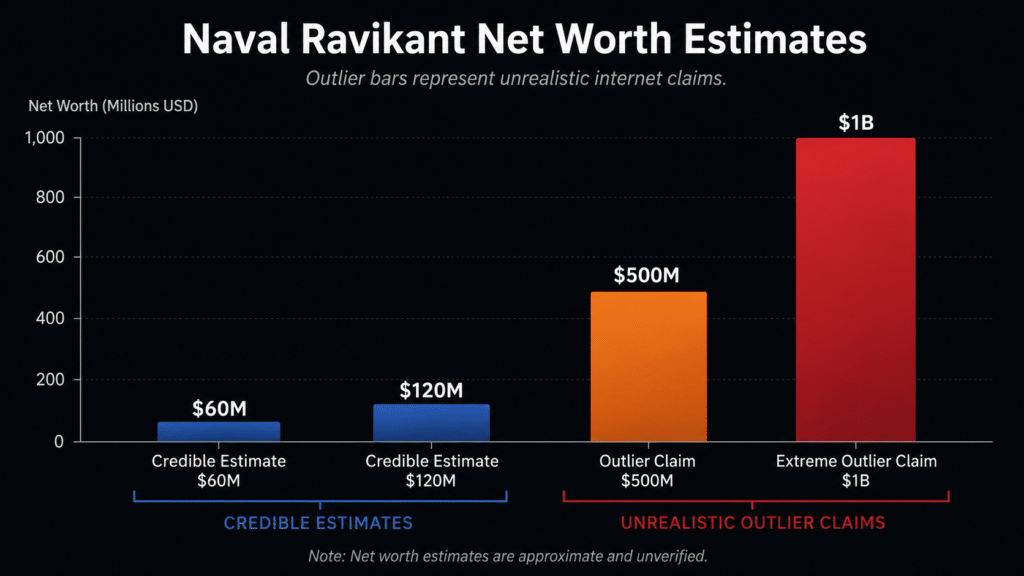
Estimates of Naval Ravikant’s net worth vary widely depending on the source, the year, and how private equity is valued.
The honest answer is that no authoritative public figure exists, and the range of credible estimates runs from around $60 million to $120 million as of mid-2026.
What Most 2026 Estimates Suggest
Most credible estimates for 2026 land in the $80 million to $120 million range.
According to a detailed breakdown at 99signals, the estimated net worth sits around $120 million, with large portions tied to his Uber investment, AngelList equity, Twitter stake, and crypto holdings.
A separate analysis by Kronix Magazine pegs the number between $80 million and $120 million, citing AngelList equity and early startup investments as the primary drivers.
Some outlier sources claim figures as high as $2 billion, but those numbers aren’t backed by credible data.
Why Private Equity Makes The Number Fuzzy
Most of Naval’s wealth is illiquid.
His AngelList stake, his early startup positions, and much of his crypto exposure are not publicly traded assets with a clear market price.
Valuations shift with every new funding round or market cycle. This is why two analysts can look at the same person and produce estimates that are $100 million apart.
Private company equity is worth whatever someone is willing to pay for it on a given day.
Is Naval Ravikant A Billionaire
Probably not, at least by any conventional definition. Naval has publicly denied the higher figures that circulate online.
The billionaire label gets attached to his name because of the scale of AngelList and his early Uber position, but equity stakes in private companies don’t make you liquid-wealthy.
Wealth creation through long-term thinking and compounding in private markets is real, but it does not equal cash in a bank account.
The $60 million to $120 million range is more grounded in what’s actually verifiable.
The Angel Equity Flywheel
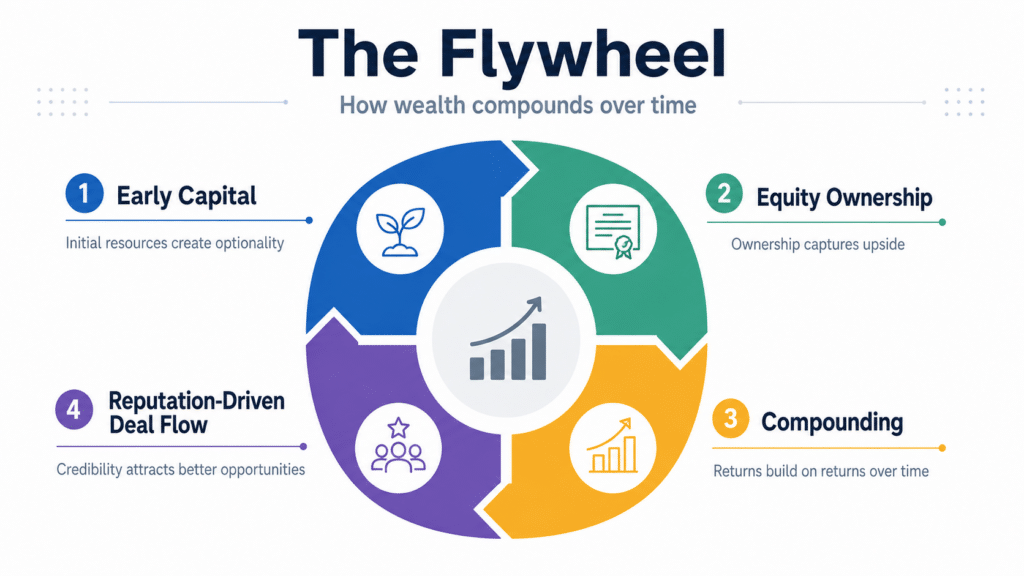
Naval’s path to wealth follows a pattern I’d call The Angel Equity Flywheel: write small checks early, hold equity, let compounding do the work, and use the network that grows from your wins to get better deal flow for the next round.
Every successful bet feeds the next one.
Why Ownership Beat Salary
Naval has said repeatedly that wages keep you in place while equity can change your life. A salary is capped by the hours you work.
Equity in a startup that 100x’s over five years is not. This is the core mechanic of angel investing. You’re trading a small amount of capital for a percentage of ownership.
If the company grows, your stake grows with it.
Specific knowledge, which is the rare expertise or insight that you built through genuine experience, gives you an edge in picking which companies to back early.
How Angel Investing Compounds
Your first few angel investments give you reputation and pattern recognition. Founders start reaching out to you because of who else you backed.
That deal flow feeds your next round of investments, which builds more reputation. The leverage here is not financial leverage in the traditional sense.
It’s the leverage of a track record. Early-stage investments compound through network effects inside the startup ecosystem, not just through the math of ownership.
Specific Knowledge And Leverage In Practice
Naval’s background in software and his early founder experience gave him the ability to evaluate technical founders quickly.
That specific knowledge let him spot Uber and Twitter before they were obvious bets.
Entrepreneurship and startup funding are domains where insider knowledge has real monetary value.
Naval’s framework around specific knowledge and leverage, both discussed extensively in his writings on wealth and happiness, explains how that edge translates into portfolio returns over time.
The Bets That Likely Built Most Of The Fortune
Naval’s angel portfolio spans more than 200 companies, but a handful of early-stage investments likely account for the majority of his wealth.
That’s how portfolio math works in venture capital: a small number of outsized wins carry the whole portfolio.
Uber, Twitter, And Other Breakout Winners
Uber is almost certainly Naval’s biggest single investment return. He backed the company in its earliest stages, before it became a global ridesharing company.
His stake, based on available estimates, may have returned tens of millions of dollars by the time of the IPO.
Twitter was another early bet. Naval invested pre-IPO, when the platform was still figuring out its business model.
Network effects eventually made Twitter a dominant social format, and his equity position benefited from that growth.
Postmates, Yammer, And Stack Overflow
Beyond the headline names, Naval’s portfolio includes companies like Postmates, Yammer, and Stack Overflow, all of which had meaningful exits.
Postmates was acquired by Uber. Yammer was bought by Microsoft. Stack Overflow was acquired by Prosus for around $1.8 billion.
These are not household names on the same scale as Uber, but they represent the kind of mid-tier exits that keep a diversified angel portfolio generating real returns over time.
How Portfolio Math Works In Early-Stage Investing
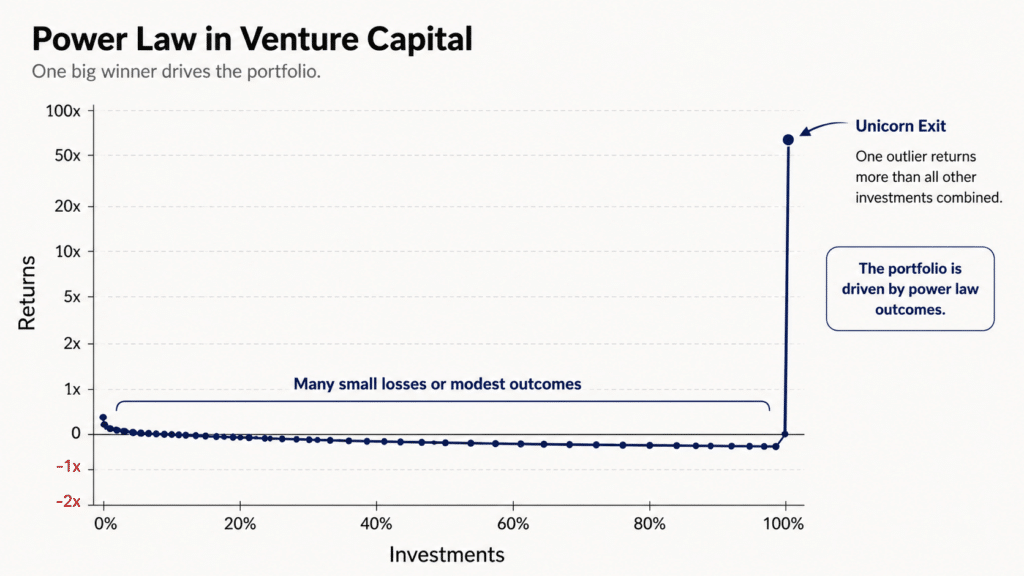
In early-stage investing, you expect most of your bets to return nothing or very little.
The strategy is built around the idea that one or two investments in a portfolio of 50 or 100 will return more than everything else combined.
Naval’s approach, spreading small checks across many companies while applying a strong founder-quality filter, is a classic implementation of this math.
The angel investor model only works if you stay in the game long enough for the big winners to emerge.
AngelList And The Platform Layer
AngelList is arguably Naval’s most durable asset.
As a co-founder with an ongoing equity stake, his ownership in the platform compounds as the startup ecosystem itself grows.
It’s not just an investment; it’s a business he helped build from scratch.
From Venture Hacks To AngelList
Before AngelList, Naval co-created Venture Hacks with Babak Nivi, a blog that gave founders straight talk about term sheets, dilution, and how to negotiate with investors.
It built a loyal audience of entrepreneurs who felt underserved by traditional Silicon Valley gatekeeping.
AngelList grew directly out of that community. It launched in 2010 as a way for founders to connect with angel investors through a simple, transparent online platform.
The original insight was that startup fundraising was slow and opaque, and it did not have to be.
How AngelList Changed Startup Fundraising
Before AngelList, raising a seed round meant cold emailing partners at venture firms and hoping for warm introductions.
AngelList flipped that model by letting founders list their companies publicly and letting investors signal interest on the platform.
It later introduced syndicates, which allow a lead investor to pull in a group of backers into a single deal.
Rolling funds came next, allowing emerging managers to raise capital on a subscription basis.
These features made AngelList a central piece of the startup funding infrastructure in Silicon Valley and beyond.
Why AngelList Equity Matters So Much
AngelList equity is likely the single most valuable holding in Naval’s portfolio.
The platform has helped launch thousands of companies, and it takes a cut of the deals that flow through it.
As the platform grows, so does the value of his stake.
Because AngelList is private, the exact valuation of his equity is unclear.
But given the platform’s position in the startup ecosystem, it represents a significant and still-growing portion of his estimated net worth.
Career Origins And Deal Flow Advantages
Naval’s investing instincts were not born in a VC firm.
They came from years of operating as a founder, watching companies fail, and learning what separates ideas that scale from ideas that don’t.
Epinions, Shopping.com, And Early Startup Lessons
Naval’s first major venture was Epinions, a consumer review platform he co-founded in 1999.
The company was eventually acquired and became part of Shopping.com.
The experience was far from smooth, and Naval has spoken publicly about the painful lessons around co-founder dynamics and governance.
Those early failures are often where the best founders learn the most.
The hard lessons from Epinions gave Naval a direct understanding of what breaks companies early, which made him a sharper evaluator when he started writing angel checks.
From Boston Consulting Group To Silicon Valley
Before founding Epinions, Naval briefly worked at Boston Consulting Group, the strategy consulting firm.
That background gave him a structured way to think about markets and business models, even if consulting was not his long-term path.
Moving into Silicon Valley entrepreneurship from that foundation gave him an unusual mix: rigorous analytical thinking combined with hands-on founder experience.
That combination helps when you’re trying to evaluate whether a founder and a market are a real fit.
Education, Background, And Founder Pattern Recognition
Naval attended Stuyvesant High School, one of New York City’s elite specialized public schools.
He then studied computer science and economics at Dartmouth College, which gave him the technical and economic frameworks to evaluate startups on both dimensions.
His background as an immigrant from New Delhi also shapes his perspective.
He’s talked openly about growing up without financial safety nets, which gave him a sharp appreciation for how wealth actually gets built, through ownership and compounding, not through a paycheck.
Media, Philosophy, And Newer Ventures
Naval’s media presence is not separate from his financial strategy. It generates deal flow, attracts talented founders, and reinforces the ideas that make his brand credible.
The content and the investing business feed each other.
The Almanack, Podcasts, And The @naval Brand
The Almanack of Naval Ravikant, compiled by Eric Jorgenson and released in 2020, pulled together Naval’s best thinking on wealth and happiness into a single book.
It became a perennial bestseller and introduced his ideas to audiences well beyond Silicon Valley. His podcast, simply called Naval, covers investing, philosophy, and long-term thinking.
He’s also appeared on The Tim Ferriss Show and The Joe Rogan Experience, reaching tens of millions of listeners.
His Twitter and Instagram presence under the handle @naval gives him direct access to a global audience daily.
Wealth And Happiness As A Public Framework
The essay How to Get Rich (Without Getting Lucky) is probably Naval’s most shared piece of writing.
It argues that wealth comes from owning equity in businesses, building specific knowledge, and creating things that scale without your direct involvement.
This life philosophy is not just inspirational content. It’s a framework that attracts founders who share his worldview, which strengthens his inbound deal flow.
The ideas and the investing business are inseparable parts of the same machine.
MetaStable Capital, Blockchain, Spearhead, And Airchat
Naval co-founded MetaStable Capital, a crypto hedge fund, making an early institutional bet on blockchain technology.
He’s been an outspoken Bitcoin and Ethereum advocate for years, and his crypto holdings form a meaningful part of his total asset picture.
Spearhead is a program Naval helped create that trains founders to become angel investors, giving them capital to deploy alongside their mentorship.
Airchat, a voice-based social app Naval co-founded, represents his most recent product bet.
It shows he’s still willing to build and ship products, not just write checks.
Frequently Asked Questions
Is he actually a billionaire, or is that just internet hype?
The billionaire label attached to Naval’s name is mostly internet hype. He has publicly denied the higher figures that circulate online, and credible estimates from financial outlets place his net worth between $60 million and $120 million, not $1 billion or more.
What are the main sources of his wealth, AngelList, venture investing, or something else?
His wealth comes from three main buckets: his equity stake in AngelList, returns from early-stage angel investments in companies like Uber and Twitter, and crypto holdings in Bitcoin and Ethereum. No single source dominates; the wealth is spread across a portfolio of illiquid private assets.
Did Forbes (or any major outlet) ever publish an estimate of his wealth?
No major outlet like Forbes has published a verified estimate of Naval’s net worth. Because most of his assets are in private companies and he avoids public financial disclosures, no authoritative figure exists. Estimates you find online are calculated from public data and are rough approximations at best.
How much did he reportedly make from early investments like Uber?
Based on available reporting and stake estimates, his Uber investment may have returned around $30 million by the time of the IPO, though some sources speculate much higher figures. The exact return is not confirmed publicly, and any specific number should be treated as an estimate.
How has his wealth changed in recent years, especially heading into 2026?
His wealth is likely somewhat compressed compared to the peak tech valuations of 2021, largely because crypto markets corrected and private tech valuations dropped. Heading into mid-2026, the range of estimates has stabilized around $80 million to $120 million, reflecting the current environment for private equity and digital assets.
How much of his wealth is tied up in private startup equity versus liquid assets?
The majority of his estimated net worth is illiquid. AngelList equity, private startup positions, and certain crypto holdings cannot easily be converted to cash without a sale or liquidation event. His actually spendable capital is a much smaller slice of whatever headline number you see quoted.

I spent years working in tech and digital publishing, where I saw how quickly industries, brands, and consumer behavior can change. I created Rich Digest to explore the business behind luxury, from iconic products and influential founders to pricing, scarcity, ownership, and brand strategy. My goal is to make the world of luxury business clear, interesting, and easy to understand.