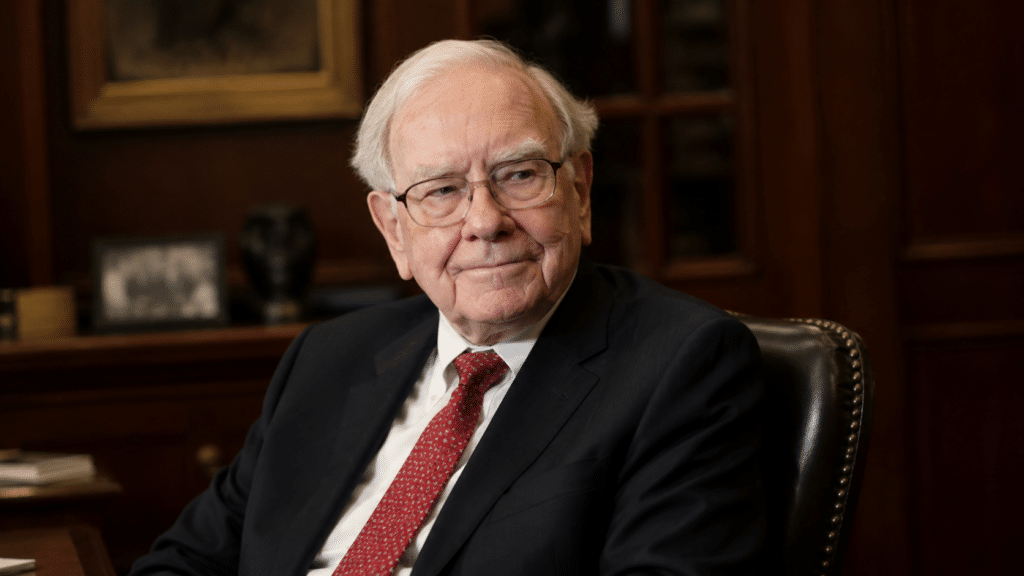
Warren Buffett has been buying stocks since he was eleven years old.
Today, Berkshire Hathaway’s track record spans more than six decades, with annualized returns of roughly 20%, nearly double what the S&P 500 delivered over the same stretch.
Most people assume the secret is some genius-level ability to pick stocks.
The real edge is simpler and harder to copy: Buffett treats waiting as the actual strategy, not the uncomfortable pause before the strategy.
His investment philosophy combines value investing principles rooted in Benjamin Graham’s work with a ruthless focus on business quality.
This approach relies on a structural setup through Berkshire Hathaway that lets him hold positions for decades without outside pressure.
Understanding how those pieces fit together tells you a lot about building wealth patiently, whether you’re managing millions or just starting out.
The Core Framework Behind Buffett’s Decisions

Buffett’s decisions come down to three consistent ideas: know what a business is worth, only buy when the price gives you a cushion, and stay inside the businesses you actually understand.
His relationship with Benjamin Graham gave him the foundation, and Charlie Munger pushed him toward quality.
Buying Businesses Through The Lens Of Intrinsic Value
Intrinsic value is an estimate of what a business is actually worth, based on the cash it can generate over its lifetime.
Buffett doesn’t treat a stock as a ticker symbol. He treats it as a fractional ownership stake in a real company with real earnings.
When he looks at a potential investment, he asks whether the business fundamentals support the price.
Does the company earn consistent returns? Does it have pricing power?
Can it grow without needing massive amounts of new capital to do it?
According to Investopedia, Buffett focuses on companies capable of generating strong earnings rather than chasing capital gains from short-term price swings.
That framing matters because it changes what you’re actually analyzing when you evaluate a long-term investment.
Why Margin Of Safety Still Sits At The Center
Margin of safety means buying a stock at a meaningful discount to your estimate of intrinsic value.
Benjamin Graham introduced the concept, and it remains one of the most practical value investing principles you can use.
The logic is straightforward.
Your estimate of intrinsic value might be wrong. The business might face unexpected headwinds.
If you paid a fair price for something, a small mistake wipes out your return.
If you paid significantly below fair value, a small mistake still leaves you fine.
Buffett described it well in The Intelligent Investor‘s context: price is what you pay, value is what you get.
The gap between those two numbers is your safety net.
From Benjamin Graham To Charlie Munger
Graham taught Buffett the discipline of paying less than something is worth.
Munger pushed him further, encouraging him to pay a fair price for an exceptional business rather than a bargain price for a mediocre one.
That shift is significant.
Early Buffett bought cheap, statistically undervalued stocks and sold when the price recovered.
Munger’s influence led Buffett to hold great businesses essentially forever, letting compounding do the work.
The two approaches share value investing principles, but the Munger version rewards patience on a much longer timeline.
The Moat Of Inaction

Patience in investing gets treated as a soft skill, almost like a personality quirk.
Buffett’s results suggest it functions more like a competitive advantage built into the system.
His willingness to sit in cash, pass on hundreds of deals, and wait years for the right price has probably generated as much return as any single stock pick.
Why Waiting Can Be A Competitive Advantage
Most investors feel compelled to act.
If you manage a fund, clients want activity.
If you’re watching the market daily, inaction feels like failure.
Buffett sidesteps that pressure structurally, which we’ll cover in the permanent capital section, but he also sidesteps it mentally.
His famous baseball analogy captures it well.
In baseball, you strike out if you don’t swing at three pitches.
In investing, you can let a thousand pitches go by and wait for the one you like.
There’s no penalty for passing on undervalued stocks that don’t meet your full criteria.
That discipline improves your average investment quality dramatically.
Most investing mistakes come from acting when you shouldn’t, not from missing opportunities.
How Patience Improves Entry Prices And Decision Quality
When you’re willing to wait, you can hold out for a price that gives you a genuine margin of safety.
Investors who feel pressure to deploy capital tend to talk themselves into mediocre deals.
The investment horizon you’re working with directly shapes the quality of your decisions.
A longer investment horizon also lets the business do the work.
Compounding requires time.
A business growing earnings at 12% per year looks modest in year three and remarkable in year fifteen.
Never Lose Money And The Discipline To Pass
Buffett’s first rule, never lose money, is often quoted and rarely practiced.
The point isn’t that you’ll never see a position go down.
The point is that permanent capital loss, buying something bad or overpaying for something good, is the thing you’re protecting against.
Risk tolerance in Buffett’s framework isn’t about volatility tolerance.
It’s about how carefully you evaluate what you’re buying.
As Investopedia notes, he looks at entire companies rather than stock market intricacies, which keeps his focus on business quality and away from short-term price noise.
Passing on a bad deal is itself a return.
What Buffett Looks For In A Great Business

Buffett’s checklist for a great business comes down to durability, management quality, and financial strength.
He wants businesses that can protect their earnings from competition, run by people who allocate capital wisely, and strong enough financially that you can hold them through rough stretches.
Economic Moats And Durable Competitive Advantages
An economic moat is anything that protects a business’s profits from competitors over a long period of time.
Buffett famously described great businesses as castles surrounded by moats.
The wider and deeper the moat, the harder it is for rivals to erode your competitive position.
Common sources of economic moats include:
- Network effects: The product gets more valuable as more people use it (think credit card networks like American Express)
- Switching costs: Customers face real friction or expense if they leave (enterprise software, banking relationships)
- Brand strength: Customers pay a premium based on trust or identity (Coca-Cola, Apple)
- Cost advantages: The business can produce at a price competitors can’t match at scale
According to an analysis on Ainvest, Buffett looks for durable competitive advantages that are genuinely hard to replicate, not just strong market share today.
Market share is temporary.
Structural moats are what make quality companies stay quality companies.
Management Quality And Capital Allocation
Buffett spends a lot of time thinking about the people running a business.
A great business with bad management will eventually disappoint.
A good business with great management often surprises you on the upside.
Capital allocation is the specific skill he values most.
It’s the ability to take the cash a business generates and put it to work in a way that grows per-share value.
Good managers reinvest in high-return opportunities, buy back shares when the price is right, and avoid empire-building for its own sake.
He’s said many times that a CEO who can run a business brilliantly doesn’t automatically have that capital allocation instinct.
It’s a distinct skill, and it matters enormously over decades.
Cash Flow, Profitability, And Financial Strength
Buffett looks at a handful of specific financial metrics when evaluating high-quality businesses.
Return on equity (ROE) over five to ten years tells you whether the company consistently earns strong returns for shareholders.
Return on invested capital (ROIC) tells you how efficiently the business uses all the capital deployed in it.
Profit margins matter too, and specifically whether they’re holding steady or growing over time.
Expanding margins usually signal good management and pricing power.
Shrinking margins often signal competitive pressure.
He also checks the debt-to-equity ratio carefully.
High debt loads make earnings volatile and limit flexibility during downturns.
A financially strong business with clean financial statements and growing free cash flow is the kind of thing Buffett can hold confidently through market cycles.
Permanent Capital And The Power Of Insurance Float

One of the most underappreciated parts of Buffett’s story is structural.
The way Berkshire Hathaway is built gives him access to capital that most investors simply don’t have, on terms that no traditional fund can match.
Why Berkshire Hathaway’s Structure Matters
Most investment funds have outside investors who can pull their money out.
That creates real pressure.
When markets fall and investors panic, fund managers face redemptions right when they’d most want to be buying.
They’re forced to sell good positions at bad prices.
Berkshire Hathaway doesn’t have that problem.
It’s a publicly traded holding company, and as one analysis points out, permanent capital eliminated the pressure of redemptions entirely.
Buffett can hold positions through any market environment without worrying about a wave of withdrawals forcing his hand.
That structural advantage compounds over time in ways that are hard to quantify but very real.
How GEICO Helped Create Investable Float
Insurance float is money that policyholders pay in premiums before any claims come due.
The insurance company holds that money in the interim and can invest it.
When the insurance operations are run profitably, the float is essentially free capital, or even negative-cost capital.
GEICO became a cornerstone of Berkshire’s strategy for exactly this reason.
According to an analysis on the Berkshire business model, the commitment to GEICO created durable float that became the engine for investing in high-quality businesses.
Berkshire’s insurance operations now generate tens of billions in float that Buffett can deploy into stocks and acquisitions.
It’s a compounding machine built on top of other compounding machines.
Why Permanent Capital Changes Investor Behavior
When you don’t face redemption pressure, your investment horizon genuinely changes.
You stop caring about quarterly results.
You stop worrying about whether a position looks bad in the short run.
According to Verdad Capital’s research on insurance float, much of Buffett’s outperformance is tied to using float as permanent capital at a negative effective interest rate.
That’s a structural edge, not just a behavioral one.
It lets the capital allocation decisions reflect actual long-term thinking rather than the constant compromise between long-term thinking and short-term pressure.
Reading The Playbook In Buffett’s Portfolio

Looking at Berkshire’s actual holdings tells you more about Buffett’s criteria than any summary of principles.
The positions he’s held for decades, and the newer ones he’s added, all reflect the same core logic applied to different industries.
Why Coca-Cola And American Express Fit The Model
Coca-Cola is probably the clearest example of a moat-driven investment.
The brand is one of the most recognized in the world.
Distribution is enormous.
Customers don’t switch.
Pricing power is durable.
Buffett started buying in 1988 and has held the position ever since.
American Express fits the model through a different kind of moat.
Its network effects and brand loyalty among high-spending customers create switching costs that protect its revenue.
As noted at Bartoli Value Capital, both Coca-Cola and American Express represent the kind of simple, durable, understandable businesses that Buffett describes as sitting inside his circle of competence.
Banking And Energy Bets In Bank of America, Chevron, And Occidental Petroleum
Bank of America reflects Buffett’s long-held comfort with financial companies that generate strong returns on equity and have durable deposit bases.
His stake there has been one of Berkshire’s largest public equity positions.
Chevron and Occidental Petroleum represent a more recent comfort with energy.
Buffett has spoken about the importance of energy infrastructure to the U.S. economy.
Occidental in particular attracted significant investment based on management’s capital allocation discipline and the quality of its assets.
These are not trend-chasing moves.
They reflect a view that energy remains a structural part of the economy for decades to come.
What These Holdings Reveal About Conviction And Diversification
Berkshire’s portfolio is concentrated compared to most institutional investors.
Buffett has said many times that diversification makes sense when you don’t know what you’re doing.
When you do know, putting meaningful capital into your best ideas produces better results than spreading thin.
A recent Forbes analysis on Berkshire’s portfolio shifts highlights that even as Greg Abel takes on more capital allocation responsibility, the underlying philosophy of concentrated conviction in quality companies remains intact.
The holdings show what a long investment horizon actually looks like in practice: large stakes in durable businesses, held through decades of market cycles.
Lessons You Can Apply Without Running Berkshire

You don’t need access to insurance float or a conglomerate structure to use the core logic.
The principles translate well to individual investors working with ordinary brokerage accounts.
Using Discounted Cash Flow Without False Precision
Discounted cash flow (DCF) analysis estimates what a business is worth today based on the cash it will generate in the future.
Buffett uses a version of this, but he’s warned against false precision.
The goal isn’t to get the number exactly right.
The goal is to get close enough to know whether you’re buying at a discount or not.
If a rough DCF analysis suggests a stock is worth 30% more than its current price even under conservative assumptions, that’s meaningful.
If the math only works under optimistic assumptions, the margin of safety probably isn’t there.
When P/E Ratios, Dividend Yield, And Liquidation Value Help
The price-to-earnings ratio (P/E) is a quick filter, not a final answer.
A low P/E might signal undervaluation or it might signal a deteriorating business.
Context matters.
Buffett uses P/E and other metrics as starting points, not conclusions.
Dividend yield tells you what a company pays relative to its price, which can indicate whether a business is generating real cash returns.
Liquidation value helps in cases where you’re trying to set a floor on downside risk.
None of these replace deeper analysis.
But used together, they help you quickly filter out the deals that clearly don’t make sense before spending time on detailed financial statements.
What Buffett Suggests For Most Investors Today
Buffett has been direct about this for years.
For most people, low-cost index funds are the right answer.
According to Morningstar’s coverage of Buffett’s approach, he’s consistently recommended that average investors put money into broad index funds rather than trying to pick individual stocks.
He’s also suggested reading his annual shareholder letters, which are free and packed with practical insight on business and capital allocation.
The letters are more useful than most investing books.
Compound interest rewards time in the market.
Getting started early and staying patient matters more than getting every pick right.
With Greg Abel now leading Berkshire going forward, the structural philosophy built over sixty years remains.
The individual investor lesson from all of it is the same one it’s always been: buy good businesses, pay fair prices, and give them time.
Frequently Asked Questions
What does the 90/10 portfolio idea actually mean in real life, and who is it for?
Buffett’s 90/10 suggestion refers to putting 90% of assets in a low-cost S&P 500 index fund and 10% in short-term government bonds. He offered this as a recommendation for the trustee managing his wife’s inheritance, designed for someone who doesn’t want to actively manage a portfolio. It’s aimed at long-term investors who prioritize simplicity and consistent returns over trying to beat the market.
How do you figure out a company’s intrinsic value without getting lost in complicated math?
A practical starting point is estimating a company’s earnings power, meaning what it can realistically earn in a normal year, and multiplying that by a reasonable P/E ratio for its industry and growth rate. You don’t need a precise number. You need to know whether the current price gives you a cushion below your estimate, which is what the margin of safety concept is really about.
What are the core rules he follows when deciding whether to buy or pass on a stock?
Buffett generally asks whether the business is understandable, whether it has durable competitive advantages, whether management is honest and capable, and whether the price is reasonable relative to intrinsic value. If any of those conditions aren’t clearly met, he passes. The discipline to pass on deals that are almost good enough is a big part of what separates his track record from others.
If you’re a beginner, where do you start without trying to copy every trade he’s ever made?
Start by reading Buffett’s annual shareholder letters, which are available free on Berkshire’s website and explain his thinking in plain language. Then focus on learning how to read a basic income statement and balance sheet before picking any individual stocks. For most beginners, low-cost index funds are a smarter starting point than trying to replicate specific stock picks.
Which books give the clearest, most practical take on his approach to picking businesses?
The Intelligent Investor by Benjamin Graham is the foundational text Buffett himself credits most. Common Stocks and Uncommon Profits by Philip Fisher influenced his thinking on business quality. For a more accessible entry point, The Warren Buffett Way by Robert Hagstrom breaks down the methodology without requiring deep finance knowledge going in.
How does he think about risk and diversification, especially compared with index fund investing?
Buffett defines risk as the probability of permanent capital loss, not price volatility. For investors who have done deep research on a small number of quality businesses, concentration makes sense. For everyone else, broad diversification through index funds reduces the risk of any single bad decision wiping out your returns. The key difference is whether you have the knowledge and time to genuinely evaluate individual businesses.

I spent years working in tech and digital publishing, where I saw how quickly industries, brands, and consumer behavior can change. I created Rich Digest to explore the business behind luxury, from iconic products and influential founders to pricing, scarcity, ownership, and brand strategy. My goal is to make the world of luxury business clear, interesting, and easy to understand.