
A Veblen good is a type of luxury item where demand actually increases as the price goes up, driven entirely by its exclusive nature and status appeal.
That runs directly against the way most economics works, and it’s exactly what makes these goods so fascinating.
Most products follow a simple rule: raise the price, sell fewer units.
Veblen goods flip that.
A Hermès Birkin bag at $30,000 feels more desirable than the same bag at $3,000.
A luxury watch priced higher than a competitor signals something the cheaper version never could: that you belong to a different tier.
The price itself becomes the product’s most powerful feature.
This isn’t just consumer irrationality.
There’s a clear economic and psychological logic behind why brands like Rolex, Chanel, and Ferrari deliberately keep prices high, limit availability, and resist discounting.
Understanding that logic tells you a lot about how markets, status, and human behavior actually intersect.
How Demand Rises With Price
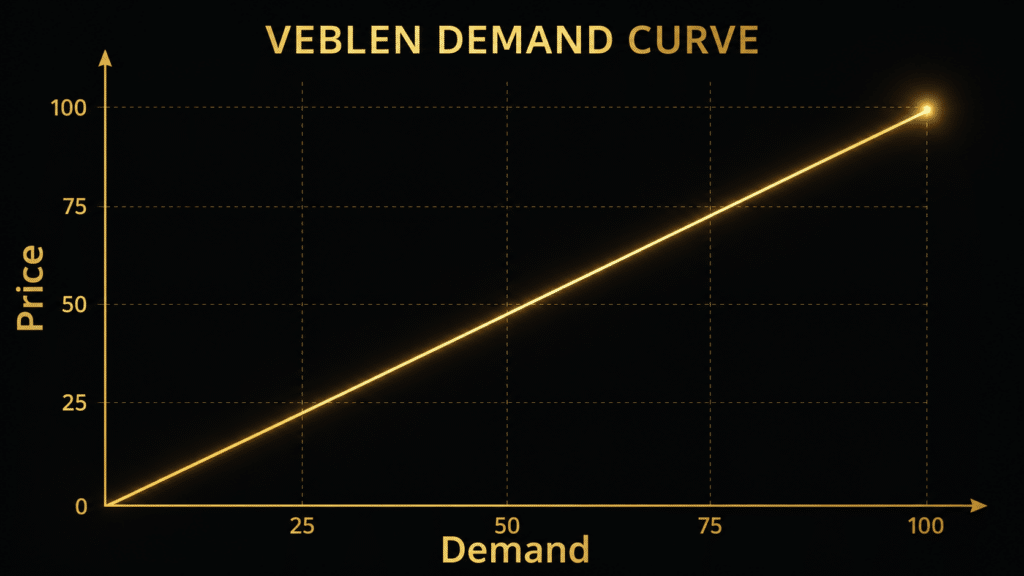
The counterintuitive demand behavior of Veblen goods isn’t random.
It comes from a combination of status psychology, consumer expectations, and how price signals quality and exclusivity in ways standard economic models don’t fully capture.
Why Veblen Goods Break The Law Of Demand
The law of demand is one of the most foundational principles in economics.
It states that as a product’s price rises, the quantity demanded falls, all else being equal.
This relationship holds for the vast majority of goods, from groceries to electronics.
Veblen goods are a recognized exception.
When a luxury brand raises its prices, some consumers don’t walk away.
They become more interested.
The higher price reinforces the perception that the product is exclusive, premium, and worth having.
Lowering the price can actually erode that perception and reduce demand.
This is a direct contradiction of what standard microeconomics predicts.
What An Upward-Sloping Demand Curve Means
A traditional demand curve slopes downward from left to right.
As price increases, quantity demanded decreases.
For Veblen goods, the demand curve slopes upward, meaning higher prices correspond to higher demand.
This upward-sloping demand curve is the defining visual representation of the Veblen effect in economic theory.
It’s worth noting that this isn’t unlimited.
Even a Veblen good has a price ceiling beyond which demand will eventually fall.
The upward slope only holds within a range where the status signal still outweighs the cost barrier.
When High Prices Increase Desirability
The Veblen effect, as defined by economist Harvey Leibenstein in a 1950 paper on consumer behavior and demand theory, describes the specific mechanism: perceived prestige rises with price, which in turn increases demand.
A corollary is that cutting prices may briefly boost sales but will ultimately reduce the quantity demanded among status-conscious buyers.
This connects to the concept of interaction effects in microeconomics.
Unlike normal goods, where preferences are assumed to be independent of price, Veblen goods create a feedback loop where price actively shapes preference.
Related anomalies include the counter-Veblen effect, which occurs when some consumers actively prefer goods that drop in price as a form of conspicuous thrift, partially offsetting the standard Veblen dynamic.
Consumer surplus calculations also shift here.
Because the high price is part of the value for many buyers, a lower price doesn’t necessarily make them better off in the way standard economic models would assume.
Status Signaling And Consumer Psychology
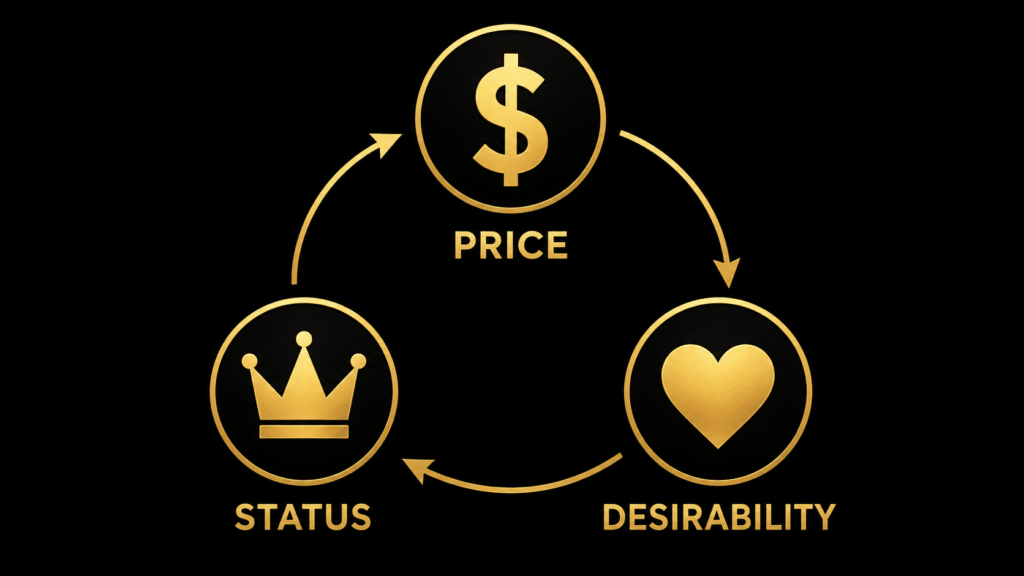
The psychology behind Veblen goods connects directly to how people use purchases to communicate identity, wealth, and social position to others.
Two forces drive this: the desire to signal success and the need to differentiate from lower-status groups.
Thorstein Veblen And The Leisure Class
The concept takes its name from Thorstein Veblen, an American economist and sociologist who published The Theory of the Leisure Class in 1899.
In it, Veblen argued that the wealthy didn’t consume goods primarily for their practical utility.
They consumed to display their economic power.
He called this conspicuous consumption, and he used the term invidious comparison to describe how people measured their own status against others.
The goal was pecuniary emulation: spending in ways that signaled financial success and pushed others to do the same.
Veblen saw this as a social trap, not rational behavior.
His framework was sharp cultural criticism as much as economics.
He observed that visible, wasteful spending was a way the leisure class maintained its position at the top of the social hierarchy.
Conspicuous Consumption In Modern Markets
The idea Veblen described in 1899 looks remarkably relevant in 2026.
You see it in designer clothes, luxury cars, and high-end handbags.
The function isn’t really the product’s utility.
It’s the public signal the purchase sends.
Research in 2007 found that social comparison directly affects reward-related brain activity in humans, providing neurological support for Veblen’s original behavioral observations.
When you buy a product that signals status, your brain responds to the social reward, not just the object itself.
Luxury brands actively design their marketing and pricing to feed this psychology.
Campaigns emphasize rarity, heritage, and exclusivity rather than practical features.
Snob Value, Social Comparison, And Positional Appeal
The snob effect is closely related to the Veblen dynamic.
It describes how demand for a good among higher-income consumers actually decreases when lower-income consumers start buying it.
Exclusivity is the point.
Once a product becomes widely accessible, it loses its appeal for the buyers who valued it as a distinction.
This is what makes Veblen goods positional goods.
Their value comes not from what they do, but from how they’re distributed and who has them.
The bandwagon effect works in the opposite direction: some goods gain value as more people adopt them.
For Veblen goods, mass adoption is precisely what destroys value.
Snob value is therefore a core feature of luxury pricing strategy, not an accident.
Brands protect it by keeping prices high and distribution controlled.
Business Examples And Luxury Pricing Strategy
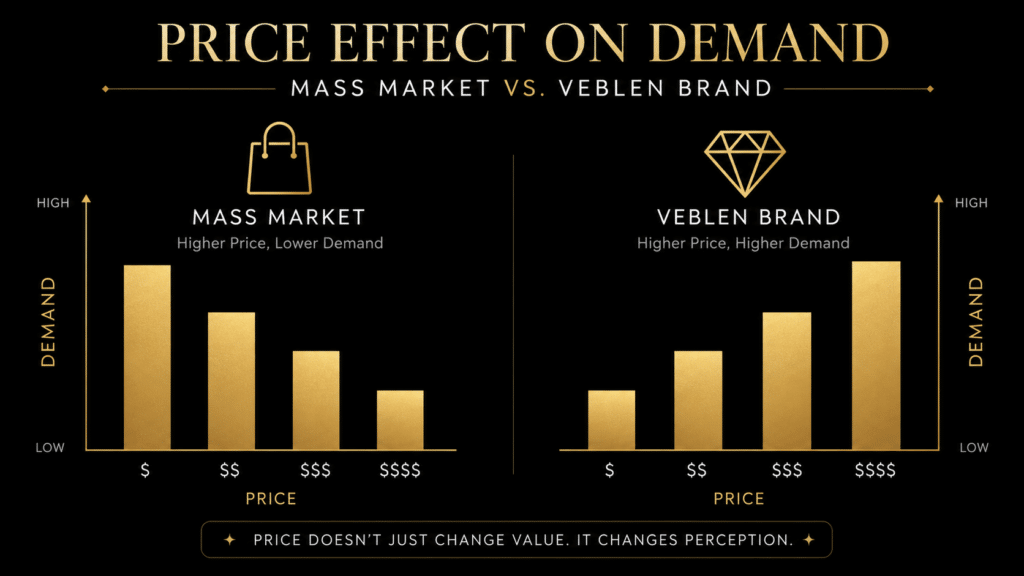
Real-world Veblen goods span fashion, art, automotive, and watchmaking.
What connects all of them is that the price and scarcity are strategic tools, not just reflections of production cost.
Common Categories And Real-World Examples
Some of the clearest examples of Veblen goods include:
- Luxury watches: Brands like Patek Philippe and Rolex are textbook cases.
As luxury watch pricing increases, demand from high-end buyers often follows.
The mechanical complexity becomes secondary to what wearing one communicates.
- Designer handbags and clothes: Louis Vuitton, Chanel, and Gucci position price increases as enhancements to brand prestige, not deterrents.
- Luxury cars: Ferrari limits production intentionally.
You can’t simply order one; in many cases, you have to be invited to purchase.
- Fine art: A Picasso or Monet painting gains value partly because of the price it commands.
The auction record reinforces the desirability.
- Designer jewelry: High-end pieces from houses like Cartier or Van Cleef communicate wealth through price alone, separate from intrinsic material value.
Even rice, in certain premium markets, has been studied as a category where quality-signaling can push demand upward at higher price points.
How Scarcity And Distribution Support Premium Prices
A key characteristic of Veblen goods is that scarcity reinforces the price signal.
Luxury brands use controlled distribution to maintain that scarcity, selling only through upscale boutiques, flagship stores, or exclusive waiting lists.
Mass retail would undercut the status message entirely.
Limited quantity is often a deliberate strategy.
When Ferrari announces a limited production run, it’s not because they can’t make more.
It’s because limiting supply protects the price point and the exclusivity that drives demand.
Pricing and distribution work together here.
A luxury watch sold at a department store discount counter stops behaving like a Veblen good almost immediately.
When A Product Stops Behaving Like A Status Good
Veblen behavior has limits.
If a brand discounts heavily, distributes too widely, or gets strongly associated with mass-market buyers, the snob value evaporates.
The product may still be a luxury item in terms of materials or craftsmanship, but it stops functioning as a status signal.
This is exactly why luxury brands resist discounting even during slow economic periods.
Cutting prices to boost short-term sales can permanently damage the positioning that makes the brand work.
Once credibility breaks, rebuilding that price-prestige relationship is very difficult.
Veblen Goods Vs Giffen Goods
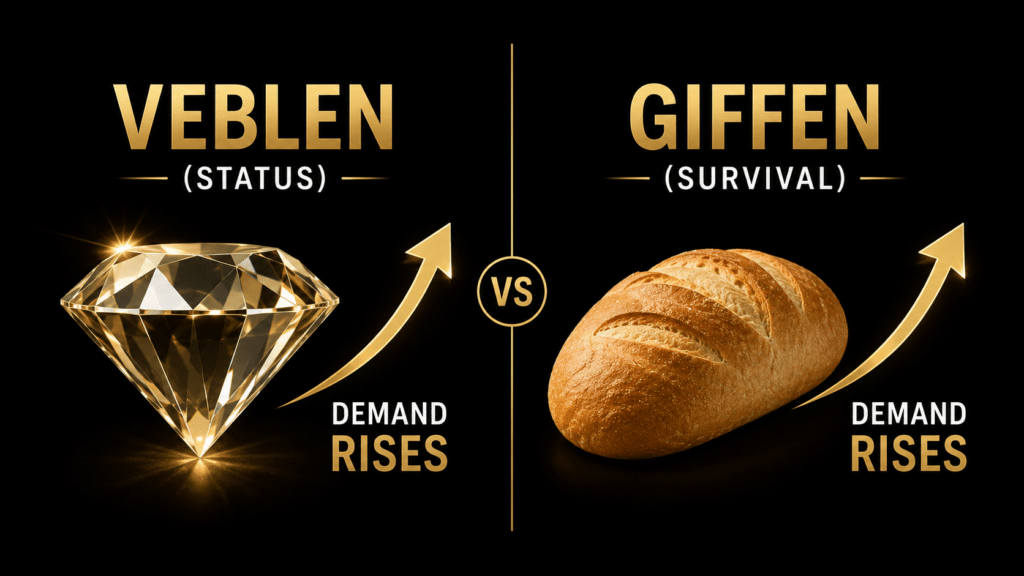
Veblen goods and Giffen goods both show demand rising as prices increase, which is why they often get mentioned together.
Their underlying causes are completely different, and mixing them up leads to real confusion in economics.
Why The Two Concepts Get Confused
Both Giffen goods and Veblen goods produce an upward-sloping demand curve in practice, which looks identical on a graph.
That surface similarity is what causes the mix-up.
Students and non-specialists often treat them as variations of the same phenomenon.
They’re not.
The Wikipedia entry on Veblen goods is explicit: Giffen behavior arises from the interplay of income and substitution effects without any interaction between price and preference.
Veblen behavior arises from status signaling, where price directly shapes consumer preference.
The psychology and economics are fundamentally different.
The Role Of Income And Substitutes
A Giffen good is typically an inferior good, meaning a product that consumers buy more of as their income falls.
When the price of a Giffen good rises, lower-income consumers can no longer afford other items.
They end up buying more of the now-pricier staple because they’ve lost purchasing power for alternatives.
The income effect dominates the substitution effect in this scenario.
With Veblen goods, income effects aren’t really the mechanism at all.
Buyers of luxury goods typically have plenty of substitutes and more than enough income.
They choose the expensive option specifically because it’s expensive.
Classic Giffen Examples And Their Limits
The most commonly cited examples of Giffen goods are staple foods: wheat, potatoes, and rice in low-income settings.
Robert Giffen, the 19th-century economist the category is named after, observed that British working-class consumers appeared to buy more bread when its price rose, because rising bread costs left them unable to afford more expensive alternatives like meat.
Empirical confirmation of true Giffen behavior is actually quite rare.
Most textbook examples of Giffen goods represent historical or theoretical edge cases rather than common market dynamics.
Veblen goods, by contrast, are observable across modern luxury markets on a regular basis.
The two concepts both challenge standard demand theory, but through entirely separate mechanisms with very different real-world footprints.

I spent years working in tech and digital publishing, where I saw how quickly industries, brands, and consumer behavior can change. I created Rich Digest to explore the business behind luxury, from iconic products and influential founders to pricing, scarcity, ownership, and brand strategy. My goal is to make the world of luxury business clear, interesting, and easy to understand.