Have you ever wondered why you stay loyal to Apple even when their hardware lags behind the competition?
While rivals obsess over megapixels and price wars, Apple has spent decades perfecting a strategy that most companies are too afraid to try.
Your iPhone remains in your pocket not because it’s the most powerful device, but because Apple has made it the easiest choice you’ll ever make.
Apple’s sustained dominance comes down to one thing it has weaponized better than almost anyone: simplicity.
Simplicity sounds soft.
It sounds like a design preference, a marketing line, something you’d put on a mood board.
But when you look at how Apple actually operates, you start to see that simplicity is a hard-nosed business strategy, one backed by vertical integration, pricing discipline, and a product development philosophy that’s decades in the making.
This article breaks down how Apple uses simplicity as a genuine competitive advantage and what that reveals about building a business that earns real trust at scale.
Why Simplicity Is Apple’s Strategic Edge

Apple’s product line is small on purpose.
The company uses restraint as a feature, keeping its lineup tight while competitors flood the market with variations.
That discipline shows up in both how the products look and how customers feel using them.
The Cognitive Moat Behind A Curated Product Line
When you walk into a store and face forty different Android phones across six price tiers, your brain works harder.
You weigh trade-offs, second-guess choices, and sometimes leave more confused than when you arrived.
Apple mostly sidesteps this problem.
Apple offers a handful of iPhone models, a few Mac configurations, and a small tablet range.
The choices feel manageable.
That’s not an accident.
I think it’s one of the most underrated parts of their business strategy.
Cognitive load drops when options shrink, and when cognitive load drops, buying decisions get easier and faster.
This curated approach builds a kind of trust that more complex lineups rarely create.
You’re not wondering which Apple laptop is the “right” one for you in the same anxious way you might with a brand offering fifteen configurations.
Apple has already narrowed it down.
How Design Excellence Shapes The Value Proposition
Apple’s design philosophy is built around removing everything that doesn’t need to be there.
Clean lines, minimal ports (sometimes controversially so), interfaces that feel intuitive before you’ve read a single instruction.
That consistency creates a strong value proposition because people will pay more for things that feel effortless.
Premium pricing works here because the experience justifies it, not just the specs.
You’re paying for the feeling that the product was built with you in mind.
That’s a brand identity most consumer electronics companies struggle to replicate consistently.
Why Fewer Choices Improve Customer Experience
When you buy into Apple, the customer experience is deliberately frictionless.
Products pair automatically, settings carry over between devices, and the learning curve on a new Apple product is shorter if you already own one.
This is the simplicity payoff.
The fewer variables Apple introduces, the more reliable the experience becomes.
And a reliable experience keeps customers from shopping around.
How The Integrated Ecosystem Makes Simplicity Hard To Copy
Apple’s simplicity isn’t just a surface-level design choice.
It’s built on a foundation of tight integration between hardware, software, chips, and services that competitors find genuinely difficult to replicate.
The whole system is designed to keep you in, not through force, but through convenience.
Vertical Control Across Hardware Software And Chips
Apple controls more of its own stack than almost any other consumer electronics company.
With Apple Silicon, which powers the Mac and iPad lines, Apple designs its own chips alongside its own operating systems.
That means iOS and macOS are built specifically for the hardware running them, not adapted from a general architecture.
This level of vertical integration lets Apple optimize performance in ways that Android manufacturers using third-party chips simply can’t match.
It also lets Apple ship software updates that work reliably across its product line, something that’s notoriously uneven in the broader Android ecosystem.
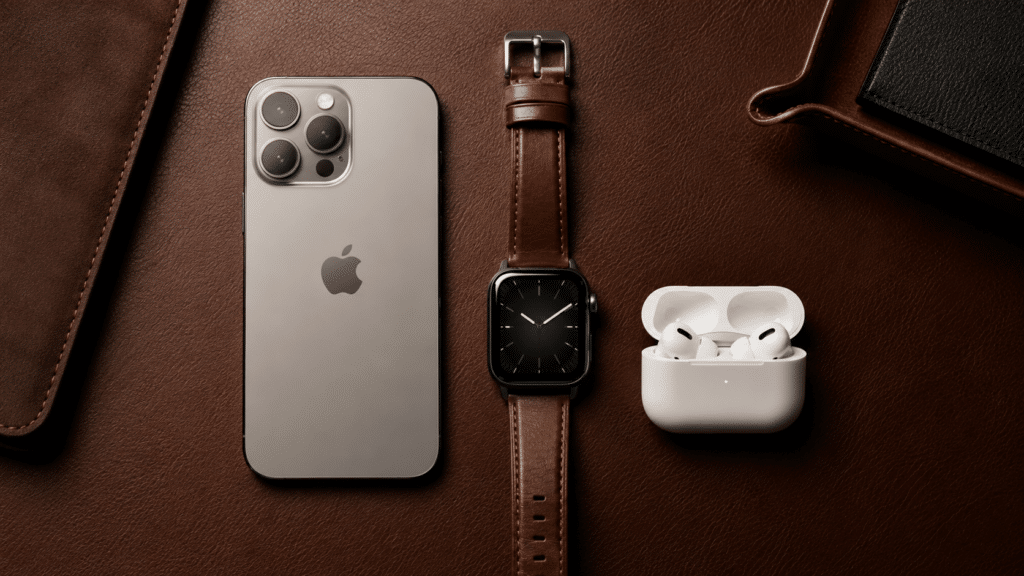
How iPhone Connects Mac iPad Apple Watch And AirPods
The iPhone sits at the center of the Apple ecosystem, and almost everything else orbits it.
Your Apple Watch tracks your activity and unlocks your Mac.
Your AirPods switch automatically between your iPhone and iPad.
Your iCloud syncs photos, notes, and contacts across every device you own.
Each individual product is good.
But together, they’re designed to create habits.
According to a case study on Apple’s ecosystem strategy, this integration isn’t accidental; it’s a deliberate design choice meant to make each device more valuable the more Apple products you own.
Once you’re in, pulling one device out means disrupting the whole setup.
Services That Deepen Everyday Switching Costs
iCloud stores your documents and photos.
Apple Music holds your playlists.
Apple TV+ has shows you’re mid-way through.
The App Store has apps you’ve paid for and rely on daily.
These aren’t just features; they’re habits with accumulated history.
Moving to Android doesn’t just mean learning a new phone.
It means rebuilding your digital life from scratch.
Services like iCloud and Apple Music create recurring revenue for Apple while quietly raising the cost of leaving.
That’s a smart economic structure, where the longer you stay, the less leaving makes sense.
The Economics Of Just Works

Apple’s front-end simplicity is backed by an economic model that depends on high margins, long-term loyalty, and a growing services layer.
The “just works” experience isn’t free to produce.
It requires enormous back-end control, and that control pays off financially.
Why Vertical Integration Supports Premium Margins
Because Apple designs its own chips, builds its own operating systems, and controls the App Store, it eliminates layers of margin that other companies pay to third parties.
That cost efficiency supports premium pricing without requiring Apple to cut corners on quality.
The Apple Store network also matters here.
Physical retail locations give Apple direct control over the customer experience, from how products are displayed to how support is delivered.
Most consumer electronics brands rely heavily on third-party retailers, which dilutes both the experience and the margin.
Customer Loyalty As A Monetization Engine
Brand loyalty at Apple works differently than at most companies.
Your loyalty doesn’t just mean you buy another iPhone.
It means you subscribe to iCloud, pay for Apple TV+, buy apps, and eventually add an Apple Watch or a pair of AirPods.
As noted in Apple’s ecosystem analysis, the company uses platform continuity to lift lifetime value across devices.
Each new product you add increases your engagement and deepens your dependence on services.
Customer retention, in this model, is essentially a recurring revenue engine.
How Simplicity Strengthens Market Penetration
Apple’s straightforward product lineup makes it easier to sell in markets where consumers are new to the brand.
You don’t need a complicated pitch.
The iPhone sells itself on reputation and experience, which makes word-of-mouth and in-store demos unusually effective.
As Apple’s differentiation strategy expands market penetration, it doesn’t have to lower prices to grow.
Instead, it grows by making more people want what already exists.
That’s a healthier growth loop than competing on discounts.
Product Development As A Growth System

Apple treats product development as its primary growth engine, not a side function.
Each new product launch connects back to a larger strategic framework, and the Ansoff matrix helps explain the logic behind where Apple chooses to grow.
How Apple Uses Product Development To Stay Ahead
Apple’s main intensive growth strategy is product development, which means creating new and improved products to grow market share.
The iPhone, iPad, and Mac all get regular upgrades, and those upgrades are tied directly to Apple Silicon improvements.
I’ve noticed that Apple doesn’t launch products just to fill a catalog.
The Apple Watch launched because wearables were a real behavior shift, not just a trend.
The iPad created a new product category rather than competing in an existing one.
These moves are strategic, not reactive.
Where Market Development And Diversification Fit
Market development plays a smaller role in Apple’s growth model, but it still matters.
Expanding iPhone availability in markets like India, where Apple has historically had limited penetration, is a meaningful revenue opportunity.
Diversification shows up in Apple’s services expansion.
Apple TV+, Apple Arcade, and Apple Fitness+ are new revenue categories built on the existing user base rather than new hardware.
These moves reduce Apple’s dependence on iPhone sales and smooth out the revenue cycle.
What Product Launches Reveal About Strategic Discipline
Apple’s product launches are tightly controlled communications events.
They’re designed to signal that each product has been refined to a point of genuine readiness.
Apple famously killed the iPod rather than letting it compete with the iPhone, a move that showed it won’t protect legacy products when a better alternative exists.
That kind of discipline keeps the product line clean and the brand strong.
It also signals to customers that when Apple does release something, it’s worth paying attention to.
Competition, Buyer Power, And The Limits Of The Model

Apple’s position is strong, but not invincible.
Global competition applies real pressure, and understanding where Apple is most exposed helps explain why the company keeps investing so heavily in ecosystem lock-in and services growth.
How Apple Differs From Samsung Huawei And Android Rivals
Samsung and Huawei compete on breadth where Apple competes on depth.
Samsung ships phones across nearly every price point, from budget to flagship, reaching customers Apple largely ignores.
Huawei has rebuilt itself as a serious competitor in China despite U.S. trade restrictions.
The Android ecosystem gives buyers enormous variety, and some Android phones now match or exceed iPhone camera and display specs at lower prices.
What Android rivals consistently struggle to replicate, according to analysis comparing Apple to competitors, is the seamless cross-device experience that Apple’s vertical integration makes possible.
What Porter Suggests About Buyer Switching Risk
Porter’s Five Forces analysis of AAPL suggests that buyer bargaining power is moderate.
Individually, any customer can walk away.
But collectively, Apple has reduced that risk through high switching costs embedded in the ecosystem.
The longer you use Apple products, the more of your data, purchases, and habits live inside Apple’s platforms.
That history creates real friction around leaving.
Switching to Android means losing your iMessage threads, your iCloud Photos library structure, and years of App Store purchases.
Where Global Competition Pressures Apple Most
Apple’s biggest vulnerability is in markets where premium pricing creates a real barrier.
In India, Southeast Asia, and parts of Africa, the average consumer simply can’t afford an iPhone at full price.
Samsung and local Android brands have significant advantages in these markets.
Apple has responded by keeping older iPhone models available at lower price points, but it’s still playing catch-up in high-growth emerging markets.
Global competition in consumer electronics will likely keep pressure on Apple’s market penetration strategy in these regions for years to come.
What Other Businesses Can Learn From Apple

You don’t need Apple’s budget or brand history to apply the principles behind its success. The strategic logic of simplicity, back-end control, and customer trust scales in ways that are surprisingly applicable to smaller businesses.
The key is understanding why these tactics work, not just copying the surface.
Using Simplicity To Build Trust At Scale
When you reduce the number of decisions a customer has to make, you make their experience feel better. That’s true whether you sell software, services, or physical products.
A tight product line or a focused service menu signals confidence and makes buying easier.
As described in Apple’s brand strategy, simplicity and emotional connection work together. Customers trust brands that seem to know what they’re doing.
Fewer options, done really well, communicate that clearly.
When Back End Control Creates Front End Clarity
Apple’s front-end clarity exists because of back-end control. If you want your customer experience to feel effortless, someone has to do the hard work of integration behind the scenes.
For businesses, this might mean owning your delivery experience rather than outsourcing it, or building internal tools rather than stitching together third-party platforms.
Supply chain management and component supplier relationships give Apple quality and speed advantages that show up directly in the product.
Tighter back-end control reduces variance, and reduced variance means a more consistent customer experience.
Applying Apple’s Lessons Without Copying Apple
You don’t need to copy Apple’s aesthetic to use its logic. The real lesson is this: pick a clear value proposition, remove unnecessary friction from the customer journey, and build your systems to support that promise consistently.
A differentiation strategy works when the differentiation is real and maintained.
Apple’s advantage isn’t luck. It comes from decades of strategic discipline around what it will and won’t do.
That same discipline is available to any business willing to make similar trade-offs.
Frequently Asked Questions
What makes Apple’s ecosystem so hard for customers to leave?
The difficulty in leaving comes from accumulated history inside Apple’s platforms. Your photos are in iCloud, your apps are tied to your Apple ID, your health data is in Apple Health, and your iMessage threads don’t carry over to Android. Each year you stay, those switching costs grow.
How does Apple keep its products feeling premium even when competitors catch up on features?
Apple invests heavily in the integration between hardware and software, which means the experience of using an Apple product often feels more polished than the spec sheet suggests. The design consistency, packaging, and retail experience also reinforce the premium feeling in ways that raw specs don’t capture.
Which parts of Apple’s supply chain give it an edge on cost, quality, or speed?
Apple’s in-house chip design through Apple Silicon is the most significant supply chain advantage. By controlling the processor, Apple can optimize performance for its own software, reduce reliance on third-party suppliers, and ship updates that work reliably at scale. Long-term supplier relationships also give Apple preferential access to high-quality components.
How does Apple’s brand translate into real pricing power and loyalty?
Apple’s brand allows it to charge premium prices without heavy discounting, even in competitive markets. Customers associate Apple products with reliability and quality, which reduces price sensitivity. That brand equity also drives repurchase behavior, where loyal customers upgrade to newer Apple devices rather than exploring other brands.
Where does Apple’s advantage over Samsung show up most clearly in phones and wearables?
The advantage is most visible in the cross-device experience. An Apple Watch works seamlessly with an iPhone in ways that Samsung’s Galaxy Watch and Galaxy phone ecosystem, while strong, haven’t fully matched. AirPods switching automatically between Apple devices is a small but telling example of how integration creates loyalty that specs alone don’t.
What are the biggest weaknesses or risks that could erode Apple’s edge over time?
Apple’s premium pricing limits its reach in high-growth emerging markets where Samsung and local Android brands dominate. Regulatory pressure on the App Store also threatens a significant portion of services revenue. And as AI becomes more central to device functionality, Apple will need to prove it can compete in that space without compromising the simplicity that defines its brand.

I spent years working in tech and digital publishing, where I saw how quickly industries, brands, and consumer behavior can change. I created Rich Digest to explore the business behind luxury, from iconic products and influential founders to pricing, scarcity, ownership, and brand strategy. My goal is to make the world of luxury business clear, interesting, and easy to understand.