Imagine a business where you pay for the privilege of walking through the door before you even see a price tag.
You buy more than you planned, yet you leave feeling like you’ve won a major victory.
The real secret is that the profit comes from membership fees, not from selling you a 48-pack of paper towels.
Merchandise is almost a side effect; the fees are the business.
This structure changes everything about how a company behaves.
When profit depends on keeping customers happy enough to renew each year, incentives shift completely.
Retailers stop trying to squeeze margin out of every product and start trying to earn trust instead.
It is a fundamentally different operating model from almost any other brand you can name.
What follows is a breakdown of how this model actually works and why it has proven so durable.
You’ll also learn how Costco Wholesale Corporation built one of the most loyal customer bases in the country.
The Membership Moat
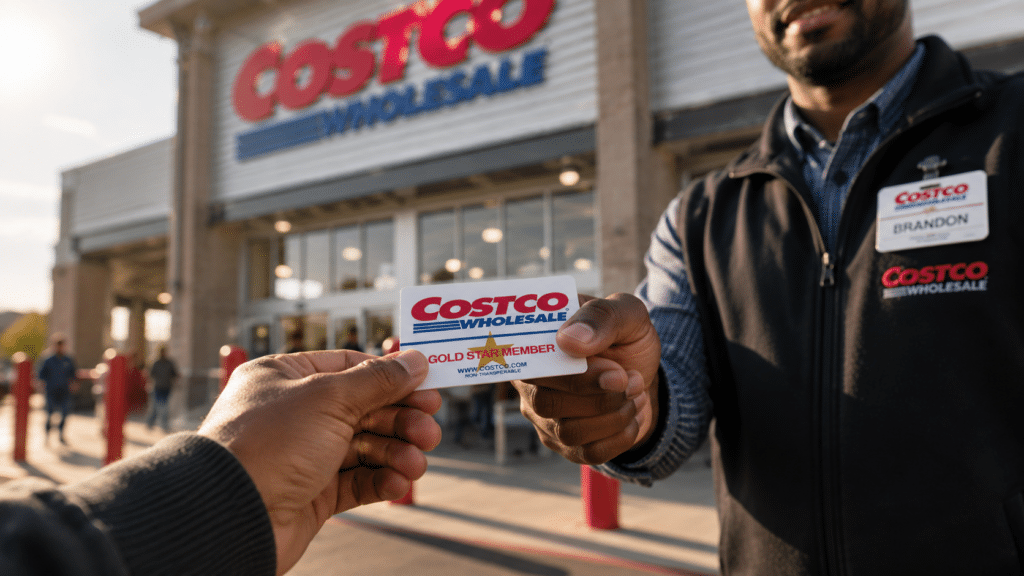
Membership fees sit at the center of everything Costco does.
The fees fund the business, discipline the pricing, and create a relationship with customers that most retailers never get close to achieving.
Why Membership Fees Matter More Than Retail Markups
Most retailers make money by marking up products.
Costco’s product margins are capped at roughly 14 to 15 percent, which is well below what traditional retailers charge.
That means the merchandise business, at that scale, barely covers operating costs.
The membership revenue is where profitability actually lives.
In FY2025, Costco generated $5.32 billion in membership fee income, and that revenue flows almost entirely to the bottom line.
When you compare that to the thin margins on merchandise, the math is clear: the fees are carrying the profit load.
This structure changes the company’s entire incentive.
Instead of trying to maximize margin on each sale, Costco needs to maximize the number of members who renew every year.
Gold Star, Executive, and Business Membership Tiers
Costco offers three main membership tiers.
The Gold Star membership is the standard option for individuals and households.
The Executive Membership costs more annually but gives you a 2 percent reward on eligible purchases plus access to additional benefits and services.
The Business Membership is aimed at small business owners who want to buy in bulk for commercial use.
The Executive tier is especially well-designed.
Members who spend enough at Costco can effectively recoup their annual fee through the 2 percent reward, which makes the higher-priced membership feel like a no-brainer.
You’re essentially getting paid to stay loyal.
A Costco Shop Card comes as part of certain promotions and reward programs, giving members another reason to keep coming back and spend inside the warehouse.
Membership Renewal as the Core Loyalty Metric
If you want to understand how well Costco is really doing, look at its membership renewal rate.
Renewal rates have consistently stayed above 90 percent in the U.S. and Canada, which is a remarkable number for any subscription-style business.
That kind of retention tells you something real.
Members aren’t just forgetting to cancel.
They’re actively choosing to stay because they believe the value is there.
The renewal rate is, in practical terms, a satisfaction score expressed as money.
How Costco Members Turn Recurring Revenue Into Stability
Because membership fees roll in on a predictable annual cycle, Costco has a revenue floor that most retailers lack.
When consumer spending dips, the membership revenue doesn’t disappear overnight.
That stability lets Costco keep prices low even during economic stress, which in turn reinforces why members keep renewing.
It’s a self-reinforcing loop.
Low prices build trust, trust drives renewals, and renewals fund the low prices.
The membership model essentially converts customer loyalty into financial predictability.
Capped Margins as a Trust Engine
Costco’s margin discipline is one of the most unusual competitive decisions in retail.
By deliberately limiting what it can earn on any single product, the company has built something most retailers can’t replicate: a reputation for always offering fair prices.
How Low Prices Build Everyday Credibility
When you shop at Costco, you don’t comparison-shop.
You don’t pull out your phone to check if the olive oil is cheaper on Amazon.
That behavior change is intentional, and it’s a product of years of consistent pricing.
Costco’s cost leadership strategy and pricing authority are built on a simple idea: if members trust that the price is already good, they stop looking elsewhere.
That trust is worth more than any short-term margin gain.
The company has reportedly walked away from vendor deals that would have required raising prices beyond its cap, treating that cap as a non-negotiable commitment to members.
Why Cost Leadership Works Better With a Paid Membership Base
Here’s something worth thinking about.
When customers pay to enter a store, they’re psychologically primed to find value.
You’ve already committed.
You want the trip to be worth it.
Costco leverages that mindset by making sure the prices genuinely back it up.
The combination of a paid membership and capped margins creates a feedback loop.
Members feel the prices justify the fee, which validates the membership, which keeps them coming back.
Without the membership, the low-margin model would be much harder to sustain.
The fee revenue subsidizes the discount pricing that makes members feel rewarded.
Kirkland Signature and the Economics of Private Label Trust
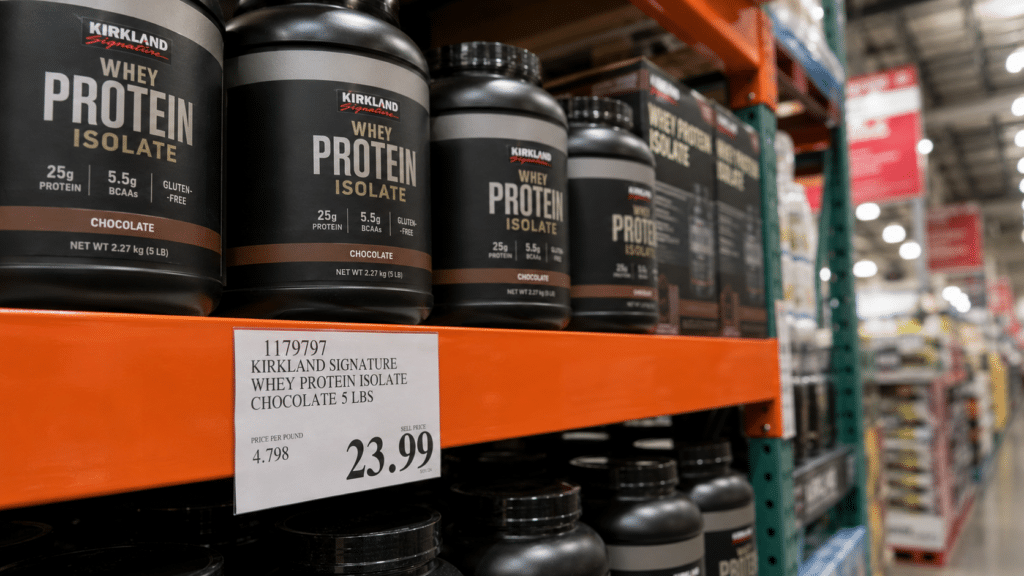
Kirkland Signature is probably the most successful private label in retail history.
From Kirkland Signature batteries to olive oil to wine, the brand covers an enormous range of categories and has built a reputation for quality that rivals national brands.
The economics work well for Costco.
By controlling the Kirkland brand, the company can source products directly, eliminate middlemen, and pass savings to members while keeping margins tight.
Kirkland Signature reportedly generates around $86 billion in annual sales, which is staggering for a store brand.
More importantly, Kirkland reinforces the trust relationship.
When you consistently find that the store brand outperforms national alternatives, you stop questioning Costco’s judgment.
That confidence extends to everything else in the warehouse.
How the Warehouse Runs So Lean

Costco’s physical operations are stripped to the essentials.
No elaborate displays, no promotional signage, minimal staff per square foot.
Every decision in the warehouse is pointed at one outcome: moving product fast and keeping costs low.
Limited Assortment, Bulk Purchasing, and High Sales Volume
Most large supermarkets carry somewhere between 30,000 and 50,000 distinct products.
Costco carries around 3,800 SKUs.
That’s not a limitation; it’s a strategy.
By stocking fewer items, Costco can negotiate harder with suppliers.
When you’re ordering one product instead of ten variations, your purchase volume on that single item becomes enormous.
Suppliers compete fiercely for shelf placement, which gives Costco serious pricing leverage.
The bulk packaging that results also means less repackaging labor and faster throughput.
Inventory Turnover, Cross-Docking, and Single-Step Distribution
Costco’s cross-docking and single-step distribution model means products move from manufacturers to depots and directly to warehouse floors, skipping the traditional multi-step retail supply chain.
The warehouse is the store.
When a pallet arrives, it goes on the floor.
This drives inventory turnover rates of roughly 12 times per year.
At that speed, Costco frequently sells products before it even pays suppliers for them, which is a meaningful cash flow advantage.
Inventory losses from shrinkage are also far below typical retail because known members buy predictably.
Warehouse Operations and Operating Efficiency at Scale
Costco’s warehouses are large, sparsely staffed relative to their size, and deliberately unglamorous.
The pallet racks and concrete floors aren’t aesthetic choices; they’re operational ones.
Less décor means lower setup costs and faster restocking.
The company’s operating efficiency at scale comes from volume concentration.
With roughly 650 warehouse locations globally, Costco moves an enormous amount of merchandise through a relatively small physical footprint compared to competitors.
Each location generates very high revenue per square foot, which spreads fixed costs thin.
The Revenue Flywheel Beyond the Aisles

Costco’s merchandise and membership fees are the core of the business, but ancillary services and digital channels have become meaningful extensions of the model.
They deepen member value and create additional reasons to stay engaged.
Merchandise Sales Versus Membership Profit
On paper, Costco’s merchandise segment generates the majority of total revenue.
In FY2025, the company brought in $269.9 billion in total revenue.
But because merchandise margins are so thin, the actual operating profit that matters comes from membership fees.
Think of the merchandise business as the mechanism that justifies the membership.
It keeps members coming back frequently, validates the value of the annual fee, and creates the foot traffic that makes ancillary services viable.
Comparable sales growth is tracked closely as a sign of member engagement and warehouse health.
Ancillary Services That Deepen Member Value
Costco optical, the pharmacy, the food court, hearing aids, and travel services all serve a specific purpose: they give you more reasons to think of Costco as part of your regular life.
Costco Travel, for instance, offers hotel and vacation packages at competitive prices that members can access exclusively.
These ancillary businesses operate on thin margins themselves, but that’s fine.
They’re not meant to be profit centers on their own.
They increase how often you visit, how much you associate Costco with value across different spending categories, and how hard it feels to let your membership lapse.
Digital Convenience Through E-Commerce, App, and Delivery
The Costco app and same-day delivery options represent a real expansion of the model’s reach.
You can now access Costco pricing without driving to a warehouse, which serves members who live farther from locations or shop in different patterns.
E-commerce fills a specific gap: products that don’t work well in bulk warehouse format, or items too large to carry out of a store.
By layering digital convenience on top of the warehouse experience, Costco extends the membership value proposition without compromising what makes the in-store experience distinctive.
Competitive Position in Modern Retail

Costco operates in a crowded retail market, but its membership warehouse club model puts it in a category that most retailers can’t easily enter or replicate.
The competition looks different depending on where you draw the comparison.
How Costco Stacks Up Against Walmart and Amazon
By revenue, Costco is the third-largest retailer in the U.S., behind Walmart and Amazon.
Walmart competes on breadth and convenience, operating roughly 4,600 stores.
Amazon competes on speed and selection, with virtually unlimited SKUs.
Costco competes on trust, value density, and the membership relationship.
Walmart and Amazon both carry far more products.
Costco’s edge is that its limited selection is curated to feel trustworthy.
Members aren’t overwhelmed by choices; they’re guided toward quality options at prices that justify the annual fee.
That’s a fundamentally different shopping experience, and a different emotional relationship with the brand.
The Warehouse Club Rivalry With Sam’s Club and BJ’s Wholesale Club
Sam’s Club (owned by Walmart) and BJ’s Wholesale Club are Costco’s most direct competitors.
Both use the membership warehouse club format.
BJ’s operates primarily on the East Coast and accepts manufacturer coupons, which gives it a slightly different member profile.
Sam’s Club has invested heavily in its scan-and-go mobile checkout and digital experience.
Costco consistently leads this category on membership renewal rates, member count, and revenue per warehouse.
Its brand reputation for quality, particularly through Kirkland Signature, gives it a loyalty advantage that neither Sam’s Club nor BJ’s has fully matched.
Where Target, Aldi, Kroger, and Whole Foods Compete Differently
Target, Aldi, Kroger, and Whole Foods all compete in adjacent spaces but with different models.
Aldi, like Costco, uses a limited assortment and private label strategy, but without the warehouse format or membership fee.
Target competes on style and convenience in smaller store footprints.
Kroger and Whole Foods focus on grocery-first shopping with different price and quality positioning.
None of these retailers generate the kind of membership loyalty Costco has built.
They compete on specific categories or shopping occasions rather than on the holistic, recurring relationship that a paid membership creates.
Costco’s model makes switching costs real in a way that loyalty points programs simply don’t.
Durability, Ownership, and Strategic Outlook
Costco’s current position is the product of decades of intentional decisions, from its merger history to how it allocates capital today.
Looking at where the company came from helps explain why it’s built to last.
From Price Club to Costco Wholesale Corporation
The warehouse club concept traces back to Price Club, founded in 1976 by Sol Price.
Consumers paid $25 annually for the right to buy bulk products at discount in a basic warehouse setting.
Costco launched in Seattle in 1983, using a nearly identical model, and became the first company to reach $3 billion in sales in under six years.
The two companies merged in 1993 to form PriceCostco, which later rebranded as Costco Companies, Inc. and eventually Costco Wholesale Corporation.
Kirkland Signature launched in 1995, named after the Washington State city where the company was headquartered at the time.
Each of these decisions compounded over time into the brand you see today.
Who Owns Costco and How Leadership Shapes Capital Allocation
Costco Wholesale Corporation is publicly traded on the Nasdaq under the ticker COST.
Its largest shareholders are institutional investors including Vanguard and BlackRock, which is typical for a company of its size.
What makes leadership interesting at Costco is its historically conservative capital allocation.
The company has generally avoided debt-heavy expansion, funded growth through operating cash flow, and maintained a reputation for taking care of employees with wages and benefits above the retail industry average.
That approach has reinforced both the brand’s reputation and its operational stability.
International Expansion, Overseas Markets, and Long-Term Viability
Costco operates in several overseas markets including Canada, the United Kingdom, Japan, South Korea, Australia, Spain, France, China, and Taiwan.
International expansion has proceeded carefully and selectively, prioritizing markets where the membership warehouse concept can take hold culturally.
China has been a notable recent focus, with strong early member adoption.
International operations face real challenges around local preferences, import logistics, and membership culture, but Costco’s format has proven more portable than many expected.
International growth represents one of the clearest long-term opportunities for adding new members and expanding the fee base.
A Focused SWOT Analysis of Risks and Competitive Advantages
Strengths: Extremely high membership renewal rates, Kirkland Signature brand equity, operational efficiency, pricing trust, and a self-reinforcing membership flywheel.
Weaknesses: Limited product selection can frustrate members looking for variety. The warehouse format requires large real estate footprints and limits store count. Digital capabilities, while improving, still trail Amazon significantly.
Opportunities: International expansion into underpenetrated markets, growth in e-commerce and delivery, and increased Executive Membership penetration.
Threats: Sam’s Club’s digital investments are closing the convenience gap. Economic downturns could slow new membership signups. Tariff fluctuations and supply chain disruptions affect bulk import economics.
As noted in a strategic outlook analysis, maintaining relevance through low prices and flexible delivery options is fundamental to Costco’s long-term membership retention.
Frequently Asked Questions
How does Costco make money if its prices are already so low?
Costco makes most of its profit from annual membership fees, not from merchandise markups. In FY2025, membership fee income reached $5.32 billion, and that revenue flows almost entirely to the bottom line because operating costs are covered by high-volume merchandise sales.
What role do membership fees play in Costco’s profitability?
Membership fees are the primary profit engine of the Costco business model. Because merchandise margins are capped at roughly 14 to 15 percent, the fees provide the reliable income that keeps the business financially healthy and funds the company’s ability to maintain low prices.
Why does Costco carry such a limited selection of products compared to other retailers?
Carrying fewer SKUs lets Costco negotiate better terms with suppliers, order in far greater volumes per product, and move inventory faster. That limited assortment also simplifies warehouse operations, reduces overhead, and makes the shopping experience less overwhelming for members.
How does Costco’s pricing and supplier approach help it keep costs down?
Costco buys directly from manufacturers and uses a cross-docking and single-step distribution model that eliminates multiple layers of the traditional supply chain. Combined with bulk purchasing leverage, this lets the company source at lower costs and pass those savings directly to members.
What kind of business is Costco, retail, wholesale, or something in between?
Costco is most accurately described as a membership warehouse club, a category it helped define. It operates like a retailer in that it sells to end consumers, but it uses wholesale-style bulk formats and membership fees to create a model that doesn’t fit neatly into either traditional category.
How does Costco’s strategy change when it operates outside the U.S.?
Costco adapts its product mix to local preferences in overseas markets. However, it keeps the core membership warehouse format intact. International locations face higher logistics costs and cultural differences around bulk shopping. But the membership model has proven transferable, particularly in markets like South Korea, Japan, and more recently China.

I spent years working in tech and digital publishing, where I saw how quickly industries, brands, and consumer behavior can change. I created Rich Digest to explore the business behind luxury, from iconic products and influential founders to pricing, scarcity, ownership, and brand strategy. My goal is to make the world of luxury business clear, interesting, and easy to understand.