Most people assume Google is a technology company. And sure, it builds technology.
But if you look at where the money actually comes from, Google is really an advertising business that happens to offer free software to billions of people.
The core insight is simple: Google doesn’t charge you to use Search, Gmail, or Maps because you’re not the customer. You’re the product being delivered to the real customers, which are advertisers.
Alphabet, Google’s parent company, crossed $400 billion in annual revenue for the first time in 2025, according to remarks from CEO Sundar Pichai on the Q4 2025 earnings call.
The vast majority of that money comes from one core mechanism: charging businesses for access to people who are actively searching for things to buy.
That’s a remarkably durable business.
And right now, it’s under more pressure than it’s faced in two decades.
This breakdown covers how Google built that model, what holds it together, and why artificial intelligence is creating the most complicated strategic problem the company has ever had to navigate.
The Search Tollbooth That Powers The Business
Google’s advertising machine is built on a single insight: search intent is the most valuable signal in marketing.
When you search for something, Google knows what you want right now, in that moment.
Why Commercial Intent Makes Search So Valuable
Most media sells ads by reaching people who might be interested in something.
Google sells ads by reaching people who are actively looking for something. That difference is enormous for advertisers.
When you search “best running shoes under $100,” you’ve already told Google your budget and your interest.
An advertiser showing you an ad at that moment is reaching you at the perfect time.
That’s why search advertising consistently commands higher prices than almost any other form of digital marketing.
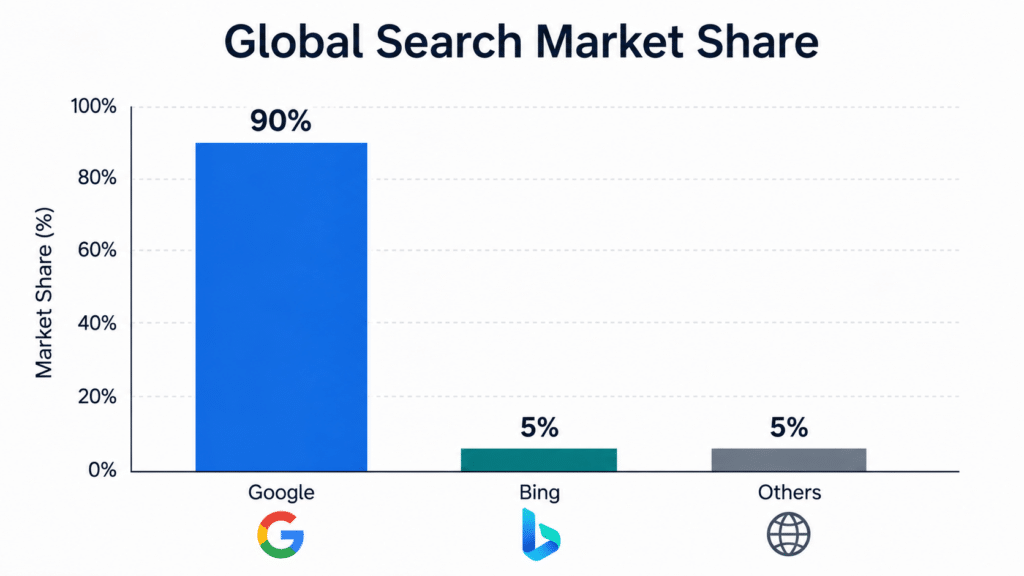
Google search has held roughly 90% of global search engine market share for years, making Bing and Microsoft distant competitors.
That dominance means Google has access to an unmatched volume of commercial intent signals every single day.
How Google Ads Turns Queries Into Revenue
When you run a search, Google’s system runs an auction in milliseconds.
Advertisers bid on keywords, and the winners get their ads placed above the organic results.
Google collects revenue when you click on those ads, which is the pay-per-click model that replaced the earlier AdWords system.
Advertisers only pay when someone actually clicks, which makes the return on investment much easier to measure than traditional media.
That accountability is a huge part of why Google advertising revenue has compounded so reliably over time.
What Drives CPC, Quality Score, And Ad Placement
It’s not just about who bids the most.
Google uses a Quality Score system that factors in ad relevance, expected click-through rate, and the quality of the landing page.
A highly relevant ad from a lower bidder can outrank a less relevant ad from a higher bidder.
This matters for Google because better ad relevance leads to better user experience, which keeps people using Search.
It also pushes advertisers to build better ads and landing pages, which benefits everyone in the ecosystem.
Cost-per-click (CPC) varies wildly by industry.
Legal services, finance, and insurance keywords can cost dozens of dollars per click, while lower-competition terms might cost pennies.
Why Search Still Anchors Google Revenue Breakdown
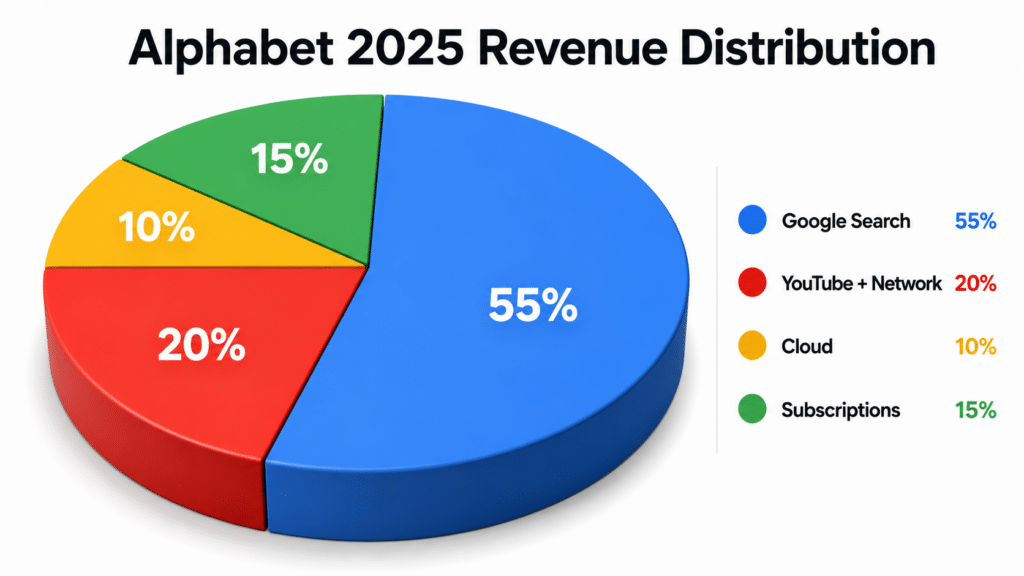
According to Alphabet’s segment data, Google Search and Other represented about 55% of total revenue in fiscal year 2025.
That’s one product line generating more than half of a $400 billion company’s revenue.
No other single product in the tech industry comes close to that kind of concentrated earning power.
Search isn’t just Google’s biggest business. It’s the financial foundation that funds everything else the company does.
The Advertising Machine Beyond Search
Google’s advertising business extends well beyond the search results page.
YouTube, third-party websites, and local map listings all function as parts of a single, interconnected ad ecosystem.
YouTube Ads And The Video Attention Engine
YouTube is the second-largest search engine in the world.
When you watch a video and see a pre-roll ad or a mid-roll interruption, that’s Google’s ad auction system working again, just applied to video inventory instead of search queries.
YouTube ads operate on a cost-per-mille (CPM) model, where advertisers pay per thousand impressions, alongside click-based formats.
YouTube Premium, YouTube TV, and YouTube Music add a subscription layer on top of the advertising base, giving Google multiple ways to monetize the same platform.
The Google Network, AdSense, And Display Advertising
Google doesn’t just run ads on its own properties.
Through AdSense and the Google Display Network, Google places ads on millions of third-party websites and apps.
Publishers get a share of the revenue, and Google keeps the rest.
AdMob extends this to mobile apps.
Google Ad Manager helps larger publishers manage their ad inventory.
This network of publisher relationships gives Google reach across a huge portion of the open internet, not just its own platforms.
Maps, Local Discovery, And High-Intent Ad Inventory
Google Maps is a powerful ad surface that’s easy to overlook.
When you search for a restaurant or a plumber near you, the businesses appearing at the top of those results often paid for that placement through local search ads.
These ads carry extremely high commercial intent.
You’re not browsing. You’re looking for somewhere to go or someone to call.
That makes Maps one of Google’s most valuable ad environments, even though most users think of it as a free navigation tool.
How Traffic Acquisition Costs Shape Ad Economics
Google pays billions of dollars every year in traffic acquisition costs (TAC) to partners who send users to Google products.
The most prominent example is the deal Google has with Apple, paying to remain the default search engine in Safari.
These TAC payments are significant.
They eat into advertising margins and have become a focal point in antitrust cases against Google.
The business logic is straightforward: paying for default placement protects the search query volume that drives ad revenue.
The Free Ecosystem That Feeds The Core Engine
Google’s free products aren’t charity.
They’re strategic infrastructure.
Each free product you use gives Google more data about your behavior, your preferences, and your location, all of which makes its ad targeting more precise and more valuable.
Android, Chrome, And Default Distribution
Android powers the majority of smartphones globally.
Chrome is the world’s most-used browser.
Together, they give Google a near-universal distribution channel for its services.
When you use an Android phone, Google Search is the default engine.
When you browse in Chrome, Google collects signal about where you go and what you look for.
That data feeds directly into ad targeting and improves the relevance of the ads you see.
Apple, Amazon, and Meta all have distribution advantages in their own ecosystems, but none match Google’s reach across both mobile operating systems and web browsers.
Google Play, In-App Purchases, And App Sales
Google Play is the primary app store for Android devices.
When you buy an app or make an in-app purchase, Google takes a platform fee, typically around 15 to 30 percent depending on the transaction type.
This creates a recurring revenue stream that doesn’t depend on advertising.
It also keeps developers building for Android, which keeps users on Android, which keeps data flowing back to Google’s ad systems.
Maps, Payments, And Everyday Product Lock-In
Google Maps and Google Pay are embedded in daily routines in ways that are easy to underestimate.
When you use Maps to navigate to work every morning, Google learns your schedule, your regular destinations, and patterns about how you move through the world.
Google Pay adds financial transaction data on top of that.
These products don’t generate huge direct revenue on their own, but they deepen your reliance on the Google ecosystem in ways that make switching to a competitor feel genuinely inconvenient.
Why Google Services Creates Compounding Data Advantages
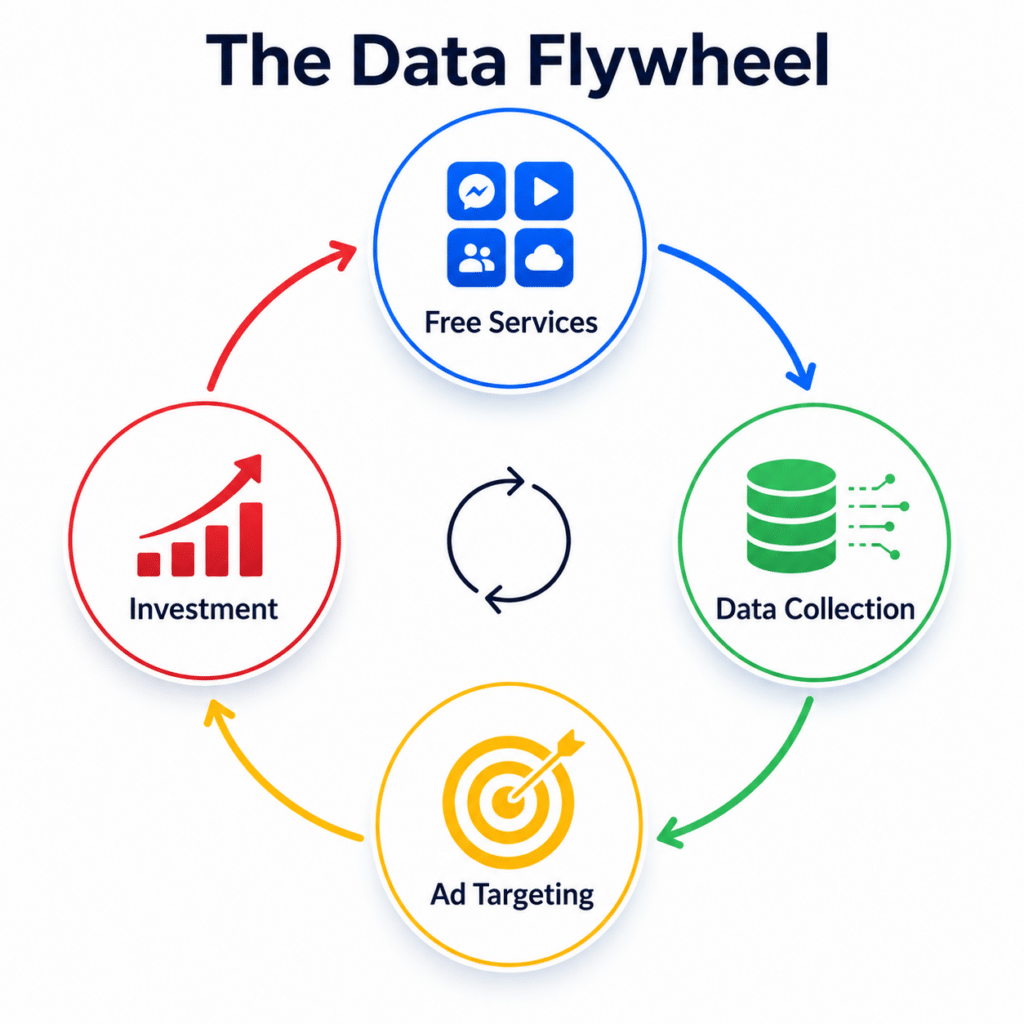
Each product you use makes Google’s model slightly more valuable.
Your Gmail activity, Maps history, Search behavior, YouTube watch history, and Android location data all combine into a picture of who you are and what you want.
That picture is what advertisers are paying to access.
I think this is the part most people miss: the free products create a data feedback loop that continuously improves ad targeting, which raises the value of each ad impression, which funds more investment in free products.
Cloud, Subscriptions, And Other Non-Ad Revenue
Google’s advertising business is dominant, but Alphabet has spent years building revenue streams that don’t depend on ad clicks.
Cloud services and subscriptions are the most significant of those.
Google Cloud Platform And Enterprise Growth
Google Cloud Platform (GCP) sells computing infrastructure, databases, machine learning tools, and data analytics services to businesses.
It competes directly with Amazon Web Services (AWS) and Microsoft Azure, though it remains smaller than both.
Google Cloud generated $31.3 billion in revenue in the first three quarters of 2024 and has become profitable after years of operating losses.
Enterprise cloud is now one of the fastest-growing parts of Alphabet’s business.
Google Workspace, Vertex AI, And AI Infrastructure
Google Workspace (formerly G Suite) bundles Gmail, Docs, Drive, Meet, and other collaboration tools into a subscription that businesses pay for monthly.
It competes with Microsoft 365 and serves as a significant recurring revenue source.
Vertex AI is Google’s platform for building and deploying AI models.
As businesses race to integrate AI into their operations, Vertex AI puts Google in position to capture that enterprise spending.
Gemini, Google’s flagship AI model family, is increasingly integrated across Workspace and Cloud products.
Subscriptions, Devices, And Platform Fees
YouTube Premium, YouTube TV, and YouTube Music are paid subscription services that sit alongside the ad-supported versions.
Google One provides expanded cloud storage.
These subscriptions create predictable recurring revenue that buffers against any single-quarter advertising slowdown.
Pixel phones generate hardware revenue, though Google has never competed with Apple on scale in the premium hardware market.
Pixel devices serve more as a showcase for Google’s software and AI capabilities than as a primary revenue driver.
Why Diversification Still Trails The Ad Business
As reported by Visual Capitalist, advertising still accounts for roughly three-quarters of Alphabet’s total revenue.
Cloud is growing fast, but it starts from a much smaller base.
The honest picture is that Google Cloud, subscriptions, and hardware are meaningful businesses individually, but they’re all much smaller than the search advertising engine.
Diversification is real and it’s growing, but it hasn’t yet changed the fundamental reality that Alphabet depends on advertising for most of its income.
Alphabet’s Structure And The Numbers That Matter
Alphabet is the parent company that sits above Google and its various ventures.
Understanding its structure helps you read its financial results and understand what’s actually driving performance.
Google Services, Google Cloud, And Other Bets
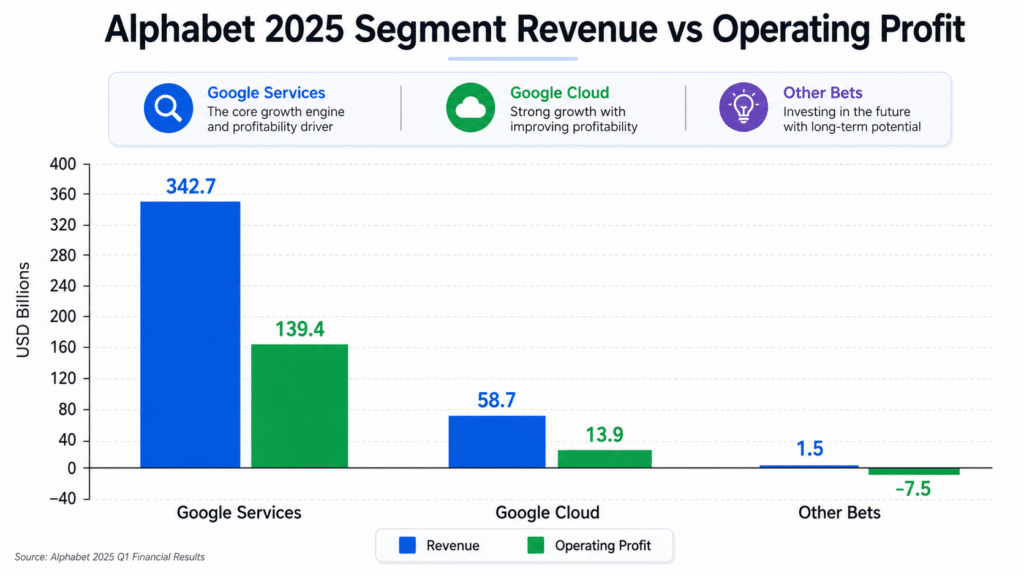
Alphabet reports results across three segments.
Google Services includes Search, YouTube, Android, Chrome, Maps, Google Play, and hardware.
Google Cloud covers GCP and Workspace.
Other Bets covers everything else, including Waymo (autonomous driving), Verily (life sciences), and Wing (drone delivery).
Google Services is by far the largest and most profitable segment.
Google Cloud added $31.3 billion in revenue and $4 billion in operating income.
Other Bets generated $1.2 billion in revenue but posted an operating loss of $3.3 billion.
Operating Income, Net Income, And Operating Margins
Alphabet’s operating margins are consistently impressive.
The Google Services segment runs at margins that most businesses can’t approach, because the marginal cost of serving one more search query is near zero.
For the first nine months of 2024, Alphabet reported net income of $73.6 billion, up nearly 39% from the same period in 2023.
Those numbers reflect both the strength of the advertising business and the improving profitability of Google Cloud.
Why Other Bets Matter Even When They Lose Money
Other Bets consistently loses money.
Waymo alone requires enormous capital to develop self-driving technology.
Verily and Wing face long timelines before they generate meaningful returns.
I think the strategic logic is that Alphabet is using its advertising profits to buy optionality.
If any one of these bets works at scale, it could become the foundation of the next generation of Alphabet’s business.
Waymo in particular could reshape transportation economics if autonomous driving reaches mass adoption.
Shares, Buybacks, And What Investors Watch
Alphabet has two publicly traded share classes.
Class A shares (GOOGL) carry one vote per share.
Class C shares (GOOG) carry no voting rights.
The Alphabet founding structure gives insiders effective control regardless of how shares are distributed.
Alphabet has been an aggressive buyer of its own stock.
Large buybacks reduce the share count and boost earnings per share, which matters to institutional investors.
What investors watch most closely is revenue per search query, YouTube ad growth, and the pace of Google Cloud’s margin improvement.
The AI Dilemma And The Risks To Google’s Model
Google built one of the most profitable businesses in history.
Generative AI is now creating a genuine tension at the center of that business, and it’s worth thinking clearly about what’s actually at stake.
Why Generative AI Threatens Search Economics
Here’s the core problem.
Google’s search advertising revenue depends on you seeing a results page.
That page is where the ads live.
When you search for something and click an ad, Google gets paid.
As noted in reporting from Northeastern University, generative AI can give you a direct answer instead of a list of links, which means you might never see the results page, and the ads on it.
If AI overviews replace enough search results page visits, Google’s ad inventory shrinks.
That’s the innovator’s dilemma in sharp relief: the best version of AI search could cannibalize the business model that funds it.
Gemini, AI Overviews, And The Push To Defend Search
Google’s response has been to embed AI directly into Search rather than cede the market to OpenAI or Microsoft.
AI Overviews now appear at the top of many search results, giving you a synthesized answer while keeping you on Google’s page.
Gemini, Google’s AI model family, is being integrated across Search, Workspace, Cloud, and developer tools.
According to Alphabet’s own disclosures, about 1.5 million developers are using Gemini across Google’s developer tools.
The bet is that Google can transition to an AI-native search experience without sacrificing the ad revenue that makes the whole company work.
Competition, Antitrust, And Distribution Risk
Google faces pressure from multiple directions simultaneously.
Microsoft has invested heavily in OpenAI and integrated AI into Bing.
Amazon and AWS are major cloud competitors.
Apple controls iPhone distribution and could redirect search traffic at any moment.
The 2024 DOJ antitrust ruling found that Google had abused its search monopoly, with a U.S. District Court judge stating plainly that “Google is a monopolist, and it has acted as one.”
Remedies from that case could disrupt Google’s default search agreements with Apple and other device makers, which would directly impact search query volume and ad revenue.
What You Should Watch Next
The metrics that will tell you how this plays out are relatively straightforward.
Watch how Google’s revenue per search query changes as AI Overviews expand.
Watch whether Google Cloud’s margin improvement continues, because cloud profits could eventually offset any softness in search ads.
Watch what happens with the DOJ antitrust remedies, particularly anything that threatens Google’s ability to pay for default search placement.
And watch whether Gemini gains genuine adoption at scale or remains a second-choice AI tool for most users.
Those signals will tell you more about Google’s next decade than any single earnings report.
Frequently Asked Questions
Where does most of the company’s revenue actually come from?
Alphabet’s revenue primarily comes from Google advertising, specifically search ads. According to Alphabet’s segment data, Search and Other drove roughly 55% of 2025 revenue. When combined with YouTube and the Google Network, advertising accounts for about three-quarters of the company’s total income.
How does it make money when people use Search for free?
Google charges advertisers instead of users. When you search with commercial intent, businesses bid in real-time auctions to show ads. You get free results, but advertisers pay to appear exactly when you are looking for their products or services.
Does it earn money from my data, and if so, how does that work?
Google doesn’t sell data directly. It uses your activity to build precise profiles, which advertisers pay a premium to reach. Your behavior effectively becomes the product, making ads more valuable by ensuring they reach the most relevant audience.
How does Gmail bring in revenue if there aren’t subscription fees for most users?
Free Gmail informs Google’s understanding of your interests, aiding ad targeting. Meanwhile, businesses pay for Google Workspace subscriptions. Free accounts also act as a strategic hook, keeping you inside the ecosystem where you interact with other ad-supported services like Search and YouTube.
How did it generate revenue in the early days before its ad business took off?
Initially, Google generated revenue by licensing its search technology to other portals. This changed in 2000 with AdWords, which introduced a pay-per-click model. This immediate success quickly turned advertising into the company’s primary and most durable source of income.
How do products like Google Maps bring in money if they’re free to use?
Maps earns revenue through local ads and by charging developers to use its API. Crucially, it also provides location data that improves ad targeting across Google’s ecosystem, making the company’s entire advertising inventory more valuable to businesses looking for local customers.

I spent years working in tech and digital publishing, where I saw how quickly industries, brands, and consumer behavior can change. I created Rich Digest to explore the business behind luxury, from iconic products and influential founders to pricing, scarcity, ownership, and brand strategy. My goal is to make the world of luxury business clear, interesting, and easy to understand.