
You already know WhatsApp is free. You’ve probably used it today. But at some point, a reasonable question creeps in: if nobody’s paying for this app, who is?
WhatsApp makes money primarily by charging medium and large businesses to send messages through the WhatsApp Business API, and by selling click-to-message ads on Facebook and Instagram that funnel users directly into WhatsApp chats.
Personal users pay nothing and see no ads inside the app itself.
Call this the Invisible Toll Road: the infrastructure looks free on your end, but businesses pay every time they drive through it to reach you.
You get a clean, fast experience. Meta gets paid. Nobody feels the friction. That’s the model in a sentence.
The sections below break down exactly how each piece works, how WhatsApp got here, and where the money is likely to go next.
The Direct Answer: Where The Money Comes From
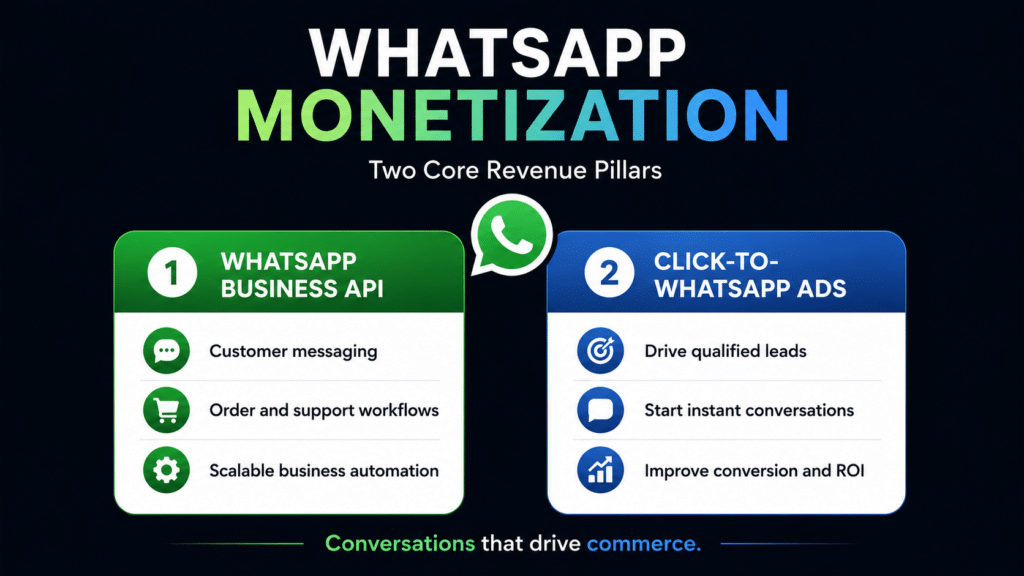
WhatsApp runs on two main revenue engines: a paid API that businesses use to message customers at scale, and a fast-growing ad format on Facebook and Instagram that sends users directly into WhatsApp conversations.
Together, these two streams have pushed WhatsApp past a $1 billion annual run rate from paid messaging alone, with click-to-WhatsApp ads adding billions more.
WhatsApp Business API As The Core Revenue Engine
The WhatsApp Business API is how medium and large companies plug into WhatsApp at scale.
A bank, airline, or e-commerce brand can send you order confirmations, shipping alerts, appointment reminders, or customer service replies directly through WhatsApp.
Businesses pay per message, with rates that vary by country and message category.
This is not the free WhatsApp Business app you might download from the App Store.
The API requires a formal setup through Meta or an approved partner.
According to Meta’s own reporting, WhatsApp Business generates most of WhatsApp’s revenues.
Click-to-WhatsApp Ads Across Facebook And Instagram
When you see an ad on Facebook or Instagram with a “Send Message” button that drops you into a WhatsApp chat, that’s a click-to-WhatsApp ad.
Businesses pay for those clicks through Meta’s standard ad platform.
Once you’re in the chat, that conversation often converts into a sale or a support ticket handled through the paid Business API.
This format generated roughly $10 billion in revenue in 2024, making it Meta’s fastest-growing ad product.
It’s especially popular in markets like Brazil, India, and parts of Southeast Asia.
Why Business Messaging Beats Consumer Subscriptions
Charging consumers $1 per year has a ceiling.
Charging businesses per conversation at scale does not.
A single large enterprise sending millions of messages per month generates more revenue than millions of individual users ever would.
The business messaging model also grows naturally as more companies adopt WhatsApp as a customer communication channel, creating compounding demand.
Why WhatsApp Stays Free For Personal Users
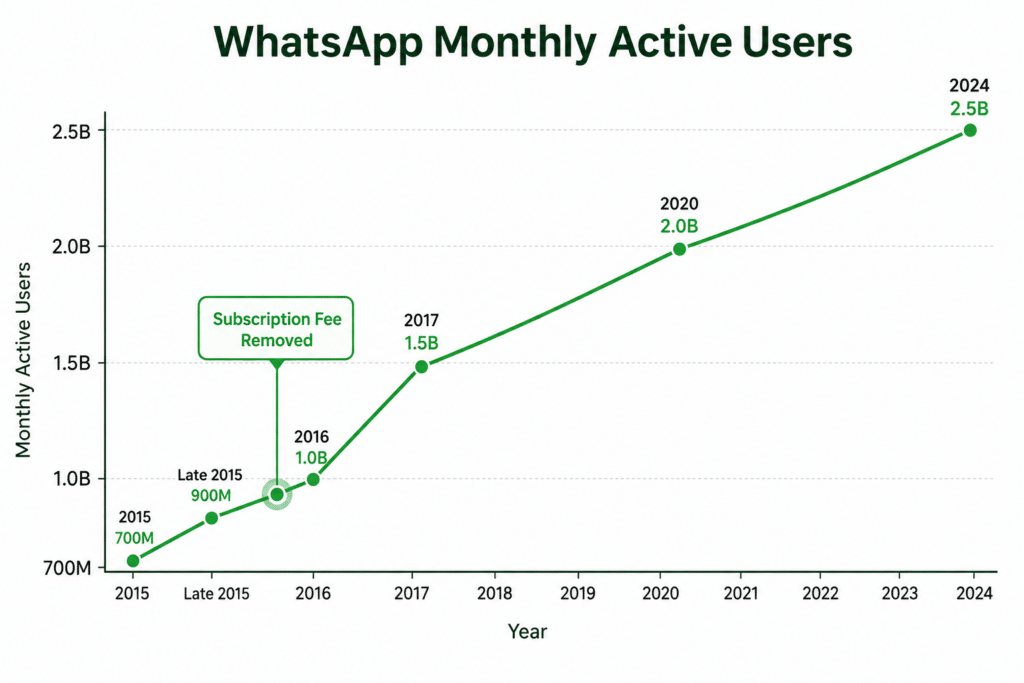
WhatsApp dropped its subscription fee in 2016 and has kept the personal experience ad-free ever since.
The logic is straightforward: scale creates the value that businesses are willing to pay for, and anything that slows user growth hurts the underlying asset.
Removing the $1 fee, avoiding in-chat ads, and offering free voice and video calls were all deliberate choices to protect that scale.
The Shift Away From The $1 Subscription
WhatsApp originally charged about $1 per year in some markets and offered a free first year before billing.
At its peak, the app had around 700 million users on that model.
Meta dropped the fee entirely in 2016, betting that a larger free user base would eventually justify a different kind of monetization.
That bet has largely paid out.
How Free Distribution Fuels Scale
At over 2.5 billion monthly active users, WhatsApp’s reach is the product.
Businesses pay for API access specifically because their customers are already there.
Every new personal user who joins for free makes the platform more valuable to businesses, which increases what Meta can charge them.
Free distribution is not a charity move; it’s the foundation of the entire revenue model.
The Logic Behind An Ad-Light User Experience
Flooding WhatsApp chats with targeted advertising would likely push users toward alternatives like Signal or Telegram.
Meta has been careful to keep the personal messaging experience clean.
I’ve noticed that this restraint is what makes the Invisible Toll Road work: users stay because it feels private, and that retention is exactly what businesses are paying to access.
The Business Products Behind The Model
WhatsApp offers two distinct tiers for businesses: a free app for small companies and a paid platform for larger ones.
These are separate products with different capabilities, pricing, and target audiences.
WhatsApp Payments adds a third layer in select markets.
What The WhatsApp Business App Does For Small Companies
The WhatsApp Business app is a free download designed for small and medium-sized businesses.
It lets you set up a business profile, create quick replies, organize chats with labels, and set automated away messages.
A local bakery or freelance consultant can manage customer conversations directly from their phone.
This app does not directly generate revenue for Meta.
Its value is strategic: it introduces small businesses to the WhatsApp ecosystem and often acts as a gateway toward paid API usage as those businesses grow.
How The Platform Serves Medium And Large Enterprises
The WhatsApp Business Platform is the paid, enterprise-grade layer.
It gives large organizations API access to send high-volume messages, integrate with CRM systems, and deploy chatbots.
Pricing is per conversation and varies by message type, including marketing, utility, authentication, and service categories.
Large companies like airlines, banks, and retailers use this layer to manage customer relationships at a scale that the free app simply cannot support.
Typical Use Cases Like Support Alerts And Commerce
Common enterprise use cases include:
- Transactional alerts: shipping confirmations, payment receipts, flight boarding passes
- Customer support: automated chatbots for FAQs, agent handoff for complex issues
- Marketing messages: promotional offers sent to opted-in users
- Authentication: one-time passwords for account verification
- Commerce: product catalogs, in-chat purchasing in supported markets
Each of these conversation types is billed at a different rate, giving Meta a tiered pricing structure based on business value.
Meta’s Ecosystem Advantage
WhatsApp’s real power within Meta’s business is not what it earns alone, but how it amplifies everything else.
WhatsApp makes Meta’s advertising products more effective and more attractive to business buyers.
Meta captures ad spend on Facebook and Instagram while also earning from business conversations that happen inside WhatsApp.
It’s a loop.
How WhatsApp Feeds Meta’s Ad Machine Without In-App Ads
WhatsApp messages are end-to-end encrypted, which means Meta cannot read their content.
But the platform still contributes metadata to Meta’s broader data ecosystem, including phone numbers, app usage patterns, and interaction frequency.
This enriches Meta’s ad targeting without requiring ads inside WhatsApp itself.
As noted in a recent breakdown of Meta’s business model, the company delivers discovery, conversation, and conversion across its entire ecosystem, with WhatsApp handling the conversation layer.
Why Click-to-Message Matters More Than Banner Ads
A banner ad you ignore generates almost no value. A click-to-WhatsApp ad that opens a real conversation with a business is a qualified lead.
For businesses, the conversion intent is higher. For Meta, the ad unit commands a premium price.
According to analysis of Meta’s ad strategy, conversations initiated by these ads also flow into the paid messaging ecosystem, driving downstream Business API usage and revenue.
Nikila Srinivasan And Meta’s Business Messaging Push
Nikila Srinivasan, Meta’s vice president of business messaging, has been one of the key figures driving the commercial expansion of WhatsApp’s business tools.
Under her leadership, Meta has pushed to position WhatsApp as the default channel for business-to-consumer communication in markets where it dominates.
Her work sits at the intersection of product, partnerships, and revenue growth, and it signals how seriously Meta takes this category.
Privacy, Data Sharing, And The Trust Tradeoff
WhatsApp’s reputation was built on privacy. End-to-end encryption, no ads, no data selling. That positioning helped it grow faster than almost any app in history.
But as Meta has pushed for more monetization, the privacy story has become more complicated and more contested.
What End-to-End Encryption Protects
End-to-end encryption means that your messages, photos, and voice calls are scrambled in transit.
WhatsApp cannot read them. Neither can Meta, law enforcement without a court order targeting your device directly, or anyone intercepting traffic.
This is the same underlying technology used by Signal. For everyday users, it means your private conversations stay private in a meaningful technical sense.
Where Privacy Concerns Come From
The concerns are not about message content. They’re about metadata. WhatsApp collects data about who you message, how often, when, and from what device.
Its 2021 privacy policy update, which drew global backlash, clarified how that metadata flows between WhatsApp and Meta’s other platforms.
Many users migrated to Signal and Telegram during that period, showing how sensitive the community is to perceived changes in privacy practice.
How Data Sharing Debates Shaped WhatsApp’s Reputation
The 2021 policy update was a turning point. As coverage at the time noted, WhatsApp had previously stood apart from Big Tech’s data practices.
When that changed, even partially, the trust damage was real.
Meta has since tried to reassure users that message content is never used for ad targeting, but the gap between technical accuracy and public perception has been difficult to close.
How WhatsApp Compares With Other Messaging Apps
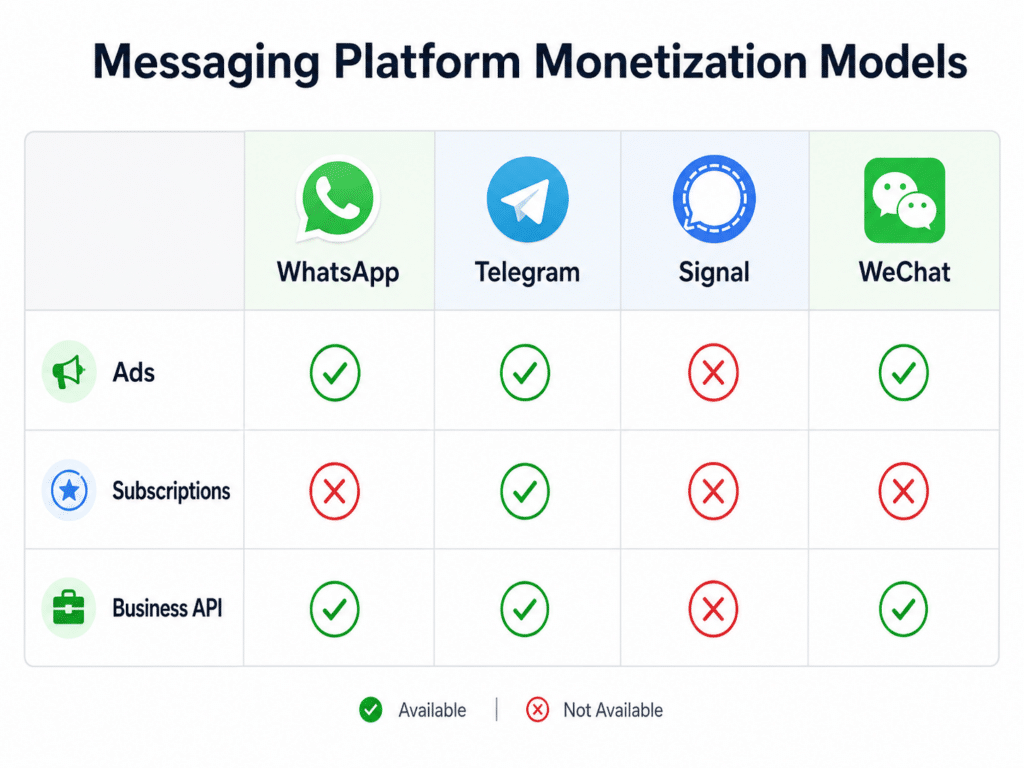
Every major messaging app has a different answer to the monetization question. Some run on ads, some on subscriptions, some on payments, and some are still figuring it out.
Comparing WhatsApp to its peers makes the Invisible Toll Road model look unusually disciplined.
Telegram, Signal, And Discord
Telegram monetizes through a premium subscription tier called Telegram Premium and has introduced a native ad platform inside public channels.
Signal is a nonprofit and does not monetize at all; it runs on donations and a grant from Brian Acton, one of WhatsApp’s own co-founders.
Discord earns through Nitro subscriptions and server boosts.
None of them have WhatsApp’s business messaging infrastructure or Meta’s ad ecosystem behind them, which limits their commercial scale.
WeChat, LINE, Viber, And Facebook Messenger
WeChat is the closest thing to a super app in the world, monetizing through payments, mini-programs, gaming, advertising, and enterprise services all inside one platform.
It’s the template many analysts point to when discussing WhatsApp’s long-term potential. LINE earns through stickers, games, and advertising.
Viber operates on a mix of ads and business messaging.
Facebook Messenger shares Meta’s ad infrastructure and has been used to run sponsored messages, though its growth has slowed in Western markets.
Snap, Snapchat, And The Ad-Heavy Alternative
Snapchat runs almost entirely on advertising, including display ads, sponsored lenses, and Story ads.
It’s a direct contrast to WhatsApp’s approach.
Snap sells ads inside the app experience and targets users based on behavioral data, which generates strong revenue per user in the US market but has faced pressure from Meta’s own Reels product.
WhatsApp’s refusal to run in-app ads means it leaves that revenue on the table in exchange for higher user trust and retention.
What Could Expand Revenue Next
WhatsApp’s current revenue base, centered on business messaging and click-to-WhatsApp ads, is still relatively small compared to Meta’s total business.
The platform has several expansion opportunities that could change that, some already in motion and some still speculative.
WhatsApp Pay And Payments Infrastructure
WhatsApp Pay is live in India and Brazil, allowing users to send money inside the app. In India, it connects to the UPI system, which links directly to bank accounts.
In Brazil, Meta integrated with PIX, the country’s national instant payments network. For individuals, peer-to-peer transfers are free. Businesses pay a small processing fee.
If Meta scales payments into more markets and deeper commerce workflows, this becomes a meaningful revenue line.
WhatsApp Channels And One-To-Many Distribution
WhatsApp Channels is a broadcast feature that lets public figures, brands, and organizations push content to followers, similar to a newsletter inside the app.
The feature is not yet monetized, but Meta has signaled plans to allow channel admins to charge for subscriptions or promote themselves in a discovery directory.
Alice Newton-Rex, WhatsApp’s vice president of product, has described Channels as a real opportunity for future revenue creation.
The Long-Term Super App Question
Mark Zuckerberg has called WhatsApp the foundation of the “private social platform of the future.”
The super app model, inspired by WeChat, would bundle messaging, payments, commerce, and business tools into one platform where users rarely need to leave.
WhatsApp already has the user base. It has the payments infrastructure in two major markets.
The missing pieces are a fully built commerce layer and regulatory clearance in markets like the US and Europe.
I think the super app ambition is real, but years away from full execution.
From Founders To Meta: How The Strategy Evolved
WhatsApp’s monetization story is inseparable from its founding philosophy and the dramatic shift that followed its acquisition.
Jan Koum and Brian Acton built something explicitly anti-commercial. Meta bought it anyway, and eventually rebuilt the business model from scratch.
Jan Koum And Brian Acton’s Original Vision
Jan Koum and Brian Acton founded WhatsApp in 2009 after both had worked at Yahoo. Their stated mission was simple: build a reliable, cheap alternative to SMS with no ads and no gimmicks.
Koum had grown up in Ukraine without reliable communication infrastructure, and that experience shaped his conviction that messaging should be private and accessible.
The founders were vocal critics of advertising as a business model, which made the eventual acquisition ironic.
When Facebook Acquired WhatsApp
Facebook acquired WhatsApp in February 2014 for $19 billion, one of the largest tech acquisitions at the time.
The deal gave Facebook a platform dominant in markets where Facebook itself was weaker, particularly in Europe, Latin America, and South Asia.
Koum and Acton both joined Meta after the acquisition but later departed, with Acton publicly expressing regret about the sale and going on to fund Signal.
Why Monetization Changed After The Acquisition
For the first few years after the acquisition, Meta largely left WhatsApp’s model alone.
The $1 subscription was dropped in 2016.
Real monetization only accelerated in the early 2020s as Meta faced pressure to justify the purchase price and as WhatsApp’s user base made business messaging commercially viable.
The shift was not sudden, but it was inevitable given Meta’s ad-driven culture and investor expectations.
Today, the original “no ads, no games, no gimmicks” tagline from Koum survives only as a historical footnote.
Frequently Asked Questions
If WhatsApp is free to use, where does the revenue actually come from?
WhatsApp earns money primarily from two sources: the WhatsApp Business API, which charges medium and large businesses per conversation when they message customers at scale, and click-to-WhatsApp ads on Facebook and Instagram, which are Meta’s fastest-growing ad format. Personal users pay nothing and generate no direct revenue. The business side carries the entire financial model.
Do regular WhatsApp users generate any income for the company at all?
Not directly. Regular users pay no fees and see no in-app ads. Their indirect contribution is scale: a larger user base makes WhatsApp more valuable to businesses willing to pay for API access and click-to-message ad campaigns. Metadata from user behavior also enriches Meta’s broader ad targeting ecosystem, though message content stays protected by end-to-end encryption.
What did WhatsApp’s business model look like before it became part of Meta?
Before and shortly after the Facebook acquisition, WhatsApp charged roughly $1 per year in some markets, with the first year free in others. That subscription model supported the platform at a smaller scale but was dropped entirely in 2016. The current business-focused model did not take meaningful shape until the early 2020s, when Meta began pushing the Business API and click-to-message ad formats in earnest.
What’s the difference between how WhatsApp and WhatsApp Business bring in money?
The free WhatsApp Business app for small companies does not directly generate revenue for Meta. It’s a strategic product designed to bring small businesses into the ecosystem. Revenue comes from the WhatsApp Business Platform, which is the paid API tier used by medium and large enterprises that pay per conversation based on message type and volume.
Roughly how much revenue does WhatsApp make in a typical year?
Estimates put WhatsApp’s annual revenue at approximately $1.3 billion as of late 2024, with paid messaging crossing a $1 billion run rate on its own. Click-to-WhatsApp ads generated roughly $10 billion in 2024, though that revenue technically flows through Meta’s ad platform rather than WhatsApp directly. Meta does not break out WhatsApp revenue separately in its public filings.
Can you get paid for WhatsApp Status views or other in-app activity?
No. WhatsApp does not have a creator monetization program for Status views or any other personal in-app activity. WhatsApp Channels may eventually allow admins to charge subscribers or promote themselves through a directory, but that infrastructure is not yet in place. Ordinary users have no path to earning money through the app as of mid-2026.

I spent years working in tech and digital publishing, where I saw how quickly industries, brands, and consumer behavior can change. I created Rich Digest to explore the business behind luxury, from iconic products and influential founders to pricing, scarcity, ownership, and brand strategy. My goal is to make the world of luxury business clear, interesting, and easy to understand.