Walk into any hotel minibar, airport lounge, or upscale grocery store, and you’ll spot that iconic square bottle almost instantly. FIJI Water has a way of standing out on any shelf. It signals something.
Luxury, maybe. Purity. A certain kind of taste.
FIJI Water is owned by The Wonderful Company, a privately held American conglomerate controlled by billionaires Stewart and Lynda Resnick.
That single fact explains a lot about how the brand is marketed, priced, and positioned.
The story behind FIJI Water runs through a Canadian entrepreneur, a remote South Pacific island, a $50 million acquisition, and one of the most quietly powerful food-and-beverage empires in the United States.
If you’ve ever wondered why a bottle of water from Fiji costs more than a cup of coffee, this breakdown is for you.
The Direct Ownership Answer
FIJI Water sits inside a larger portfolio of premium consumer brands, all ultimately controlled by the same two people. The ownership chain is straightforward once you trace it back.
The Wonderful Company As The Parent
The Wonderful Company is the parent company of FIJI Water. It’s a privately held LLC based in Los Angeles, California. Because it’s private, it doesn’t report earnings publicly, which means you won’t find a stock ticker or quarterly filing attached to the FIJI Water brand.
The Wonderful Company controls a wide range of consumer brands across beverages, produce, and floral delivery. FIJI Water is one of its most globally recognized labels.
Stewart And Lynda Resnick As The Ultimate Owners
Stewart and Lynda Resnick are the ultimate owners of FIJI Water. They own The Wonderful Company outright, which means every bottle of FIJI Water sold traces back to them.
The Resnicks are agricultural and marketing billionaires. They built their fortune across decades by acquiring premium brands and scaling them aggressively. As noted in a recent ownership breakdown, the Resnicks acquired FIJI Water in 2004 and have run it out of Los Angeles ever since.
From Roll Global To Roll International To The Wonderful Company
Before it was called The Wonderful Company, the Resnick business operated under the name Roll Global and later Roll International.
The rebrand to The Wonderful Company came years after the FIJI Water acquisition, consolidating their portfolio under a single umbrella name that reflected their marketing-forward approach.
The name change was strategic. “The Wonderful Company” signals premium quality across every brand it touches, from pistachios to pomegranate juice to imported water.
How The Brand Changed Hands
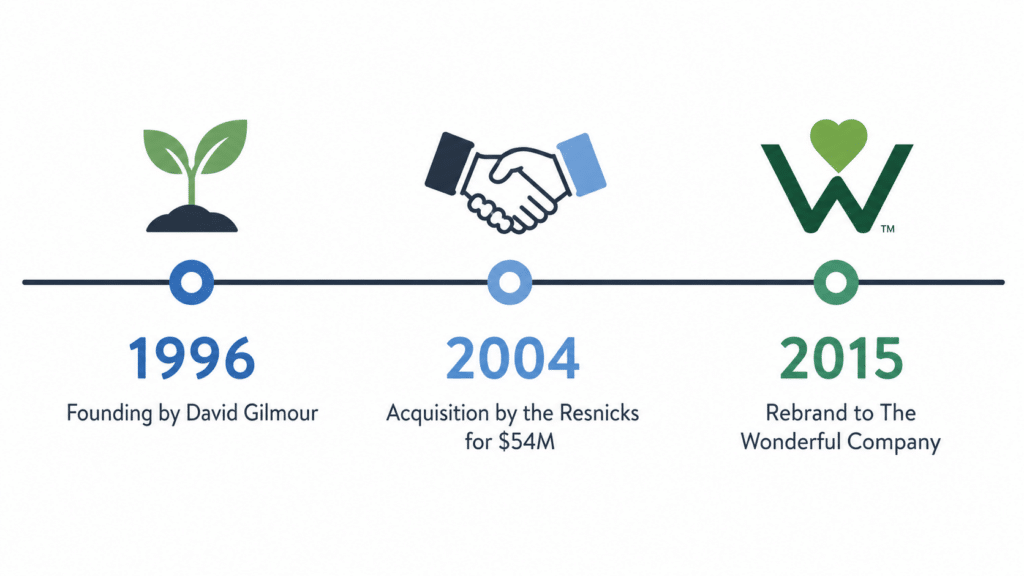
FIJI Water didn’t start as a Resnick venture. It was born from a different kind of entrepreneur with a different vision, and the acquisition in 2004 reshaped everything. The brand’s early identity was built on scarcity and geography, which made it an attractive buy.
David Gilmour And The 1996 Founding
Canadian businessman David Gilmour founded FIJI Water in 1996. Gilmour had already made his fortune through real estate and gold mining before turning his attention to Fiji and its natural water resources.
He saw an opportunity to build a premium bottled water brand before the category was crowded.
His vision was simple: bottle water from a remote, pristine source and sell it as something special.
Natural Waters Of Viti Ltd. And The Early Business
Gilmour launched the brand under the name Natural Waters of Viti Ltd. The company bottled water from an artesian aquifer on Viti Levu, the largest island in Fiji, and began exporting it internationally.
The early business was small but deliberate. Gilmour positioned the product at the top end of the market from day one. The square bottle, the tropical label, the “Earth’s finest water” messaging, all of it was built into the brand’s DNA before the Resnicks arrived.
The 2004 Acquisition And What It Unlocked
The Wonderful Company acquired FIJI Water in 2004 for a reported $50 million. Some sources place the figure closer to $54 million. Either way, it was a significant bet on premium bottled water at a time when the category was growing fast.
What the acquisition unlocked was scale. The Resnicks brought distribution muscle, marketing infrastructure, and a proven playbook for turning niche premium products into mainstream luxury staples.
Why FIJI Water Feels Luxurious
There’s a specific strategy at work behind FIJI Water’s premium positioning. I’d call it The Premium Scarcity Paradox, and it’s worth naming because it shows up across the Resnick portfolio in interesting ways.
The Premium Scarcity Paradox
The Premium Scarcity Paradox works like this: FIJI Water is widely available in thousands of retail locations, yet it still feels rare. That feeling of exclusivity comes from controlling the narrative around origin, not the actual supply.
The water comes from one place on Earth. You can’t get “Fiji water” from anywhere else. That geographic lock-in creates the psychological scarcity even when the product is sitting on shelves at your local Walmart.
Earth’s Finest Water And The Power Of The Slogan
FIJI Water uses the slogan “Earth’s finest water.” Four words that do a lot of work. The slogan doesn’t say “one of the best” or “a premium option.” It claims the top spot outright.
That kind of confident, superlative branding shapes how you perceive the product before you even taste it. The slogan pairs with the tropical imagery on the label to reinforce the idea that this water is categorically different from what comes out of your tap.
Square Bottle Design, Shelf Presence, And Perceived Value
The square bottle is one of the most recognizable packaging choices in the beverage industry. Most water bottles are round and cylindrical, blending into each other on the shelf. FIJI’s square silhouette breaks the visual pattern immediately.
Packaging research consistently shows that unusual shapes signal premium pricing to consumers. When your eye lands on a square bottle next to ten round ones, you perceive the square one as different, and different often reads as better.
How An Imported Water Brand Became A Status Signal
FIJI Water became a premium bottled water brand that celebrities, restaurants, and hotels reach for when they want to signal quality. Part of that is deliberate placement strategy. The Resnicks made sure FIJI Water appeared in the right contexts early on.
When a brand shows up consistently at award shows, on five-star dining tables, and in first-class cabins, those associations stick. You start to associate the bottle with a certain lifestyle, and that association is worth far more than the product itself.
Source, Geography, And Product Story
FIJI Water’s entire brand story rests on where the water comes from. Geography is the product, at least in the marketing sense. The facts behind the source are specific and worth knowing.
Yaqara Valley And Viti Levu Explained
The water is sourced from Yaqara, a valley on the north shore of Viti Levu. Viti Levu is the largest island in Fiji, and Yaqara sits in a relatively remote, rural part of it. The area’s rainfall filters through layers of volcanic rock before reaching the aquifer below.
That filtration process is central to the brand’s purity claims. The remoteness of the location is part of the story FIJI Water tells about itself.
The Artesian Aquifer And Brand Purity Claims
FIJI Water comes from a natural artesian aquifer, meaning the water is held underground under pressure. Artesian water doesn’t require pumping in the traditional sense; the natural pressure pushes water up when a well is drilled.
The brand markets this as a sign of purity. The water is described as untouched until the bottle is sealed. Whether that distinction matters for your health is a separate question from whether it matters for the brand, and it clearly does for the brand.
What Readers Should Know About Taste, Minerals, BPA, And Microplastics
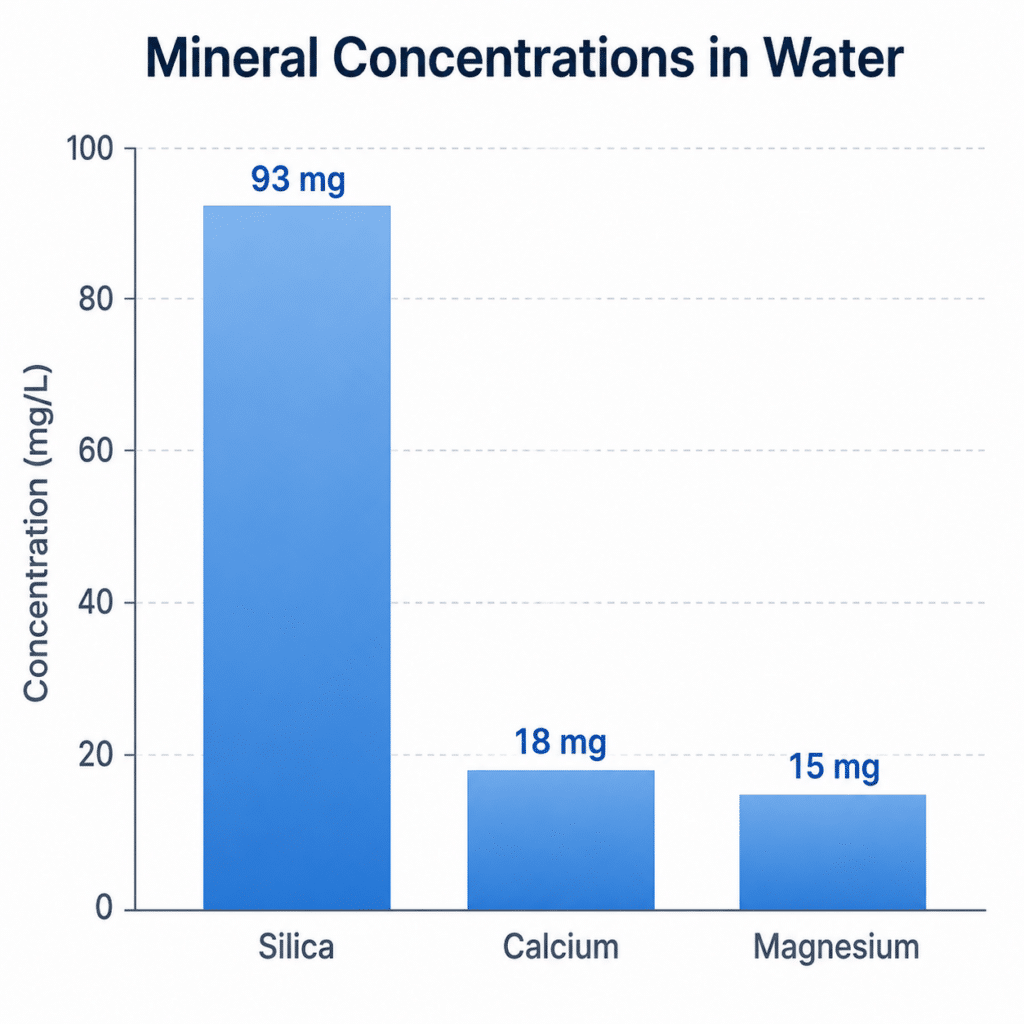
FIJI Water has a pH range of 7.3 to 7.7, which is slightly alkaline. It contains notable levels of silica (93 mg/L), calcium (18 mg/L), and magnesium (15 mg/L). Some people find the silica content gives it a smooth, soft taste compared to other bottled waters.
On the concern side, you should know a few things.
In January 2025, environmental watchdog group The Plastic Coalition filed a lawsuit against FIJI Water, claiming the product contains harmful microplastics and the chemical BPA, contradicting its “natural artesian water” marketing.
Also, in 2024, the FDA flagged a recall of nearly two million bottles due to elevated manganese levels and bacterial genera, though products were classified as not likely to cause adverse health consequences.
The Wonderful Company Ecosystem
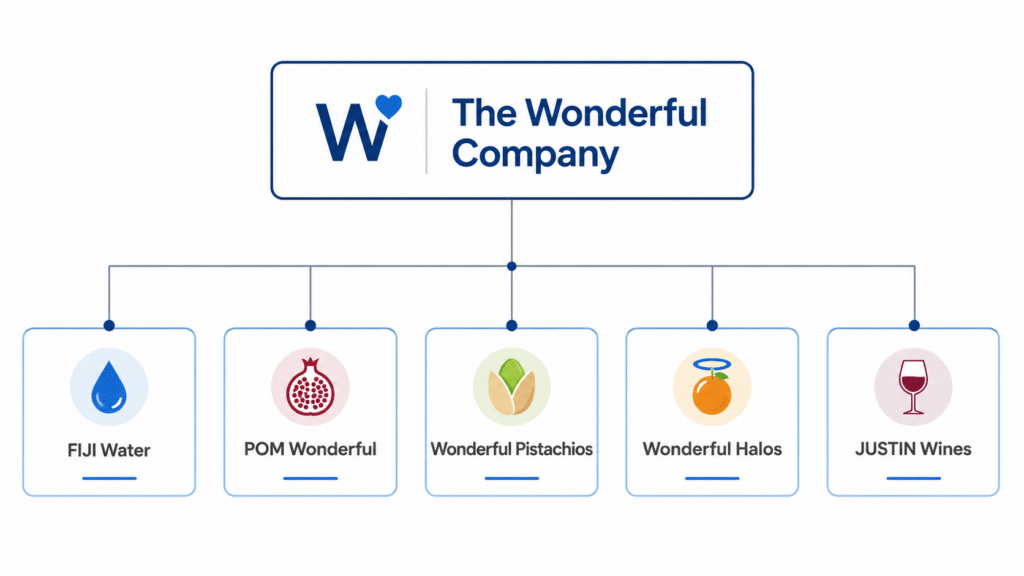
FIJI Water is one piece of a much larger puzzle. The Resnicks built The Wonderful Company around the idea that premium branding could be applied across categories. Water, fruit, nuts, wine, and flowers all live under the same roof.
How FIJI Water Fits The Resnick Portfolio
FIJI Water fits the Resnick portfolio because it follows the same formula: take a product with a compelling natural origin story, position it at the premium end of the market, and distribute it at scale.
The Resnicks apply this template across every brand they own. Each product is positioned as the best in its category, and each one reinforces the overall “Wonderful” brand identity.
As noted in coverage of the company’s structure, this cross-brand approach has made The Wonderful Company one of the most effective premium consumer goods operations in the US.
POM Wonderful, Wonderful Pistachios, And Wonderful Halos
Three of the most recognizable Resnick brands sit right next to FIJI Water on grocery shelves across America.
- POM Wonderful brought pomegranate juice into the mainstream by marketing its antioxidant content aggressively.
- Wonderful Pistachios became the best-selling pistachio brand in the US through memorable advertising campaigns.
- Wonderful Halos (also called Halos mandarins) turned clementines into a branded, premium fruit product.
Each brand shares the same DNA: a natural product elevated through marketing, packaging, and consistent messaging.
Teleflora, JUSTIN, Landmark, And Cross-Brand Leverage
The Resnick portfolio extends beyond food and beverage. Teleflora is one of the largest floral delivery services in the country. JUSTIN Vineyards and Winery and Landmark Wines bring premium wine into the mix.
FIJI Water’s connection to JUSTIN is particularly interesting because FIJI Water actually acquired JUSTIN Vineyards and Winery in 2010 before it was fully absorbed into The Wonderful Company’s portfolio.
The cross-brand leverage here is real: a company that sells luxury water, luxury wine, luxury nuts, and luxury fruit is building a coherent lifestyle identity across every aisle of the store.
Controversy, Taxes, And The Cost Of Shipping Water
Owning a brand that extracts water from a developing nation and ships it thousands of miles to wealthy consumers comes with reputational and logistical baggage. FIJI Water has faced criticism on multiple fronts.
Environmental Impact And Carbon Footprint
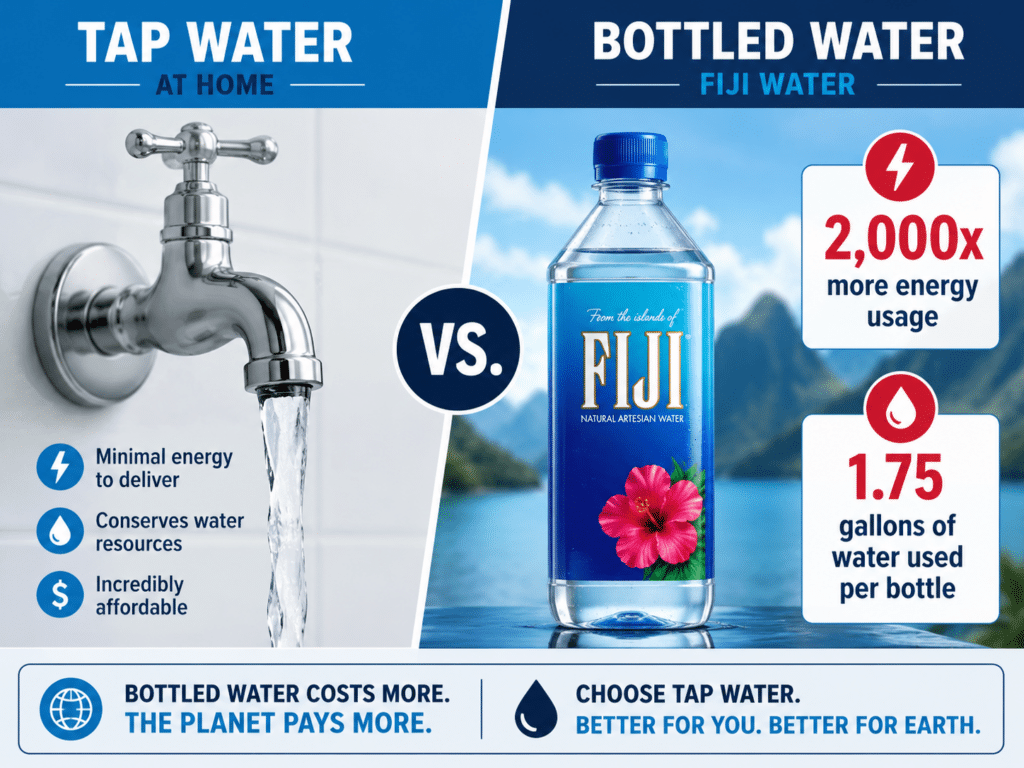
The environmental cost of FIJI Water is significant. Producing one bottle uses 1.75 gallons of water and roughly 2,000 times more energy than tap water, according to reporting by Fast Company. The factory machinery runs on diesel fuel.
The company announced plans in 2008 to plant natural forest to offset its carbon footprint. By 2019, only about 50% of the promised forest area had been planted. The company’s carbon-negative target reportedly won’t be met until at least 2037.
Disputes With The Fiji Government
The relationship between FIJI Water and the Fijian government has been tense at times.
In 2007 and 2008, disputes over export duties led to legal cases, impounded shipments, and a self-imposed shutdown of Fijian water bottlers.
The government eventually dropped a proposed 20-cent-per-liter tax.
Tensions flared again in 2010 when Fiji deported a FIJI Water executive for allegedly interfering in domestic affairs.
The government then raised the extraction tax significantly, pushing FIJI Water’s annual tax contribution from roughly F$500,000 to an estimated F$22.6 million.
As described in coverage of the brand’s ownership tensions, the Resnicks own the brand but the Fijian government controls the land and water rights.
The Fiji Water Foundation And Community Questions
FIJI Water established a foundation to provide water filters to rural Fijian communities. When the foundation launched, roughly 50% of rural Fiji lacked access to clean water.
By 2018, that figure had dropped to 12%, though it’s not clear how much of that improvement is directly tied to the foundation’s work versus broader infrastructure development.
Critics question whether a company profiting from Fiji’s water resources does enough to give back to the communities that live near the source.
The foundation is real, but the scale of FIJI Water’s exports versus its local community investment is a conversation that continues.
Frequently Asked Questions
Is FIJI Water owned by The Wonderful Company, and what does that mean for the brand?
Yes, FIJI Water is owned by The Wonderful Company, a privately held LLC based in Los Angeles, California. For the brand, that means it operates with significant marketing resources and distribution infrastructure behind it, without the pressure of public shareholder reporting.
How did Stewart and Lynda Resnick end up connected to FIJI Water?
Stewart and Lynda Resnick acquired FIJI Water in 2004 through their company, then called Roll Global. The acquisition brought the brand into their growing portfolio of premium consumer goods, where it joined products like POM Wonderful and eventually Wonderful Pistachios and Halos.
Is FIJI Water still a family-run company, or is it owned by a larger corporation now?
FIJI Water is owned by a larger private corporation, The Wonderful Company, which is itself controlled entirely by Stewart and Lynda Resnick. So in one sense it’s family-controlled, but it operates as a professionally managed corporate brand within a large portfolio.
What’s FIJI Water’s estimated value today?
As of early 2026, FIJI Water remains 100% privately held, so no public valuation exists. The Resnicks paid approximately $50 to $54 million for the brand in 2004, and its value has grown considerably given the global expansion of the premium bottled water category since then.
What happened with the David Gilmour sale, and how much did it go for?
David Gilmour, who founded FIJI Water under the name Natural Waters of Viti Ltd. in 1996, sold the brand to the Resnicks’ Roll Global in 2004. The reported sale price was approximately $50 million, though some accounts place it slightly higher at around $54 million.
What are the biggest controversies people bring up about the brand?
The main controversies include the brand’s environmental footprint (high energy use, plastic waste, slow carbon offset progress), tax disputes with the Fijian government, and a January 2025 lawsuit alleging the product contains microplastics and BPA despite being marketed as natural artesian water. A 2024 recall involving elevated manganese levels has also drawn attention.

I spent years working in tech and digital publishing, where I saw how quickly industries, brands, and consumer behavior can change. I created Rich Digest to explore the business behind luxury, from iconic products and influential founders to pricing, scarcity, ownership, and brand strategy. My goal is to make the world of luxury business clear, interesting, and easy to understand.