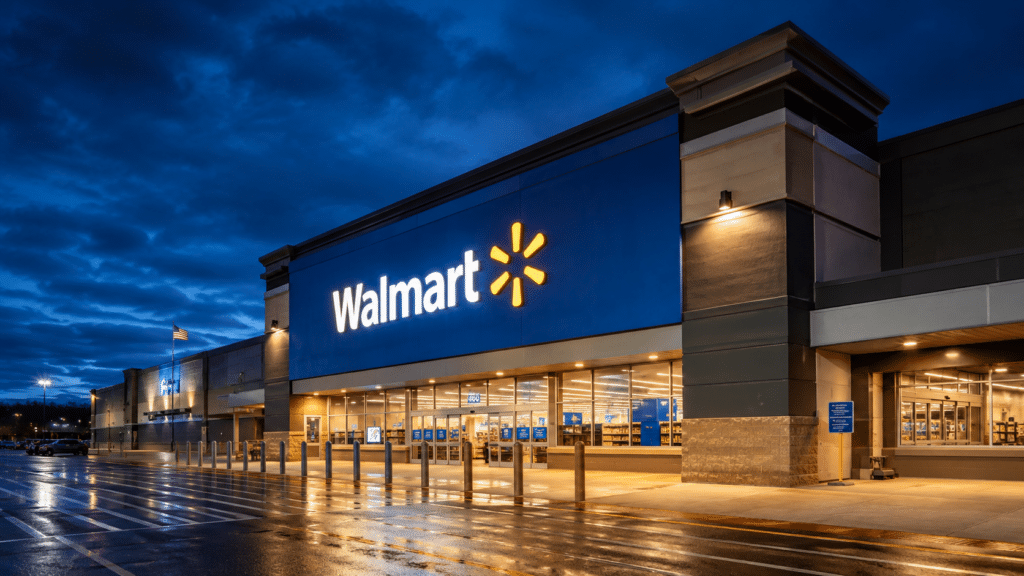
Walmart processes roughly 1 million customer transactions every hour. That number alone tells you something important about the scale this company operates at.
But the more interesting question isn’t how big Walmart is. It’s why it keeps winning, even as retail has been completely reshaped by e-commerce, shifting consumer habits, and aggressive competition.
The Walmart business model is built on a simple but brutally effective idea: strip out every unnecessary cost, use scale to pressure suppliers, and pass the savings to customers as lower prices. Repeat that cycle long enough and you build something that’s genuinely hard to displace.
What makes Walmart’s story worth studying in 2026 is that the company has done something most legacy retailers couldn’t: it stayed relevant.
It turned its physical footprint from a liability into a fulfillment weapon. It built a growing advertising business on top of its retail traffic.
And it’s using AI and supply chain data to get faster and leaner every year.
This article walks through how the revenue engine actually works, why the logistics network is the real moat, how EDLP holds up under competitive pressure, and where Walmart is placing its biggest bets going forward.
How The Revenue Engine Works
Walmart’s revenue comes from three core segments, each serving a distinct customer and purpose.
The mix of merchandise sales, membership fees, advertising, and financial services makes the model more diversified than it looks from the outside.
Core Segments And Revenue Mix
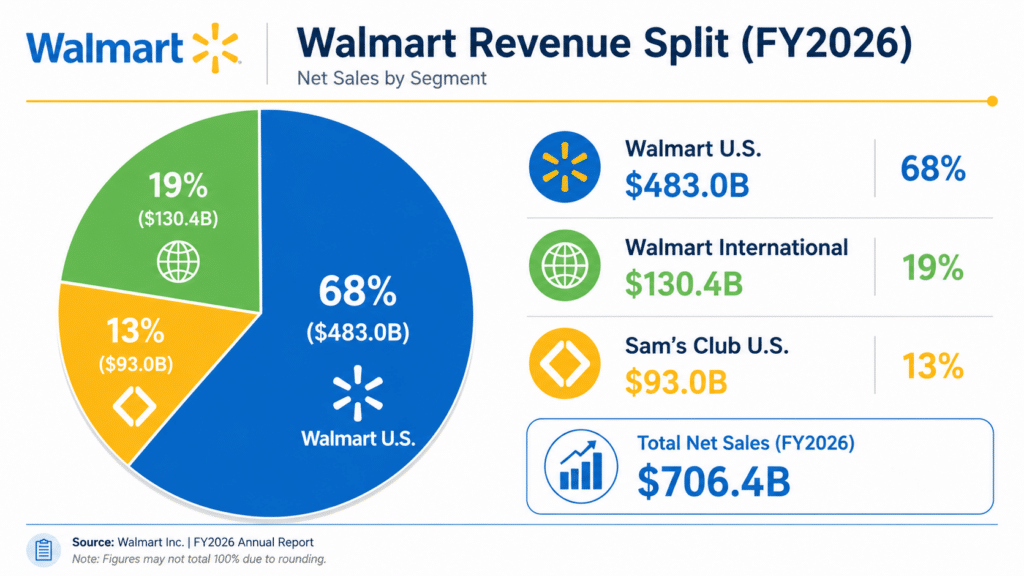
Walmart’s total revenue hit $674.5 billion in FY2025, making it the largest company in the world by revenue.
That number breaks down across three reported segments.
Walmart U.S. is the biggest piece by far. It covers all 50 states and includes Supercenters, Discount Stores, and Neighborhood Markets.
This segment drives the majority of net sales.
Walmart International covers operations across several countries, with significant presence in markets like Canada, Mexico (through Walmex), China, and India (through Flipkart).
It’s a smaller share of total revenue but strategically important for long-term growth.
Sam’s Club operates as a membership-only warehouse club in the U.S., running a model similar to Costco.
It generates revenue from both merchandise sales and annual membership fees.
| Segment | Key Revenue Driver |
|---|---|
| Walmart U.S. | Merchandise sales, Walmart Connect ads |
| Walmart International | Local retail sales, e-commerce |
| Sam’s Club | Merchandise + membership fees |
Merchandise Sales, Memberships, And New Profit Pools
Merchandise sales still account for the overwhelming majority of Walmart’s revenue.
Grocery is the largest category, followed by general merchandise and health and wellness products.
But the more interesting growth is happening elsewhere. Walmart+ memberships, launched in 2021, now bundle free delivery, Scan & Go, and fuel discounts for $98 per year.
It’s Walmart’s answer to Amazon Prime, and it drives repeat purchasing and higher basket sizes.
Then there’s Walmart Connect, Walmart’s retail media advertising platform.
Brands pay to reach Walmart’s massive shopper base with targeted ads, both on-site and off-site.
According to one analysis, this business is now approaching $5 billion in high-margin revenue.
That’s a fundamentally different profit profile than selling groceries at thin margins.
Financial services, including money transfers, check cashing, and prepaid cards, add another layer.
These services serve a large portion of Walmart’s customer base that’s underbanked or unbanked.
Who Owns Walmart And Why Governance Matters
Walmart is publicly traded on the NYSE under the ticker WMT, and you can find investor information at stock.walmart.com.
The Walton family, descendants of founder Sam Walton, still own roughly 45% to 50% of the company’s shares.
That level of family concentration is unusual for a company this size.
The practical effect is that Walmart’s leadership, currently under CEO Doug McMillon, can make long-term investments without the same short-term earnings pressure that public-company shareholders typically apply.
That ownership structure has helped Walmart absorb years of heavy investment in e-commerce and supply chain modernization before those bets fully paid off.
Return on investment and free cash flow have both improved as those investments matured, which has contributed to Walmart’s market capitalization crossing $1 trillion.
The Logistics Moat
Walmart’s supply chain isn’t just a back-end operation. It’s the actual source of the company’s pricing power.
The distribution network, inventory discipline, and cross-docking system work together to create cost advantages that compound over time.
Why Distribution Centers Became The Real Advantage
In the 1980s, most retailers relied heavily on wholesalers to get products from manufacturers to stores.
Walmart made a different bet. It built its own distribution centers and invested early in a private trucking fleet and proprietary inventory systems.
That decision paid off enormously. By owning the distribution layer, Walmart could move goods faster, track inventory more accurately, and cut out the middleman’s margin.
Today, Walmart operates over 150 distribution centers across the U.S., and the supply chain network covers more than 1,000 locations globally.
Distribution centers are strategically placed to minimize the distance between inventory and stores.
When you’re running over 4,600 domestic locations, that geographic precision matters enormously for cost and speed.
Cross-Docking And Inventory Discipline
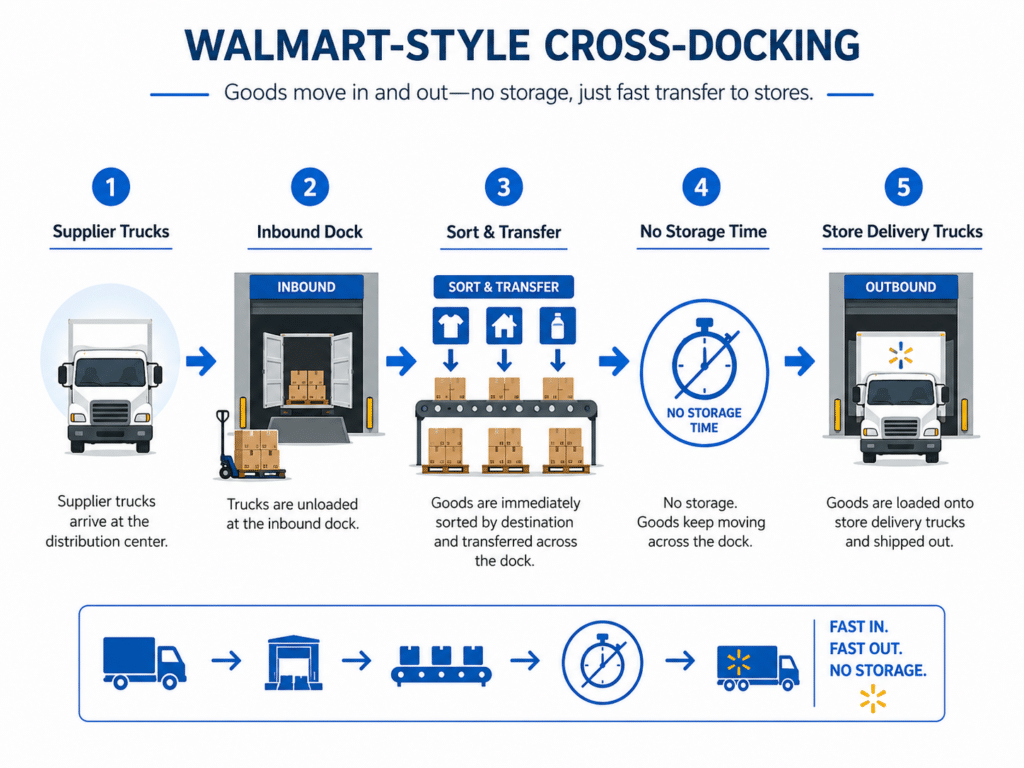
Cross-docking is one of the more underappreciated parts of Walmart’s cost leadership strategy.
The concept is straightforward: instead of storing goods in a warehouse and retrieving them later, products from suppliers arrive at a distribution hub and are immediately transferred to outbound trucks headed for stores.
Storage time drops to near zero.
This keeps inventory holding costs low and reduces the risk of stock sitting on shelves too long.
It also means Walmart needs less warehouse space per unit of goods moved.
Paired with sophisticated inventory management software, cross-docking lets Walmart respond quickly to demand shifts.
When a product starts selling fast in a specific region, the system can reroute supply before a stockout happens.
How Supply Chain Execution Supports Low Prices
The connection between supply chain efficiency and shelf prices is direct.
Every dollar saved in logistics is a dollar that can either improve margin or be passed on as a lower price.
For Walmart, the default is to pass it on.
Artificial intelligence now plays a growing role here.
Walmart uses AI-driven demand forecasting to improve inventory accuracy and reduce waste.
The recommendation engine also personalizes online shopping and improves conversion.
When supply chain disruptions happen, whether from natural disasters, trade restrictions, or geopolitical events, Walmart’s scale and network redundancy give it more resilience than most competitors.
It can reroute, source alternatives, and absorb shocks that would seriously damage a smaller retailer.
Scale, Supplier Power, And Everyday Low Prices
Walmart’s pricing strategy isn’t magic. It’s math.
The company uses its enormous buying volume to extract better terms from suppliers, then runs those savings through a lean cost structure and out the door as low prices.
Cost leadership and EDLP are two sides of the same flywheel.
The Economics Of Cost Leadership
When you’re doing $674 billion in annual revenue, you have leverage that most businesses can’t imagine.
Walmart is often the single largest customer for many of its suppliers.
That position gives it the ability to negotiate pricing, packaging, logistics terms, and payment schedules in ways that favor Walmart’s cost structure.
Suppliers who want shelf space in Walmart’s stores have to work within Walmart’s system.
That includes sharing sales data in real time and often co-investing in supply chain efficiency.
The result is a cost structure that smaller retailers simply can’t replicate, no matter how hard they try.
Buying Power And Economies Of Scale
Economies of scale show up at every level.
Walmart buys more toilet paper, more chicken, more motor oil than almost any other buyer on earth.
The per-unit cost it pays is lower than what a regional grocery chain could negotiate.
That gap is the pricing moat.
Fixed costs like distribution infrastructure, technology systems, and advertising also get spread across a much larger revenue base.
That means Walmart’s cost per dollar of sales is structurally lower than a competitor operating at one-tenth the size.
Walmart’s main motto is to “lead on price, invest in differentiating on access, be competitive on assortment, and deliver a great experience”.
That’s a practical operating philosophy, not a marketing slogan.
EDLP, Price Matching, And Customer Loyalty
Everyday Low Prices (EDLP) is Walmart’s commitment to keeping prices consistently low rather than cycling through sales and promotions.
The companion principle, Everyday Low Cost (EDLC), is the internal discipline that makes EDLP possible by constantly pushing to reduce operating expenses.
I think this is actually what separates Walmart from most competitors. Promotional pricing creates spikes and complexity.
EDLP simplifies operations and builds customer trust over time.
When you know Walmart’s price is reliably low, you don’t have to shop around.
During periods of inflation, that trust becomes even more valuable.
Consumer confidence tends to flow toward predictable, low-cost options when household budgets tighten.
Walmart’s EDLP strategy positions it well for exactly those environments.
Brand recognition and customer loyalty reinforce the cycle: low prices bring traffic, traffic brings volume, and volume funds even lower prices.
Stores As An Omnichannel Fulfillment Network
Walmart’s physical stores used to be its biggest advantage and, more recently, its perceived weakness against Amazon.
What’s happened instead is that Walmart turned its store footprint into an omnichannel asset.
The density of its locations gives it a fulfillment capability that a pure-play e-commerce company can’t easily replicate.
From Supercenters To Neighborhood Markets
Walmart operates several distinct store formats, and each serves a different purpose in the network.
- Walmart Supercenters are the flagship format, averaging around 178,000 square feet.
They carry full grocery departments alongside general merchandise.
- Discount Stores are smaller, focused on general merchandise with a limited food selection.
- Neighborhood Markets are grocery-focused stores, roughly 38,000 square feet, designed for quick shopping trips in urban and suburban locations.
This range of formats lets Walmart serve customers across different shopping occasions and densities.
A Supercenter serves a suburban family stocking up for the week.
A Neighborhood Market serves a city resident grabbing dinner ingredients.
Using Physical Footprint To Win On Access
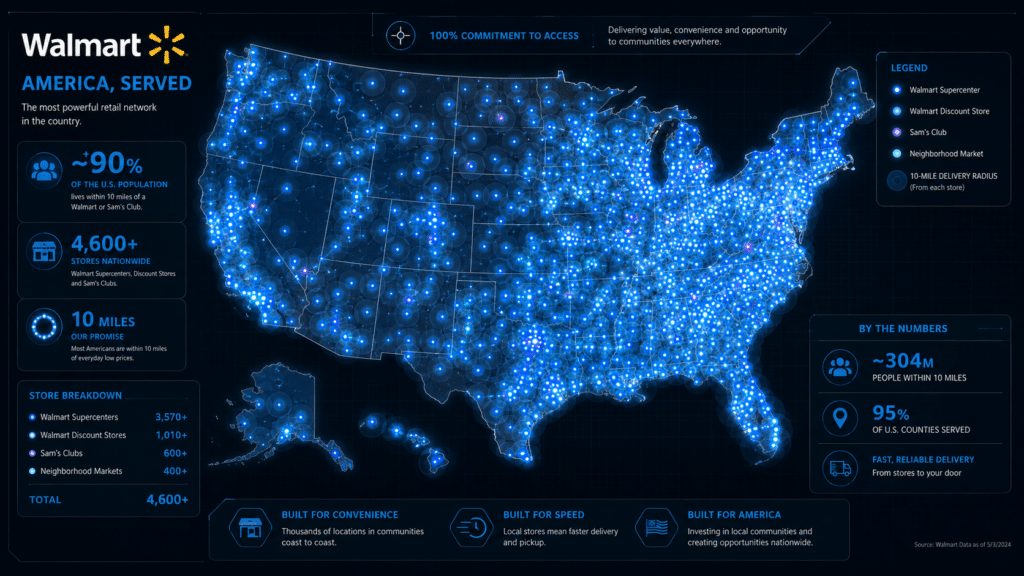
Here’s the strategic math: Walmart stores are within 10 miles of roughly 90% of the U.S. population. That proximity is a logistics advantage that would cost billions to build from scratch.
When a customer places an online order, a nearby store can serve as the fulfillment center. That cuts delivery times and costs dramatically compared to shipping from a centralized warehouse.
Walmart has transformed over 4,700 stores into fulfillment hubs, enabling same-day delivery and curbside pickup at scale.
This is where Walmart’s e-commerce strategy is actually smart. Rather than competing with Amazon on pure logistics infrastructure, it used what it already had.
The Customer Experience Across Store And App
The Walmart app ties the physical and digital experience together. You can browse inventory, build a cart, schedule curbside pickup, or track a delivery in one place.
Scan & Go, a feature available to Walmart+ members, lets you scan items as you shop and skip the checkout line entirely.
The UX isn’t perfect, and I’ve noticed the app can still feel clunky in places. But the integration between online orders, in-store pickup, and home delivery is genuinely useful.
The goal is to make the shopping experience feel seamless regardless of how you choose to shop, and Walmart is closer to that goal than most give it credit for.
Competing With Amazon, Target, And Costco
Walmart doesn’t face one type of competitor. It faces multiple rivals with different strengths, and each one pressures a different part of the model.
The competitive picture in 2026 is more nuanced than a simple “Amazon vs. Walmart” narrative.
Where Walmart Has The Edge
Grocery is Walmart’s clearest advantage. No competitor matches its combination of price, convenience, and physical reach in food retail.
Amazon’s grocery business (Whole Foods plus Amazon Fresh) still hasn’t cracked the mainstream, and Target’s grocery selection is limited compared to a full Supercenter.
In e-commerce, Walmart’s global e-commerce grew 22% in Q1 of a recent quarter, powered largely by store-fulfilled delivery.
The store-as-warehouse model is something Amazon can’t replicate without a physical footprint it doesn’t have.
Market share in total U.S. retail remains firmly with Walmart. Among the top retailers, Walmart, Amazon, and Costco have captured over half of recent retail growth, squeezing mid-tier players hard.
Where Rivals Pressure The Model
Amazon has the edge in pure e-commerce assortment, speed for Prime members, and the breadth of its marketplace. For non-grocery online shopping, many consumers still default to Amazon first.
Target competes effectively in the mid-range general merchandise space, particularly in apparel, home decor, and beauty. Its stores are perceived as a more pleasant shopping environment by a certain customer segment.
Target’s brand positioning skews slightly more upscale, which creates a different but real competitive pressure.
Costco competes directly on bulk groceries and household staples, and its membership renewal rates are famously high.
The comparison between Costco and Walmart often comes down to shopping frequency and trip size, with Costco winning the large-format bulk buyer.
What Sam’s Club Adds To The Competitive Set
Sam’s Club gives Walmart a direct answer to Costco’s membership model. Sam’s Club membership fees create a recurring revenue stream that’s largely profit, since the club business operates on thin merchandise margins by design.
I think Sam’s Club is more strategically important than it sometimes gets credit for. It serves a higher-income, more engaged customer than the typical Walmart shopper, and its membership growth has been strong.
Sam’s Club also competes with Costco and Amazon Business in the small-business buyer segment, which is a growing market. The membership model builds loyalty and makes switching costs real.
Growth Bets, International Moves, And Strategic Risks
Walmart’s core business generates enormous free cash flow, and the company is putting that capital to work in several directions simultaneously. Some of these bets are already paying off.
Others carry meaningful risk.
Marketplace, Advertising, And Higher-Margin Expansion
Walmart’s online marketplace, which allows third-party sellers to list products on Walmart.com, is a direct play to expand assortment without owning the inventory. Sellers pay referral fees, which are high-margin revenue for Walmart.
This mirrors what Amazon built with its third-party seller platform, and it’s growing fast.
Walmart Connect, the retail media advertising business, is the highest-margin growth story inside the company right now. Brands pay premium rates to reach shoppers with high purchase intent, and Walmart’s transaction data makes that targeting precise.
As noted in a recent business strategy analysis, Walmart is explicitly focused on growing profit faster than sales, which means higher-margin revenue streams like advertising are central to the plan.
These new profit pools matter because they improve the economics of the whole business, not just the margin line.
Global Expansion, Acquisitions, And Divestitures
Walmart International has been strategically reshaped over the past decade. The company exited markets where it couldn’t compete effectively and doubled down on those with clearer paths to profitability.
The acquisition of Flipkart in India was the most significant international bet. India’s e-commerce market is one of the fastest-growing in the world, and Flipkart gives Walmart a platform-native foothold rather than a traditional retail one.
Walmart’s international strategy now blends acquisitions, local partnerships, and format adaptation rather than just exporting the U.S. Supercenter model.
Divestitures have been equally important. Exiting underperforming markets in Japan and the UK freed up capital for higher-priority investments.
A Practical SWOT Analysis For 2026
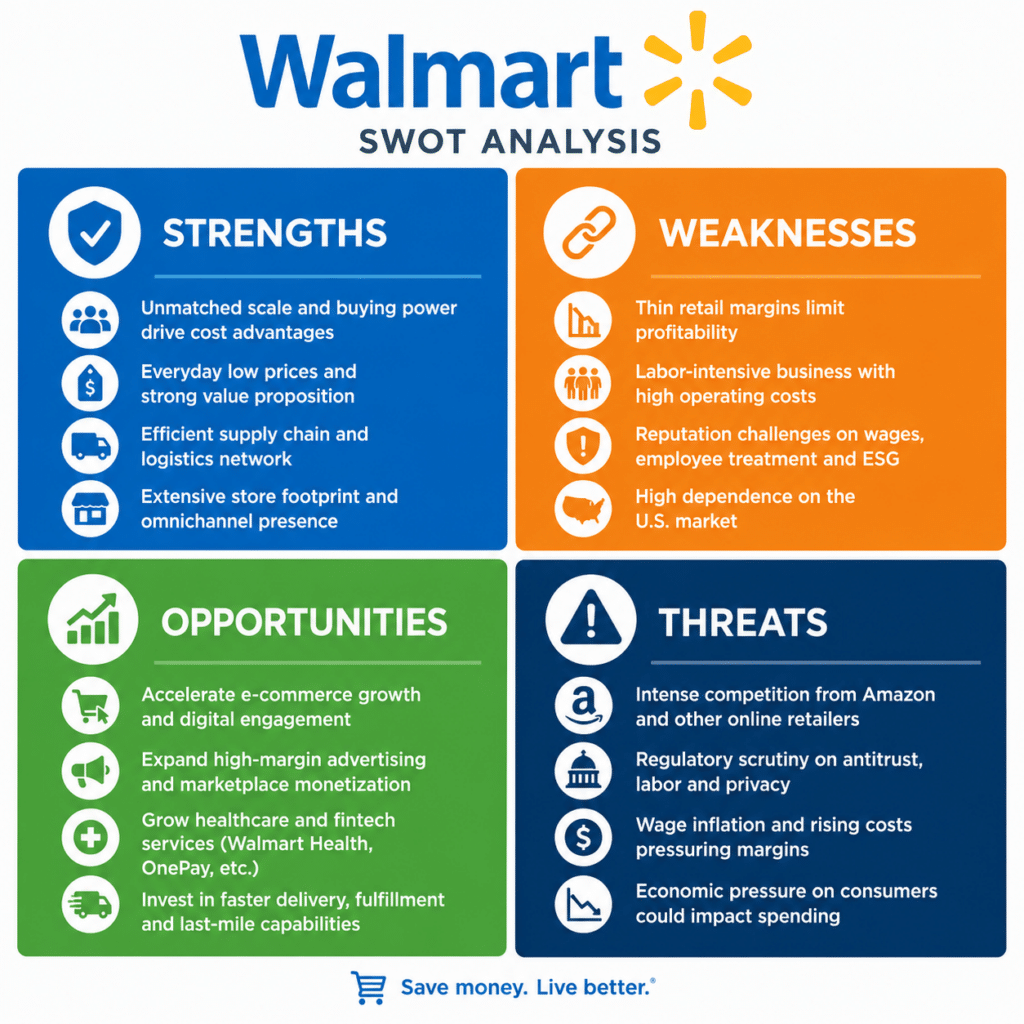
Strengths:
- Largest retailer in the world by revenue
- Unmatched grocery distribution and physical reach
- Growing high-margin revenue in advertising and memberships
- Resilient supply chain with AI-driven optimization
Weaknesses:
- Thinner margins than Amazon or Costco on a per-sale basis
- E-commerce UX and third-party marketplace still trail Amazon
- Brand perception skews budget-conscious, limiting premiumization
Opportunities:
- Retail media advertising still in early growth stages
- India and other emerging markets via Flipkart and Walmart International
- Walmart+ membership expansion and deeper ecosystem integration
- AI-driven supply chain improvements continue to reduce operating costs
Threats:
- Supply chain disruptions from trade restrictions or geopolitical events
- Consumer confidence shocks or sustained inflation compressing discretionary spending
- Amazon’s continued e-commerce dominance and Prime ecosystem stickiness
- Regulatory scrutiny on marketplace practices and supplier relationships
A fuller look at Walmart’s competitive positioning and SWOT in 2026 shows a company with real strengths and real risks, which is an honest picture of any business operating at this scale.
Frequently Asked Questions
How does Walmart actually make most of its money?
Most revenue comes from merchandise sales across Walmart U.S., International, and Sam’s Club, with grocery as the largest category. High-margin streams like advertising and Walmart+ fees are growing but remain a smaller portion of the total revenue engine.
What are Walmart’s main revenue streams and cost drivers?
Revenue flows from merchandise, memberships, advertising, and financial services. Major costs include goods sold, logistics, labor, and technology. Maintaining a lower cost structure than competitors is essential to Walmart’s revenue model.
What’s the key strategy behind Walmart’s everyday low prices?
Everyday Low Prices (EDLP) is powered by Everyday Low Cost (EDLC). Walmart leverages massive scale to negotiate lower supplier prices, passing savings to customers. This consistency builds the trust that drives the high volume necessary for the model to work.
How does Walmart’s supply chain and logistics setup give it an edge?
Walmart’s logistics edge comes from proprietary distribution centers and cross-docking. These assets, plus AI-driven forecasting, allow Walmart to move goods more cheaply than rivals, keeping shelf prices lower than anyone else can match.
How has Walmart adapted its approach for e-commerce and omnichannel shopping?
Walmart uses its 4,700+ stores as fulfillment hubs for same-day delivery and pickup. Being within 10 miles of 90% of Americans provides a last-mile advantage that warehouse-only models can’t beat, all integrated through the Walmart app.
What does Walmart’s business model canvas look like in plain English?
Walmart focuses on high-volume, low-margin sales supported by a massive supply chain. The model monetizes demand across stores and digital channels through merchandise, memberships, and advertising, providing reliable access to goods at the lowest possible prices.

I spent years working in tech and digital publishing, where I saw how quickly industries, brands, and consumer behavior can change. I created Rich Digest to explore the business behind luxury, from iconic products and influential founders to pricing, scarcity, ownership, and brand strategy. My goal is to make the world of luxury business clear, interesting, and easy to understand.