
Jeff Bezos had a habit that made Amazon executives nervous. He read customer complaint emails. Not summaries, not reports, not dashboards. Actual emails from real customers.
When he saw something that felt wrong, he didn’t write a memo or schedule a meeting. He forwarded the email to whoever owned that part of the business with a single character in the body: ?
The Jeff Bezos question mark email is one of the most studied management tools in modern business history: a customer complaint forwarded directly from the CEO with nothing but a question mark, which immediately triggered an escalation inside Amazon.
That one punctuation mark carried enormous weight. It told the recipient that Bezos had seen a real problem, that he expected answers, and that this was now their top priority. No explanation needed.
What makes this interesting is how much it reveals about Amazon’s culture and how Bezos thought about accountability, customer experience, and the limits of data.
What The Email Actually Looked Like Inside Amazon
The question mark email worked because of its simplicity and because of who it came from. The mechanics were straightforward, but the organizational pressure behind it was anything but simple.
How A Customer Complaint Reached The Top
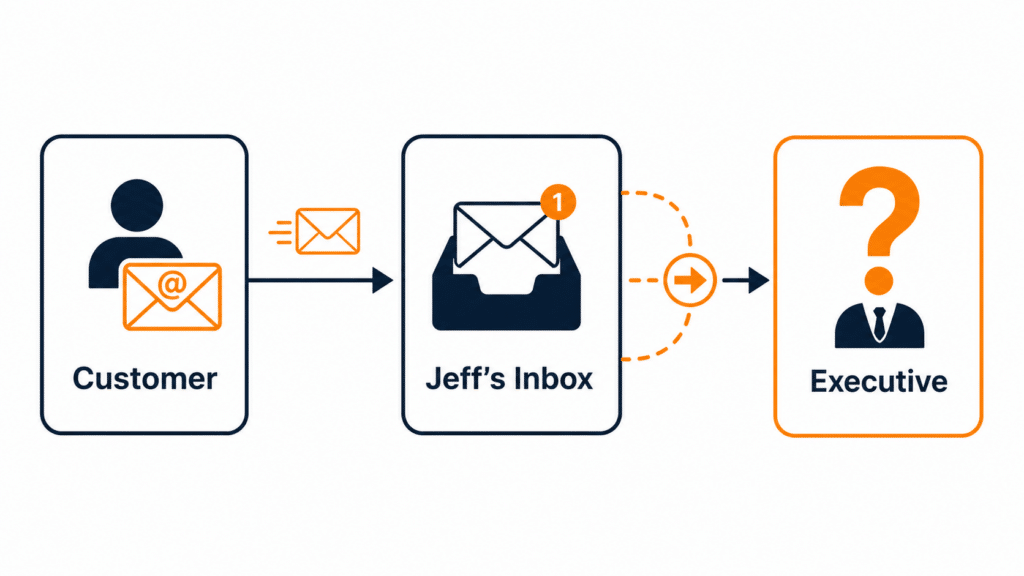
Bezos made his email address public. Customers could write to [email protected], and according to the AWS Executive in Residence Blog, he actually read those emails.
As Amazon grew, the volume got too large to read everything, so he trained people on his team to flag anomalies, real customer experiences that didn’t match what the data was showing.
Those flagged emails would land back with Bezos. If something caught his attention, he’d act immediately.
Why A Single Character Triggered Immediate Action
When the forwarded email arrived with just a “?” in the body, the recipient knew exactly what it meant. According to Quartz, former Amazon employees described the experience as stopping whatever they were doing to focus entirely on the problem.
Work would halt. The team would investigate the specific customer complaint, trace what went wrong, and report back to Bezos with a full explanation.
The pressure wasn’t just about solving one complaint. The expectation was that you’d figure out if the problem was widespread.
Bezos’s Own Explanation Of The Shorthand
Bezos has addressed this practice publicly. Speaking at the George W. Bush Presidential Center, he explained: “I still have an email address customers can write to.
I see most of those and I forward them to the executives in charge of the area with a question mark.” He called it shorthand for “can you look into this?” which, coming from the CEO, meant something much stronger than a casual request.
Why This Became A Powerful Accountability System
The real significance of the question mark email isn’t the email itself. It’s what the practice built over time: a cultural reflex where no one at any level could stay too comfortable with aggregate numbers and ignore what individual customers were actually experiencing.
The Single-Character Escalation Model
You can think of this as the Single-Character Escalation Model: using the minimum possible signal to create maximum organizational response. One character from the CEO carried more urgency than a five-page report from a middle manager.
The brevity was intentional. A question mark requires the recipient to do all the thinking, all the investigating, and all the explaining. Bezos didn’t tell you what was wrong. He told you to figure it out.
This model worked because the authority behind the signal was absolute. The same email from a junior employee would have been ignored or quietly rerouted. From Bezos, it triggered immediate action.
How It Cut Through Bureaucracy
Large organizations tend to filter bad news upward very slowly. By the time a serious customer complaint surfaces in an executive dashboard, it’s been averaged, categorized, and deprioritized.
The question mark email bypassed all of that. A single customer experience went directly from inbox to CEO to the responsible team in hours, sometimes minutes.
That kind of speed is almost impossible to manufacture through formal processes alone.
Why Executives Couldn’t Hide Behind Reports
Reports can be framed. Metrics can be explained away. A forwarded customer email with a question mark cannot. The complaint is right there, in the customer’s own words.
There’s no buffer between the executive and the reality of what a customer went through. That’s a harder thing to rationalize or minimize.
Customer Obsession In Practice
Amazon’s official Leadership Principles define customer obsession as starting with the customer and working backwards.
The question mark email was one of the clearest expressions of what that actually looks like in practice.
Why Bezos Prioritized Customers Over Competitors
One of Amazon’s stated principles is that leaders pay attention to competitors but obsess over customers. Bezos believed that spending too much energy watching what rivals were doing left you reactive rather than proactive.
The question mark email reinforced this by keeping executive attention anchored to specific customer experiences rather than competitive strategy sessions.
If a customer couldn’t get a refund easily or a package arrived damaged, that mattered more to Bezos than what a competitor was launching that quarter.
When Anecdotes Beat Metrics
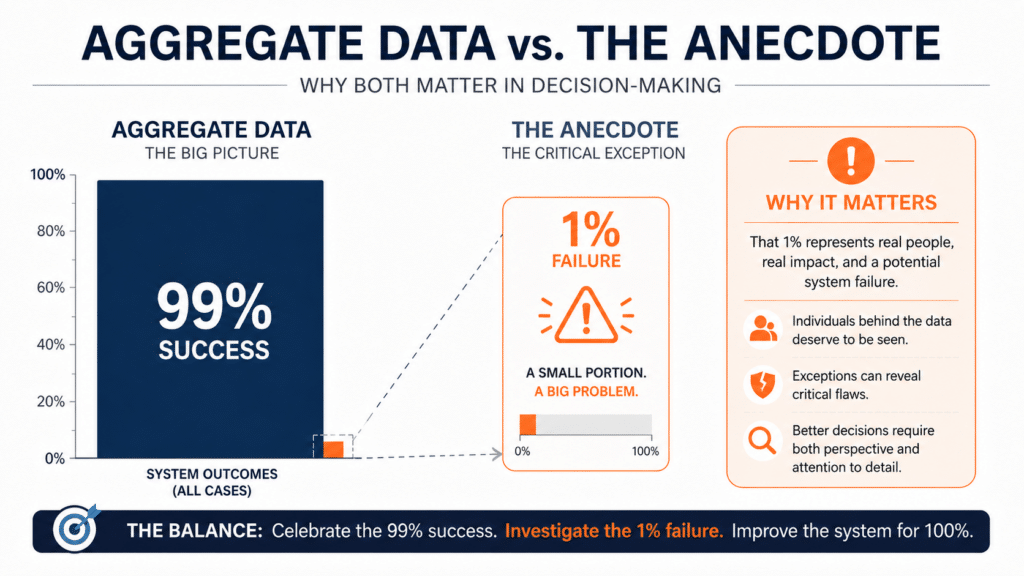
This is one of the counterintuitive insights behind the practice. Data tells you what happened on average. A single customer story can tell you what’s broken in a way that aggregate numbers sometimes mask.
As noted by the AWS blog, the investigation triggered by a question mark email often revealed that many customers had experienced the same issue, which would have gone unaddressed without that one forwarded complaint.
A metric showing “97% customer satisfaction” can hide the 3% who are furious and telling everyone they know.
How Front-Line Pain Shaped Better Decisions
When executives are forced to trace a specific complaint back through their systems, they often discover process failures that weren’t visible from the top.
The question mark email essentially made senior leaders do the kind of investigation that usually falls to junior employees. That exposure to operational reality shaped how decisions got made.
What This Reveals About Amazon’s Culture
Amazon is frequently described as a demanding place to work. The question mark email is part of why.
It created a culture where no one at any level could fully relax, because a single customer complaint could land on your desk directly from the CEO with no warning.
High Standards And Constant Escalation
Amazon operates with what it calls “high standards,” and the question mark email enforced those standards in a very direct way. There was no grace period where a recurring problem could quietly persist.
If a customer experienced it and emailed Bezos, the clock started immediately. That kind of pressure tends to produce sharp operational responses, but it also means the organization is always in a state of alert.
Why The Method Created Pressure Alongside Speed
The speed the question mark email created came with a cost. According to former employees, receiving one was stressful.
Even if the problem turned out to be minor, the process of investigating it, assembling a response, and reporting back to the CEO was high-stakes work that interrupted everything else. Over time, that pattern becomes part of the culture’s texture.
The Tradeoff Between Responsiveness And Stress
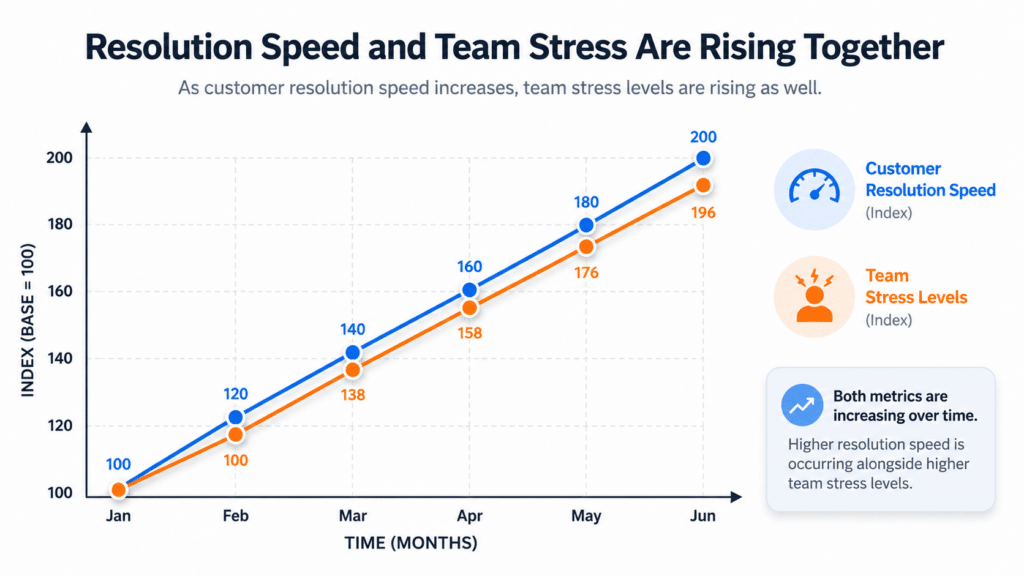
There’s a genuine tension here. A company that responds fast to individual customer problems is genuinely better for customers.
But the mechanism that creates that responsiveness can also create a kind of anxiety that doesn’t always bring out the best thinking in people.
When you’re panicking, you’re not always solving the root problem. You’re often just solving it fast enough to satisfy the CEO this time.
That tradeoff is worth being honest about when you’re thinking about whether this approach fits your organization.
How The Story Spread And Why It Stuck
The question mark email became widely known outside of Amazon because a few key sources brought the story to a broader audience, and because it captured something real about how Bezos thought.
Brad Stone And The Everything Store
Much of what the public knows about Amazon’s internal culture comes from Brad Stone’s book The Everything Store, which documented Amazon’s rise and Bezos’s management philosophy in detail.
Stone’s reporting helped establish the question mark email as a serious leadership practice rather than just an interesting anecdote.
The book gave context for why the method made sense within Amazon’s broader cultural framework.
How Business Insider Helped Popularize The Anecdote
Business Insider covered Bezos’s explanation of the practice after his talk at the George W. Bush Presidential Center, which helped bring the story to a mainstream business audience.
Once the CEO himself explained the method on the record, it became a reference point for conversations about leadership accountability and customer focus across industries.
Why The Method Became A Modern Leadership Reference Point
The story stuck because it’s simple, memorable, and easy to visualize. You don’t need an MBA to understand what it means when the CEO forwards your customer’s complaint with a question mark.
It became a shorthand for a bigger idea: that leadership accountability works best when it’s direct, specific, and impossible to ignore.
What You Can Learn From It Without Copying It Literally
You probably aren’t Jeff Bezos, and your team probably isn’t an Amazon executive team bracing for a question mark email every morning.
The literal practice doesn’t transfer to most organizations, but the principle behind it absolutely does.
How To Build Faster Escalation Loops
The core idea is that customer problems should reach decision-makers faster than most systems allow. You don’t need a CEO forwarding emails to make this happen.
You can build faster escalation loops by creating a direct channel where real customer complaints get reviewed by someone with the authority to fix them, not just logged and categorized.
Even a weekly ritual where a senior leader reads raw customer feedback without filters can have a meaningful effect on organizational awareness.
What A Better Version Looks Like For Smaller Teams
For a small team, the question mark email approach can be adapted more gently. You might designate one person to flag the week’s most significant customer complaint and bring it directly to a leadership discussion.
The goal is the same: make sure real customer experiences inform decisions at the top, not just smoothed-out metrics.
The key is that someone with authority actually sees the raw experience. Not a summary. Not a score.
Where This Approach Fits And Where It Can Backfire
This works best when your organization has enough operational maturity to actually investigate and fix problems quickly.
If your team is already overwhelmed, adding a high-urgency escalation channel can create chaos rather than clarity.
It also works better when the culture already trusts that escalations are about solving problems, not assigning blame.
If your team treats the question mark as punishment, the fear response undermines the learning response.
Frequently Asked Questions
What’s the actual email address people say belongs to Jeff Bezos, and is it real?
Bezos’s public address was [email protected]. Since he is no longer CEO, it is no longer a direct line. Messages sent there now go to Amazon’s team rather than Bezos personally.
Why do I keep seeing emails with a question mark symbol in the address or subject line?
This is usually caused by encoding issues or technical formatting problems, unrelated to Bezos’s management method. In unsolicited messages, it is often a phishing indicator rather than anything connected to Amazon leadership.
How can I tell if an email claiming to be from Jeff Bezos is a scam?
Bezos is no longer CEO and does not contact consumers directly. Emails asking for money, personal info, or prizes are scams. Legitimate Amazon communication uses official @amazon.com domains and never requests payment through unusual channels.
Is it safe to reply to or forward an email that looks like it came from a Bezos address?
Interacting with suspicious emails is inadvisable. Scammers use replies to confirm active accounts, leading to more targeted attacks. If an email seems suspicious, do not engage with it at all.
What should I do if I already clicked a link in a suspicious message that mentioned Bezos?
Change your passwords immediately, especially for Amazon and linked accounts. Run a security scan, monitor financial accounts for unusual activity, and contact your bank if you shared any payment information.
How do you report a fake Bezos email to Amazon or the right authorities?
Forward impersonation emails to [email protected], Amazon’s official reporting address. You can also report scams to the FTC at reportfraud.ftc.gov. Reporting helps protect others from similar schemes.

I spent years working in tech and digital publishing, where I saw how quickly industries, brands, and consumer behavior can change. I created Rich Digest to explore the business behind luxury, from iconic products and influential founders to pricing, scarcity, ownership, and brand strategy. My goal is to make the world of luxury business clear, interesting, and easy to understand.