Gucci is owned by Kering, a French luxury conglomerate founded by billionaire François Pinault.
That’s the short answer, but the full story is a lot more interesting.
Kering holds 100% of Gucci through its subsidiary Guccio Gucci S.p.A., and the Pinault family controls Kering itself through a holding company called Groupe Artémis.
So when you buy a Gucci bag, your money travels up through one of the most powerful family-controlled corporate structures in global fashion.
Gucci didn’t start out as a corporate asset.
It was a small leather goods shop in Florence, Italy, founded in 1921.
It passed through family hands, survived feuds and scandals, and eventually made its way through a series of ownership changes before landing inside Kering’s portfolio in the early 2000s.
That journey tells you a lot about how luxury fashion actually works today.
Kering’s model is worth paying attention to.
The group acquires heritage brands with strong identities, provides financial firepower and global infrastructure, and lets each brand maintain its own creative voice.
Gucci keeps its Italian soul.
Kering handles the scaling.
That balance between artisanal mystique and corporate muscle is exactly how modern luxury conglomerates operate.
Who Controls Gucci Today
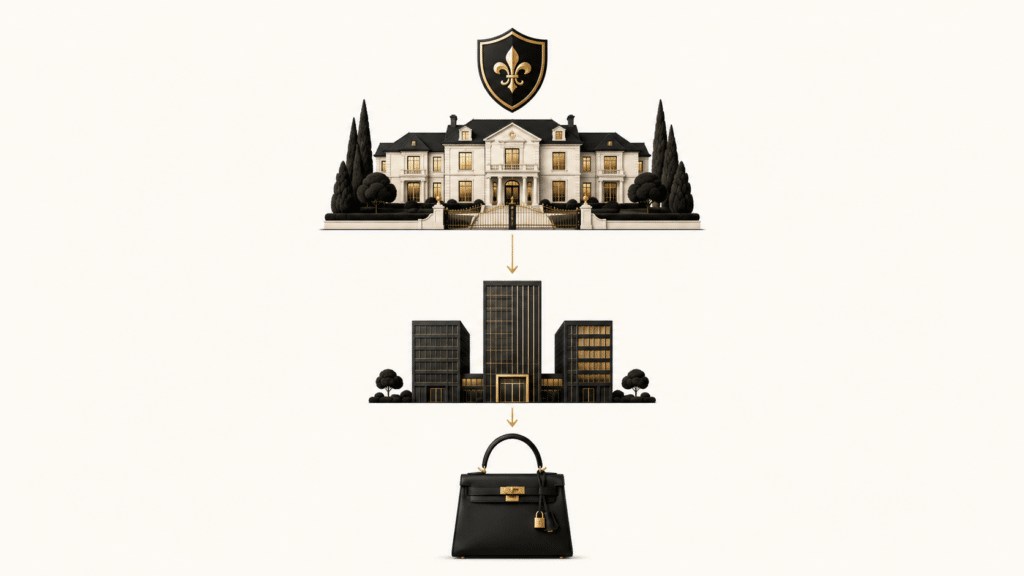
Kering owns Gucci outright, and the Pinault family controls Kering through Groupe Artémis.
Gucci has no independent stock listing, meaning you can’t buy a share in it directly.
Kering’s Full Ownership Of Gucci
Kering S.A. is the sole owner of Gucci, holding the brand as a wholly owned subsidiary through Guccio Gucci S.p.A.
There is no partial ownership, no minority stakeholders, and no joint venture.
Kering acquired full control in 2004 after a prolonged corporate battle that started in 1999.
As a luxury group, Kering provides Gucci with access to global distribution networks, shared services, and the financial stability to invest in campaigns, retail expansion, and product development.
Gucci operates with significant creative autonomy inside that structure.
How The Pinault Family Controls Kering Through Artémis
Kering itself is a publicly traded company listed on Euronext Paris, but being publicly listed doesn’t mean the public runs it.
The Pinault family controls Kering through Groupe Artémis, their private investment holding company.
Artémis owns roughly 42% of Kering’s share capital but holds a larger share of voting rights, which gives the family strategic control over major decisions.
François-Henri Pinault serves as Chairman and CEO of Kering, continuing his father François Pinault’s legacy of building the group from a retail business into a global luxury powerhouse.
Why Gucci Is Not Independently Publicly Traded
Gucci does not trade on any stock exchange on its own.
If you want financial exposure to Gucci, your only path is buying shares in Kering on Euronext Paris.
This structure is common among major luxury brands.
Keeping Gucci inside a larger group protects its brand positioning and shields it from the short-term pressures that come with being an independently listed company.
It also gives Kering full strategic control over how Gucci grows, where it opens stores, and how it positions itself in the global luxury market.
How Gucci Moved From Family Ownership To Kering
Gucci’s path from a Florentine family business to a corporate subsidiary spans about 80 years and includes a murder, a hostile takeover attempt, and a bidding war between two of the world’s biggest luxury conglomerates.
The brand changed hands multiple times before Kering locked in full ownership in 2004.
From Guccio Gucci To The Gucci Family
Guccio Gucci founded the brand in Florence in 1921, initially selling leather luggage and accessories inspired by the refined travel goods he had seen while working at the Savoy Hotel in London.
The business grew steadily, and Guccio’s sons, including Aldo Gucci, helped expand it internationally, opening stores in New York and beyond.
For decades, Gucci was a true family business.
Aldo opened new markets.
The brand built its iconic identity around Italian craftsmanship, the double-G logo, and a clientele that included royalty and celebrities.
By the 1970s, it was one of the most recognized luxury names in the world.
Investcorp, Maurizio Gucci, And The End Of Family Control
Internal conflict fractured the Gucci family over time.
Maurizio Gucci, a grandson of the founder, eventually consolidated control, but the business was struggling and the family was feuding.
Maurizio sold his remaining stake to Bahrain-based investment firm Investcorp in 1993, ending the Gucci family’s ownership entirely.
Then in 1995, Maurizio Gucci was shot and killed outside his Milan office.
His ex-wife Patrizia Reggiani was later convicted of arranging the murder.
That moment marked a grim and definitive end to the Gucci family era.
Investcorp brought in outside management, including Domenico De Sole as CEO, and the brand began a dramatic creative and financial turnaround under designer Tom Ford.
The PPR And LVMH Battle For Gucci
By the late 1990s, Gucci had become a hot acquisition target.
Bernard Arnault’s LVMH began quietly buying up Gucci shares, aiming for a hostile takeover.
To block that move, Gucci’s management turned to François Pinault’s retail and investment group, then called Pinault-Printemps-Redoute (PPR), a company that had grown from timber trading into a conglomerate owning brands like Printemps, La Redoute, and Fnac.
PPR invested in Gucci in 1999, giving it a major stake and blocking LVMH’s path.
The battle between PPR and LVMH eventually settled in court, with PPR buying out LVMH’s stake.
PPR acquired the remaining shares over the following years and reached full ownership of Gucci in 2004.
PPR later rebranded as Kering in 2013, signaling its full transformation from a retail group into a pure luxury conglomerate.
Why Gucci Matters Inside Kering
Gucci sits at the top of Kering’s brand portfolio and has historically been its single largest revenue contributor.
Kering manages a collection of high-end fashion and jewelry houses, but Gucci’s scale and global recognition set it apart from the others.
Gucci’s Role In Kering’s Luxury Brands Portfolio
Kering’s portfolio includes some of the most recognized names in luxury fashion: Saint Laurent (formerly Yves Saint Laurent), Bottega Veneta, Balenciaga, Alexander McQueen, Boucheron, Brioni, Pomellato, Qeelin, and Kering Eyewear, among others.
Valentino joined the portfolio more recently, and Stella McCartney has had a partial relationship with the group.
The Swiss watchmaker Girard-Perregaux is also part of the family.
Each brand operates with its own creative team and identity.
Kering provides the corporate scaffolding: legal, financial, logistics, and sustainability infrastructure.
How Conglomerate Ownership Supports Growth And Exclusivity
This is where the luxury conglomerate model gets interesting.
When you walk into a Gucci store, nothing signals “corporate parent.”
The brand feels singular, Italian, and artisanal.
That impression is partly real and partly engineered.
Kering’s scale lets Gucci negotiate better retail leases, access top-tier manufacturing partners, and invest in flagship store experiences that smaller independent brands couldn’t afford.
At the same time, Kering keeps each brand siloed enough that they don’t feel like products of the same factory.
The goal is controlled exclusivity at massive scale, which is a difficult balance that conglomerates like Kering and LVMH have largely figured out.
Revenue Importance And Exposure To The Luxury Market
Gucci has historically generated the majority of Kering’s total revenue, making it far more than just one brand among many.
When Gucci performs well, Kering performs well.
When Gucci goes through a creative transition or slump, it shows up clearly in Kering’s financial results.
For investors holding Kering shares on Euronext Paris, Gucci is effectively the core bet.
The brand’s products span ready-to-wear, leather goods, footwear, beauty products, and luxury eyewear, giving it broad exposure across multiple segments of the luxury market.
Leadership, Strategy, And The Broader Pinault Empire
The Pinault family’s influence over Gucci runs through Kering’s executive structure, and François-Henri Pinault sits at the center of it.
Gucci also has its own leadership layer, including a President and creative director who shape the brand’s direction day to day.
François-Henri Pinault, Luca de Meo, And Current Oversight
François-Henri Pinault was born in 1962 and took over his father’s business in 2005.
He transformed what was then a mixed retail conglomerate into a focused luxury group.
He serves as Chairman and CEO of Kering and is the primary strategic voice behind how the group’s brands are managed and positioned.
Kering’s board includes a range of experienced directors.
Luca de Meo, known for his leadership at Renault, has served on the board, bringing automotive industry strategy experience into a fashion context.
Other board members have included Serge Weinberg, Dominique d’Hinnin, Véronique Weill, Rachel Duan, and Giovanna Melandri, reflecting a mix of financial, industrial, and cultural expertise.
Creative Leadership At Gucci And Brand Direction
Gucci’s creative direction has gone through visible shifts in recent years.
Alessandro Michele led the brand through a maximalist, eclectic era that defined much of the 2010s.
Sabato De Sarno then took over as creative director, bringing a quieter, more refined aesthetic.
Separately, Demna (the designer known for leading Balenciaga) represents the kind of distinct creative voice Kering cultivates across its different houses.
Francesca Bellettini has served in a senior leadership role within Kering’s brand management structure, overseeing the strategic development of Gucci and other houses.
Each creative director at a Kering brand works within a framework that balances artistic freedom with commercial expectations.
What Else The Pinault Family Owns Beyond Fashion
The Pinault family’s holdings extend well beyond fashion. François Pinault built one of the world’s most significant private art collections, displayed across venues including the Palazzo Grassi and Punta della Dogana in Venice.
The collection is also shown at the Bourse de Commerce in Paris. The family also acquired Christie’s, the prestigious British auction house.
This gives them a major stake in the global art market.
Château Latour, one of Bordeaux’s most celebrated vineyards and wine estates, is another Pinault family asset.
And through Artémis, the family has held a stake in Creative Artists Agency (CAA), one of Hollywood’s most powerful talent agencies.
François Pinault’s net worth has been estimated in the range of tens of billions of dollars.
This cements the family’s position as one of the most influential in global luxury, art, and culture.

I spent years working in tech and digital publishing, where I saw how quickly industries, brands, and consumer behavior can change. I created Rich Digest to explore the business behind luxury, from iconic products and influential founders to pricing, scarcity, ownership, and brand strategy. My goal is to make the world of luxury business clear, interesting, and easy to understand.