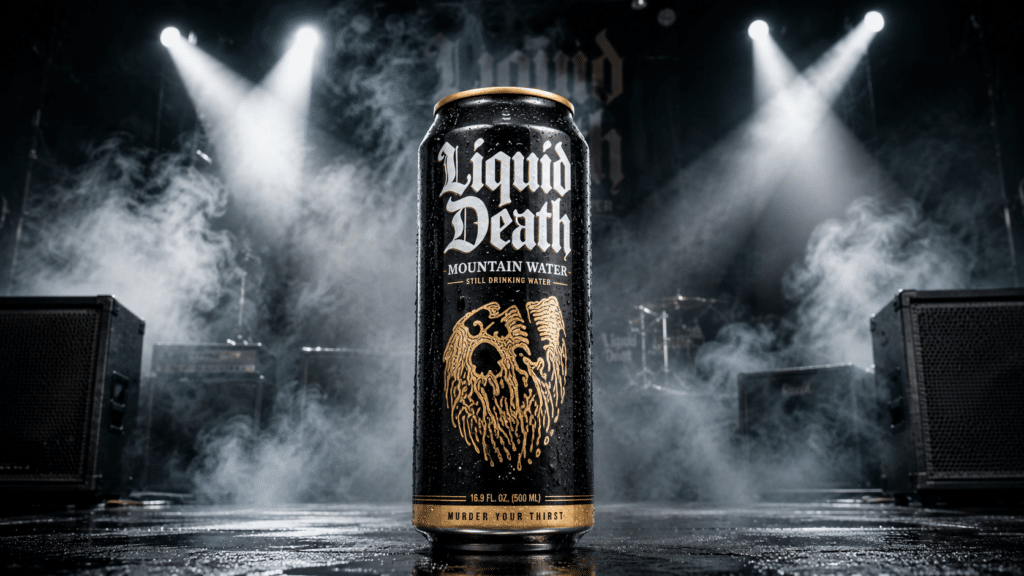
Liquid Death is owned by Supplying Demand, Inc., a privately held company founded by Mike Cessario and backed by investors like Science Inc. and Live Nation. It is not owned by Coca-Cola, PepsiCo, or any other beverage giant.
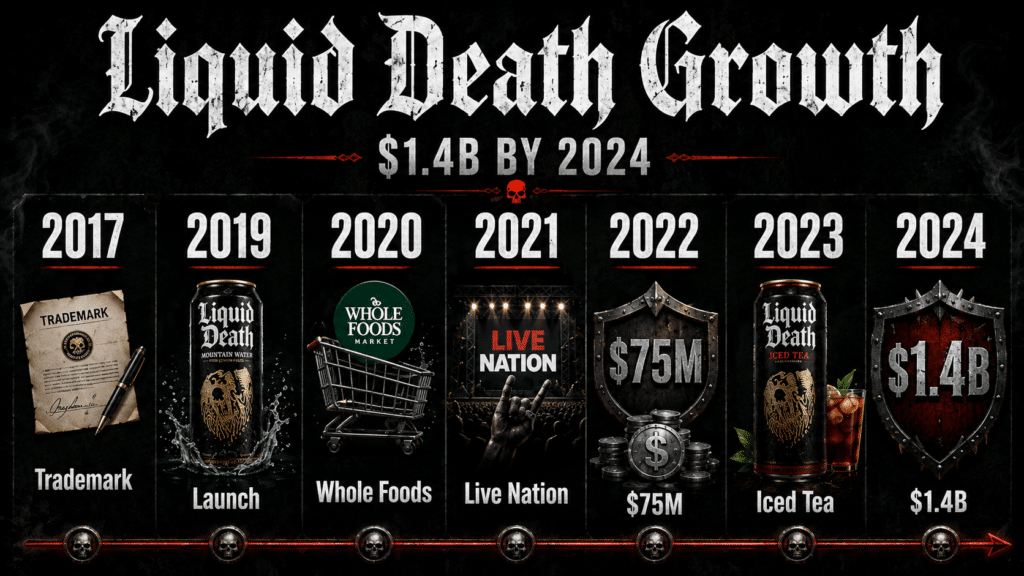
The company hit a $1.4 billion valuation in March 2024 and remains fully independent.
The reason people search “who owns Liquid Death” is because the brand feels too weird, too polished, and too successful to belong to a startup.
That’s exactly the point. Cessario built something that looks like it should be owned by a major label or a Hollywood studio. It isn’t.
Ownership Structure And Major Backers
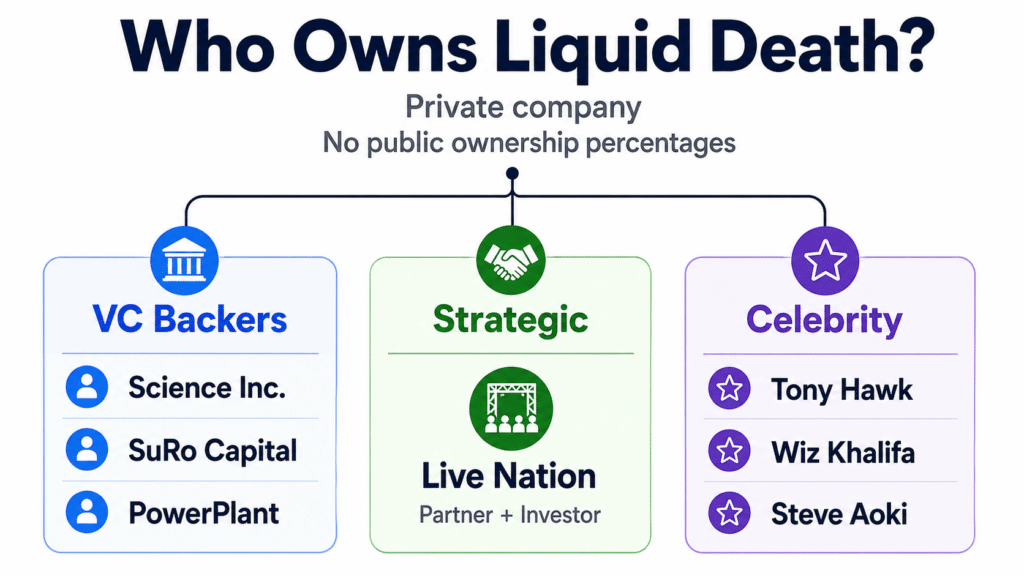
The cap table behind Liquid Death reads like a mix of Silicon Valley and the Sunset Strip.
The legal entity is Supplying Demand, Inc., and the investors span traditional venture capital firms alongside entertainment and celebrity money.
The Legal Company Behind The Brand
Supplying Demand, Inc. is a Delaware-registered corporation doing business as Liquid Death. It’s headquartered in Los Angeles, California.
The company also operates Supplying Demand UK Limited as a subsidiary, which signals its push into international markets.
Why Liquid Death Is Still Private
Liquid Death has raised significant capital across multiple rounds without going public. It raised $1.6 million in seed funding led by Science Inc., followed by a Series A, Series B, and multiple Series C rounds.
The January 2022 Series C alone brought in $75 million at a $525 million valuation. By October 2022, an insider-led round led by Science pushed the valuation to $700 million.
The company is not publicly traded on any stock exchange, so you can’t buy shares of Liquid Death through a brokerage account.
Key Investors And Strategic Investor Roles
Science Inc. and Live Nation are the two most strategically important backers. Science Inc. led the original seed round and has remained central to the company’s growth.
Live Nation joined in a May 2021 Series C and agreed to sell Liquid Death exclusively at its events and venues for a period, giving the brand instant access to millions of concertgoers.
Goldman Sachs has also been involved in later funding rounds. On the celebrity side, investors include Tony Hawk, DeAndre Hopkins, Whitney Cummings, Josh Brolin, and Swedish House Mafia.
Michael Dubin, the founder of Dollar Shave Club, is also on the cap table. These aren’t just vanity checks.
Celebrity investors double as brand validators who reach audiences that no traditional water ad ever could.
How The Brand Turned Water Into Entertainment
Cessario’s core insight was simple: water is a commodity, but attention is not. He didn’t try to compete on price or purity. He competed on entertainment.
Mike Cessario’s Creative Bet
Cessario’s background was in advertising and creative direction, including work at Netflix.
He spotted the gap in 2009 at a Vans Warped Tour, where he noticed fans drinking water out of Monster Energy cans because the cans looked cool. That moment stuck with him.
He filed a trademark for “Liquid Death” in 2017 and produced a video ad before the product even existed. That video got three million views.
The brand had over 100,000 Facebook likes before most people had ever tasted the water.
Why The Metal Aesthetic Worked
The skull logo, the “murder your thirst” tagline, and the heavy metal and punk rock visual identity weren’t random. They were a deliberate targeting strategy.
Cessario built the brand to appeal to people who felt left out of the clean, pastel, wellness-brand aesthetic that dominated the water category.
He gave them something that felt like their culture. That loyalty turned into word-of-mouth that money can’t easily buy.
Merchandise, Media, And Direct-To-Consumer Momentum
Liquid Death released Greatest Hates, an album of death metal songs written from hate comments the company received online. That’s not marketing in any traditional sense. It’s content.
The brand sells merchandise, produces its own media, and built a direct-to-consumer channel before most retailers took them seriously.
This entertainment-first approach meant the brand generated press and social sharing far beyond what its ad budget would normally allow.
You can think of it as building a beverage brand the way a record label builds a band.
Products, Distribution, And The Growth Engine
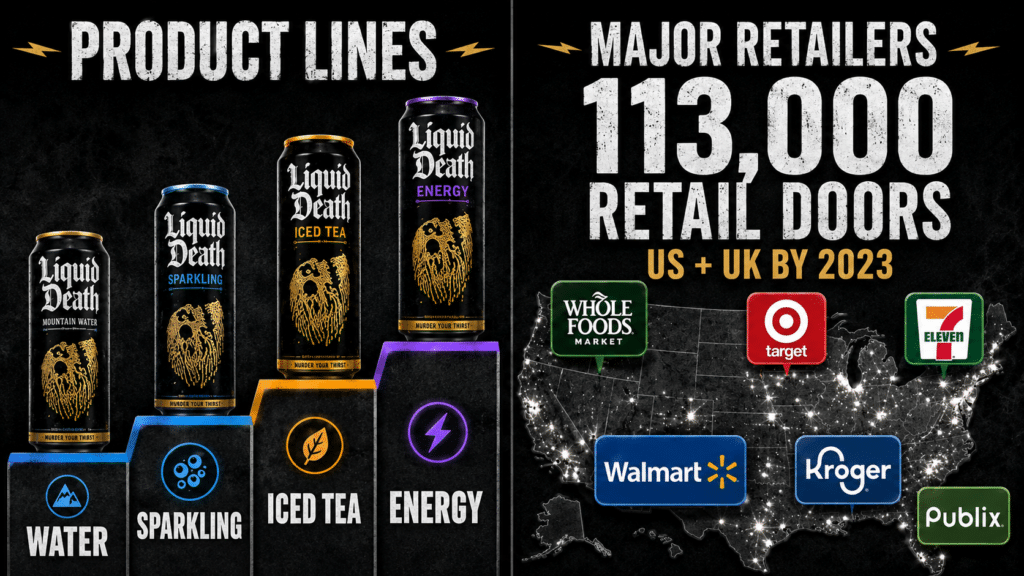
Liquid Death’s product line has expanded well beyond still water, and that expansion has been deliberately paced to protect the brand’s identity while chasing real revenue.
From Still Water To Sparkling Energy
The original product was still mountain water in tallboy aluminum cans.
In 2020, the brand added sparkling water. Then came flavored sparkling waters: Mango Chainsaw, Severed Lime, Convicted Melon, and Berry It Alive.
These are low-calorie, naturally sweetened options that sit closer to soda than plain seltzer.
In 2023, iced teas arrived under names like Grim Leafer, Rest in Peach, and Dead Billionaire (originally called Armless Palmer until Arizona Beverage Company threatened legal action).
In early 2026, Liquid Death launched a sparkling energy line with 100 mg of caffeine per can, no sugar, and no artificial sweeteners, positioned as a saner alternative in a caffeine-saturated category.
Retail Expansion Across Grocery And Convenience
Liquid Death’s retail footprint grew fast. It launched in Whole Foods in February 2020 and quickly became the fastest-selling water brand on those shelves.
From there it moved into 7-Eleven locations in Los Angeles and San Diego, then into Publix and Sprouts by late 2021. Today you can find it at Target, Kroger, and convenience stores nationwide.
A distribution deal with Big Geyser expanded its reach into the New York market. International expansion is also underway through its UK subsidiary.
Sustainability As A Commercial Advantage
Every Liquid Death product comes in infinitely recyclable aluminum cans. The brand built its #deathtoplastic campaign into its core identity, not as a footnote on a label but as a genuine brand pillar.
Aluminum cans recycle at far higher rates than plastic bottles, which gives Liquid Death a credible environmental story to tell at a time when plastic pollution is a mainstream concern.
That sustainability angle has helped the brand win shelf space at grocery retailers like Whole Foods and Sprouts, where shoppers actively seek out eco-conscious options.
The can itself, something every energy drink already uses, became a differentiator in the bottled water market simply because Cessario committed to it before it was obvious.

I spent years working in tech and digital publishing, where I saw how quickly industries, brands, and consumer behavior can change. I created Rich Digest to explore the business behind luxury, from iconic products and influential founders to pricing, scarcity, ownership, and brand strategy. My goal is to make the world of luxury business clear, interesting, and easy to understand.