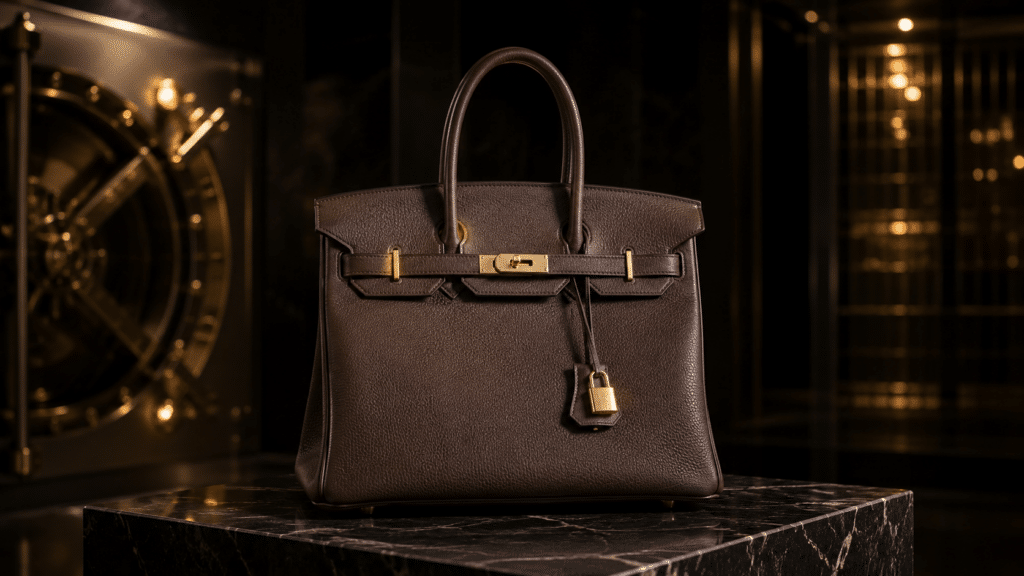
A Birkin bag is so expensive because of extreme artificial scarcity, meticulous hand-craftsmanship, and a strict retail strategy that forces you to build a significant spend history with Hermès before you’re even offered the chance to buy one. That last part is the piece most people miss entirely.
The real price of a Birkin has almost nothing to do with the leather and almost everything to do with the system Hermès has built around it.
Most luxury brands want to sell you things. Hermès has engineered a world where you have to prove yourself worthy of spending your own money.
That tension between desire and access is precisely what keeps prices climbing, year after year, with no ceiling in sight.
This breakdown covers exactly how that system works, what you’re actually paying for at retail and resale, and which factors separate a $12,000 Birkin from one that sells at Sotheby’s for seven figures.
The Fast Answer: What You’re Really Paying For
Three forces combine to make Birkin pricing so durable: genuine production cost, engineered scarcity, and status-driven demand that pushes willing buyers to pay far beyond the rational value of the object itself.
Craftsmanship Drives The Cost Base
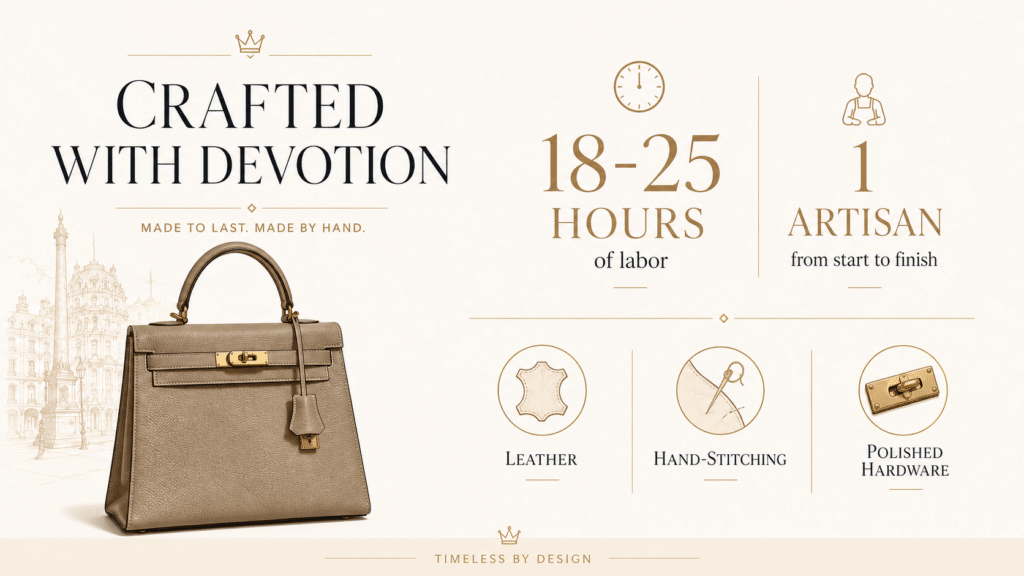
Each Birkin is built by a single trained artisan using hand techniques that take 18 to 25 hours per bag, according to BirkinVault’s breakdown of production.
That labor cost alone is real.
Add in premium leathers sourced from tanneries with decades-long relationships with Hermès, hand-polished hardware, and a quality inspection process that would reject most finished goods, and you have a genuine cost base that justifies a price well above the typical handbag.
The timeless craftsmanship here creates a floor.
There’s a real argument that a well-made Birkin, maintained properly, outlasts almost any other bag you could buy.
Scarcity Creates Pricing Power
Hermès deliberately limits production.
Supply never meets demand, and that gap is not accidental.
As noted in an analysis of the Hermès business model, scarcity is the strategy, not a byproduct of capacity constraints.
When something is genuinely hard to get, its perceived value rises independent of production cost.
This is scarcity value in action.
The fewer units available, the more each unit is worth to someone who wants it badly enough.
Status Turns Demand Into A Premium
Economists call goods like the Birkin “Veblen goods.”
When the price goes up, demand goes up too, because the high price is part of the appeal.
Owning a Birkin signals financial success in a way that a cheaper bag, no matter how well made, cannot.
That quiet luxury signal is worth a premium to buyers who can afford it, and that willingness to pay a status premium is what truly separates Birkin pricing from ordinary luxury goods.
How Hermès Builds Value Into Every Bag
Hermès controls every detail of production, from the tanneries supplying leather to the artisan doing the final stitch.
That vertical control is what lets the brand make meaningful quality claims, and what makes each authentic Birkin a genuinely different object from anything a competitor produces.
Single-Artisan Construction
A single artisan builds your Birkin from start to finish.
Hermès does not use assembly-line production, where one worker cuts and another stitches.
One person handles the whole bag.
This means every Birkin carries a consistent craft signature, and it means production cannot simply be scaled up to meet demand without years of additional training.
That training bottleneck is itself a form of supply control.
Saddle Stitching And Durability
The saddle stitch technique Hermès uses on every Birkin is a two-needle method pulled tight by hand.
If one thread breaks, the stitch holds because the second thread locks it in place.
Machine stitching, by contrast, can unravel from a single break point.
The result is a seam that lasts decades.
The saddle stitching process is one of the production steps that most visibly separates Hermès construction from factory-made luxury goods.
Leather Selection And Finishing
Standard Birkins come in four primary leathers, each with a distinct texture and use case:
- Togo leather: pebbled, scratch-resistant, very popular with first-time buyers
- Clemence leather: softer and heavier, with a looser grain
- Epsom leather: structured and firm, holds its shape extremely well
- Swift leather: smooth and supple, more prone to scratching
Each leather is selected, cut, and finished by hand.
The edges are painted and burnished individually.
There are no shortcuts in the finishing process that make it into a retail-ready bag.
Hardware And Functional Details
The palladium or gold-plated hardware on every Birkin is polished by hand.
The lock, keys, and clochette (the small leather pouch holding the keys) are all included and matched.
Every functional element, the turn-lock closure, the double-handle attachment points, the feet that protect the base, is built to last and adds to the overall weight and feel of quality when you pick the bag up.
The Qualification Moat: Why Access Is Part Of The Price
Here is the strategy that sets Hermès apart from every other luxury brand on earth.
I’ve coined it the Qualification Moat: a retail system where access to the product you want is gated behind a history of spending on products you weren’t necessarily seeking.
You do not buy a Birkin.
You earn the right to be offered one.
Why Buying From A Hermès Boutique Is Hard
Walk into a Hermès boutique with $20,000 in cash and ask for a Birkin.
In most cases, you will leave without one.
Sales associates at most boutiques do not sell Birkins to walk-in customers with no purchase history.
The bags are allocated, and those allocations go to customers who have already demonstrated loyalty to the brand.
This policy is widely documented and applies in boutiques across the United States.
Purchase History As A Gatekeeping System
To build your way toward a Birkin offer, you typically spend on other Hermès products first: scarves, shoes, home goods, jewelry, ready-to-wear.
Once your purchase history shows sufficient engagement with the brand, a sales associate may quietly offer you the opportunity to purchase a Birkin.
The retail price is the reward for your prior spending.
That prior spending is not refunded against the Birkin’s cost.
It is simply the ticket to the door.
How The Scarcity Loop Strengthens Demand
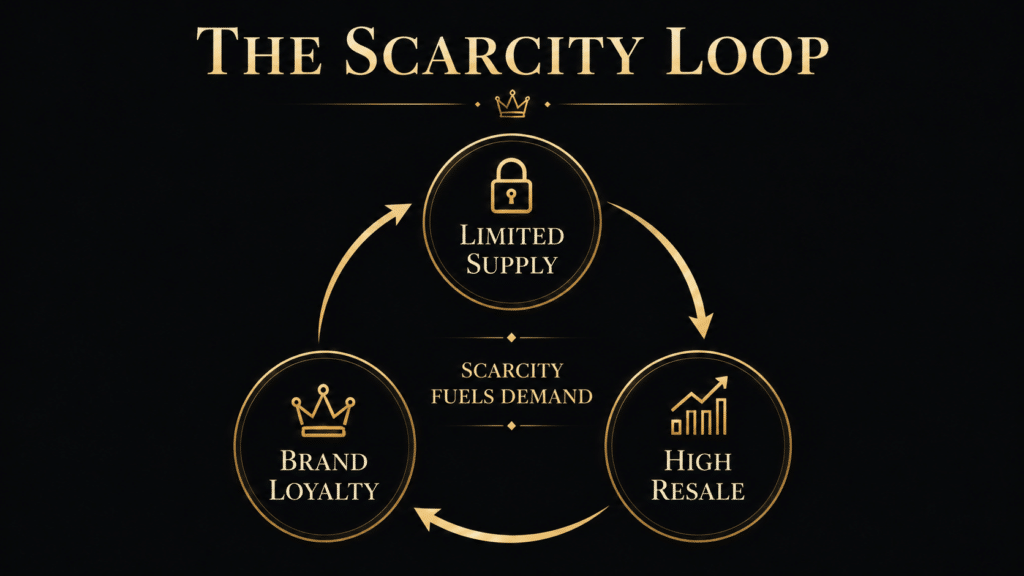
The Qualification Moat creates what you might call a scarcity loop.
Limited supply forces buyers toward the resale market.
Resale prices run well above retail.
That gap makes retail access look even more valuable to aspiring buyers.
Which drives more desire for boutique relationships.
Which drives more spending on other Hermès goods.
The loop reinforces itself with every price increase Hermès announces, and the brand has raised prices consistently across the past decade.
What A Birkin Costs At Retail And On Resale
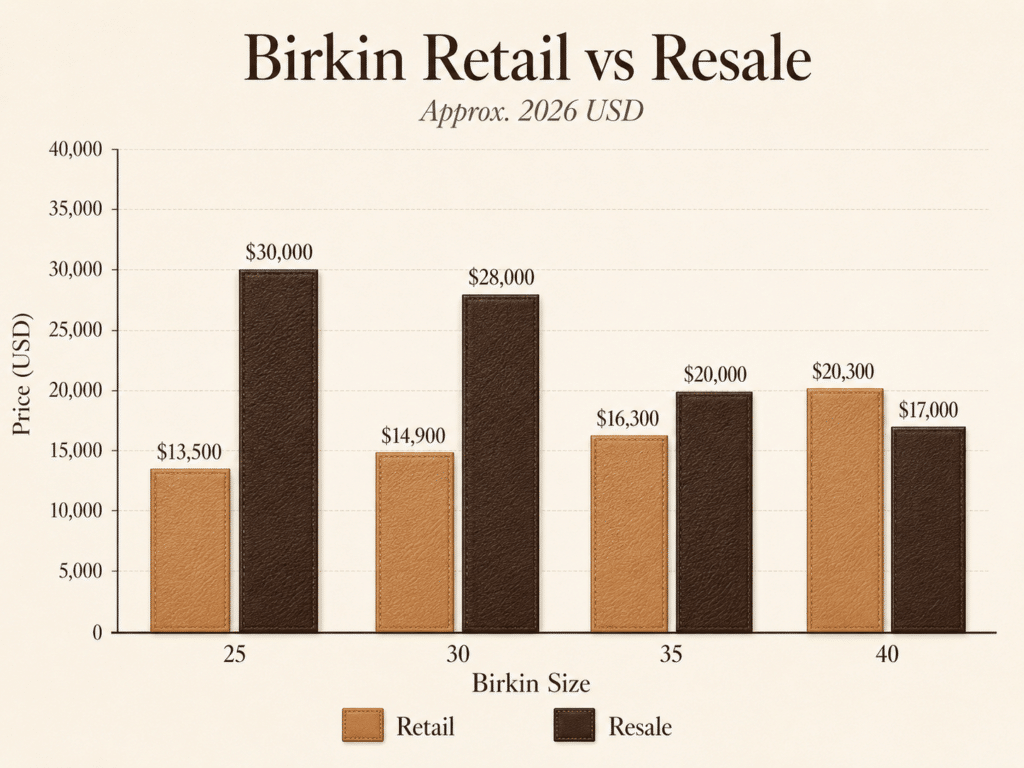
Birkin pricing covers an enormous range depending on size, leather, color, and whether you’re buying retail or on the secondary market.
According to a 2026 Birkin price guide, retail entry points have risen sharply and resale premiums remain significant.
Starting Prices By Size
Current retail price ranges by size, in standard leathers:
| Size | Approximate Retail Price (USD) |
|---|---|
| Birkin 25 | $10,900 to $12,500 |
| Birkin 30 | $12,000 to $14,000 |
| Birkin 35 | $13,500 to $16,000 |
| Birkin 40 | $15,000 to $18,000+ |
Exotic skin versions in any size can push well past $30,000 at retail, if they are offered at all.
Why Birkin 25 Often Beats Larger Sizes
The Birkin 25 is the smallest standard size, and it often commands a higher resale price per dollar of retail cost than larger bags.
Collector demand for the 25 is intense because it reads as a statement piece rather than a working bag, and its compact size makes certain rare colorways look more concentrated and visually striking.
Demand for the 25 has outpaced supply even more sharply than for the 30 or 35.
Secondary Market Markups Explained
Pre-owned Birkins routinely sell for 50 to 100 percent above retail in standard leathers, and rare configurations push much higher.
A standard black Togo Birkin 30 bought at retail for roughly $12,000 might resell for $18,000 to $22,000 in excellent condition.
The secondary market exists because boutique access is so restricted that buyers who want a Birkin now must pay a premium to get one without waiting years.
What Moves Birkin Prices Year To Year
Hermès raises retail prices annually, typically between 5 and 10 percent.
Those increases pull resale prices up with them, since retail is the reference point for secondary market buyers.
Currency fluctuations also matter for international buyers.
And any high-profile auction result, especially a record-breaking sale, tends to lift resale expectations across the entire market for several months afterward.
What Makes One Birkin Worth More Than Another
Two Birkins can look nearly identical and differ in price by tens of thousands of dollars.
The variables that drive that gap are specific and learnable.
Size, Color, And Date Stamp
Smaller sizes, particularly the Birkin 25, carry collector premiums.
Color matters enormously.
As noted in Sotheby’s analysis of the most valuable Hermès bags, classic colors like black and neutral tones form the foundation of collectible value, while rare seasonal colors can spike resale prices dramatically.
The date stamp inside the bag tells you the year of production.
Older bags in excellent condition from certain production years carry additional collector interest.
Condition And Completeness
Condition grades on the secondary market move prices significantly.
A bag rated “pristine” or “like new” with its full set of accessories, including the clochette, lock, and keys, the original dust bag, box, and receipt, will sell for measurably more than the same bag missing any of those components.
Hardware scratches, corner wear, and interior staining all reduce price.
Standard Leather Versus Exotic Skins
Togo leather and Clemence leather Birkins are the most common.
Epsom and Swift are slightly less common.
Exotic Birkins in crocodile, alligator, ostrich, or lizard skin are in a different price category entirely.
An exotic Birkin can reach $50,000 to $300,000 or more at retail or resale, depending on skin type, color, and condition.
Why Rare Models Break Records
Limited-edition Birkins, bags produced in very small numbers with unusual specifications, break auction records because the pool of competing buyers is large relative to the supply of exactly that configuration. A collector who has been seeking a specific rare colorway in a specific exotic skin for years will pay well beyond market rate when one finally appears.
That concentrated demand on a single unit is what pushes individual sale prices into the millions.
Auction Records, Provenance, And Collector Demand
The highest prices in the Birkin market are set not at boutiques but at auction, where competitive bidding and collector demand intersect. Auction results set the psychological ceiling for what serious buyers believe any given Birkin configuration is worth.
Why Sotheby’s Matters In The Birkin Market
Sotheby’s is one of the primary auction venues where rare Hermès bags reach their highest recorded prices. When a Birkin sells at Sotheby’s for a record sum, that result ripples through the entire secondary market.
Resale platforms and private sellers use major auction results as benchmarks. I’ve noticed that a single record sale tends to push comparable bags upward in asking price almost immediately across multiple platforms.
How Provenance Changes Price
Provenance refers to a bag’s documented history of ownership. A Birkin with a verified celebrity owner, especially one tied to the founding story of the bag itself, carries a premium that the physical object alone cannot justify.
Documented provenance raises a bag from a luxury object to a collectible artifact, and the price reflects that shift in category.
Jane Birkin And The Power Of Origin Stories
The Hermès Birkin bag takes its name from actress and singer Jane Birkin, who reportedly described her ideal travel bag to Hermès CEO Jean-Louis Dumas on a flight in 1984. That story is part of the product’s identity.
As noted in a business breakdown of the Hermès model, when a celebrity is literally the origin of the product, their association carries a value that no marketing campaign can replicate. Jane Birkin’s connection to the bag gave it a cultural authenticity that Hermès has never needed to manufacture.
Authentication And Consignment Basics
If you are buying a Birkin on the secondary market, authentication is non-negotiable. Counterfeit Birkins are sophisticated enough to fool untrained buyers.
Reputable resellers provide detailed authentication documentation. If you want to consign a Birkin for sale through auction, houses like Sotheby’s require authentication before listing.
Condition reports, original accessories, and purchase receipts all support the authentication process and directly affect the consignment value you receive.
Frequently Asked Questions
What actually makes Hermès Birkin bags cost so much?
A Birkin’s price comes from three stacked factors: genuine hand-craftsmanship that takes up to 25 hours per bag, intentionally limited production that keeps supply far below demand, and a retail access system that forces buyers to spend heavily on other Hermès products before being offered one. Each factor reinforces the others, which is why the price keeps rising.
How much does it cost to make a Birkin compared to its retail price?
The exact production cost is not publicly disclosed by Hermès. Estimates vary widely, but the consensus across multiple resale market analyses is that the margin is substantial, as is expected for a brand with Hermès’s pricing power. The production cost includes premium leather, hand labor, and hardware, but the retail price also reflects brand equity, exclusivity, and controlled distribution, none of which show up in material cost.
Is the Birkin’s high price mostly about craftsmanship, materials, or brand hype?
All three contribute, but the proportions matter. Craftsmanship and materials create a real cost floor that puts the Birkin above ordinary handbags. Brand strategy and artificial scarcity are what push it from a high-quality expensive bag into a Veblen good where price increases drive demand upward rather than reducing it.
Why are Birkin bags so hard to buy, even if you’ve got the money?
Hermès allocates Birkins to customers based on purchase history, not purchasing intent. Walking into a boutique ready to spend does not guarantee access. The system, which this article calls the Qualification Moat, is deliberate. It requires you to build a relationship with the brand over time before you are offered the opportunity to buy a Birkin at retail price.
What’s the cheapest way to get a Birkin without paying crazy resale prices?
The lowest-cost path is building a purchase history at a Hermès boutique over time and waiting to be offered one at retail. If you want a bag faster, the secondary market is your only realistic option, and you will pay a premium. Reputable resellers like BirkinVault authenticate their inventory, which reduces the risk of buying a counterfeit at a steep price.
Which Birkin styles and leathers tend to be the most expensive, and why?
Exotic skin Birkins in crocodile or alligator are consistently the most expensive, followed by ostrich. Among standard leathers, the Birkin 25 in rare colors commands some of the highest resale premiums relative to its retail price. The Himalaya Birkin, made from Nile crocodile skin with a gradient coloring, holds multiple auction records and is widely considered the most valuable production Birkin in the world.

I spent years working in tech and digital publishing, where I saw how quickly industries, brands, and consumer behavior can change. I created Rich Digest to explore the business behind luxury, from iconic products and influential founders to pricing, scarcity, ownership, and brand strategy. My goal is to make the world of luxury business clear, interesting, and easy to understand.