
Beneath the golden arches lies a financial fortress built on dirt, not dough. While billions of burgers are flipped annually, the real secret to this global giant’s success is a massive property portfolio spanning the globe.
McDonald’s operates as a real estate empire by owning the land and buildings of its franchise locations and collecting guaranteed rent. This strategy generates consistent, high-margin revenue, effectively making the company a global real estate investment trust disguised as a fast-food chain.
Following the cash flow reveals a business model far more durable than any typical restaurant. The company doesn’t just sell fries; it controls some of the most valuable street corners on Earth.
Ray Kroc’s real estate thesis transformed a simple fast-food operation into an unstoppable economic engine. By owning the ground, the company secured its future regardless of food cost spikes or market shifts.
How The Money Flows Through The System
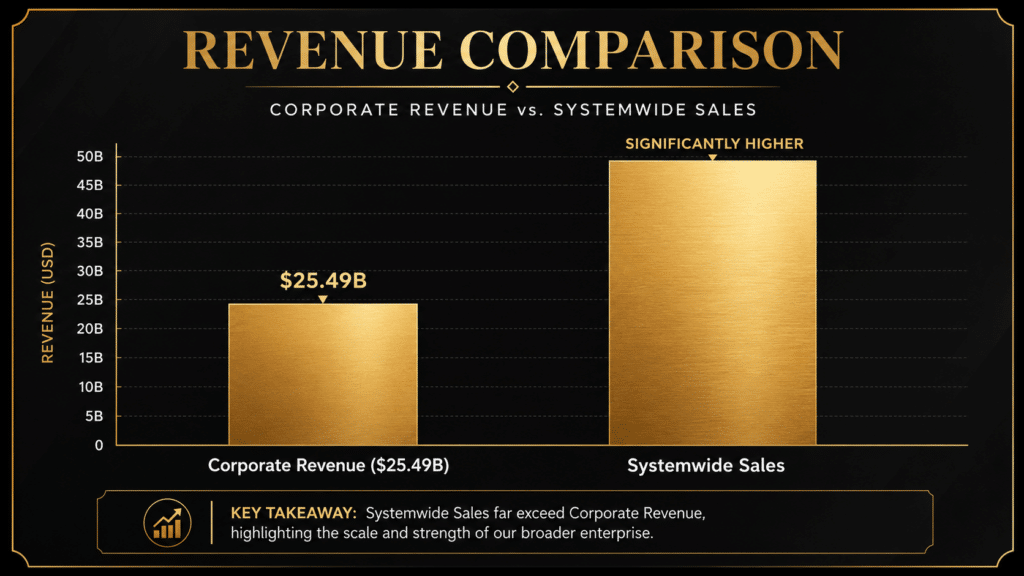
McDonald’s revenue structure looks simple on the surface, but there are a few layers worth pulling apart. The company collects money from two fundamentally different places: its own restaurants, and the network of franchised locations that operate under its name.
Corporate Revenue Vs Systemwide Sales
When you see McDonald’s report “systemwide sales,” that number includes every dollar spent across all restaurants globally, whether corporate-owned or franchised.
In 2024, McDonald’s generated $25.49 billion in total revenues, but systemwide sales were considerably higher because most franchise revenue flows to the franchisee first.
Corporate revenue only captures what flows directly to McDonald’s: rent, royalties, and fees from franchisees, plus the full sales from company-operated restaurants.
It’s a smaller number than systemwide sales, but it carries far better margins.
Rent, Royalties, And Franchise Fees
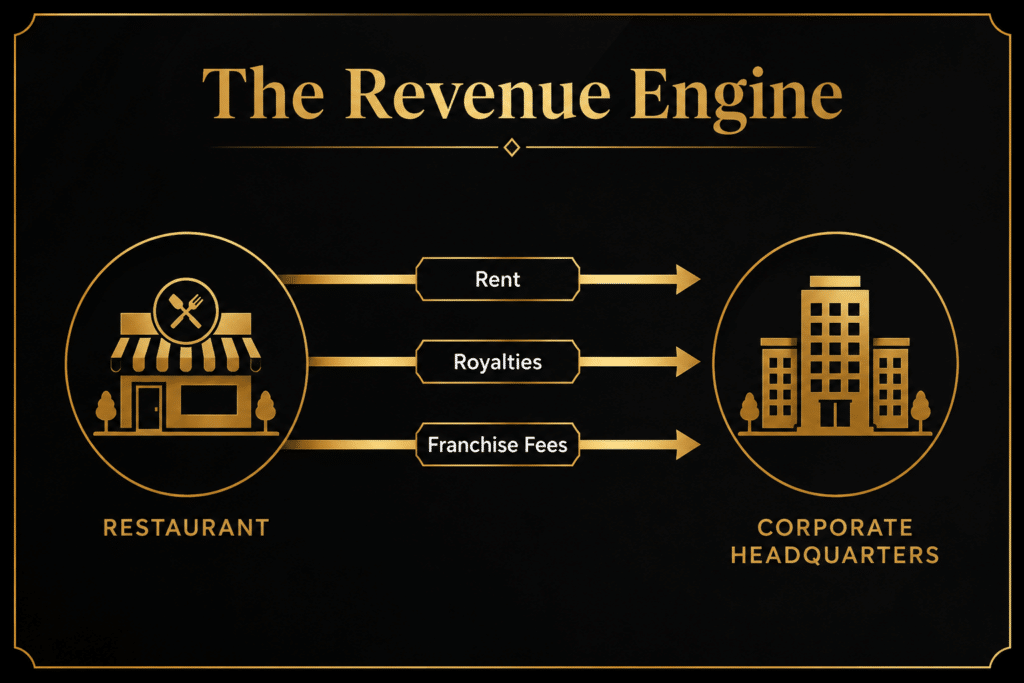
Here’s where the model gets interesting. Franchisees pay McDonald’s in three main ways:
- Rent: McDonald’s owns or leases the property and subleases it to the franchisee, typically at a markup.
- Royalties: A percentage of sales, generally around 4-5%, paid to McDonald’s on an ongoing basis.
- Franchise fees: An upfront fee paid when a franchise agreement is signed.
Of these, rent is the most structurally powerful. It arrives regardless of whether the franchisee is having a good week or a bad one.
As noted in analysis of McDonald’s real estate model, rent behaves more like an annuity than a restaurant revenue stream.
Why Franchised Restaurants Outperform Company-Operated Economics
Company-operated restaurants carry full cost exposure: labor, food, utilities, maintenance. The margins are thinner because corporate absorbs all the risk.
Franchised restaurants flip that equation. McDonald’s collects rent and royalties while the franchisee handles day-to-day costs.
This is why McDonald’s has been steadily moving toward approximately 95% franchised restaurants.
The operating income per dollar of revenue is simply higher when you’re collecting a percentage of sales rather than managing every line item in a restaurant’s P&L.
The Real Estate Strategy Behind McDonald’s Economics
The real estate strategy is probably the most underappreciated part of how McDonald’s operates. It’s not just about owning buildings; it’s about controlling the best locations and using that control as financial leverage across the entire franchise network.
Why Site Selection Matters More Than Most People Think
Location determines foot traffic, and foot traffic determines sales volume. McDonald’s has developed one of the most sophisticated site selection processes in commercial real estate.
You can’t just open a McDonald’s anywhere. The company evaluates traffic patterns, demographics, visibility, and competition before committing to a location.
Because royalties are a percentage of sales, every incremental improvement in foot traffic from a better location compounds over the life of the franchise agreement.
A great location isn’t just good for the franchisee. It’s good for McDonald’s royalty income for decades.
Owning Or Controlling Prime Locations
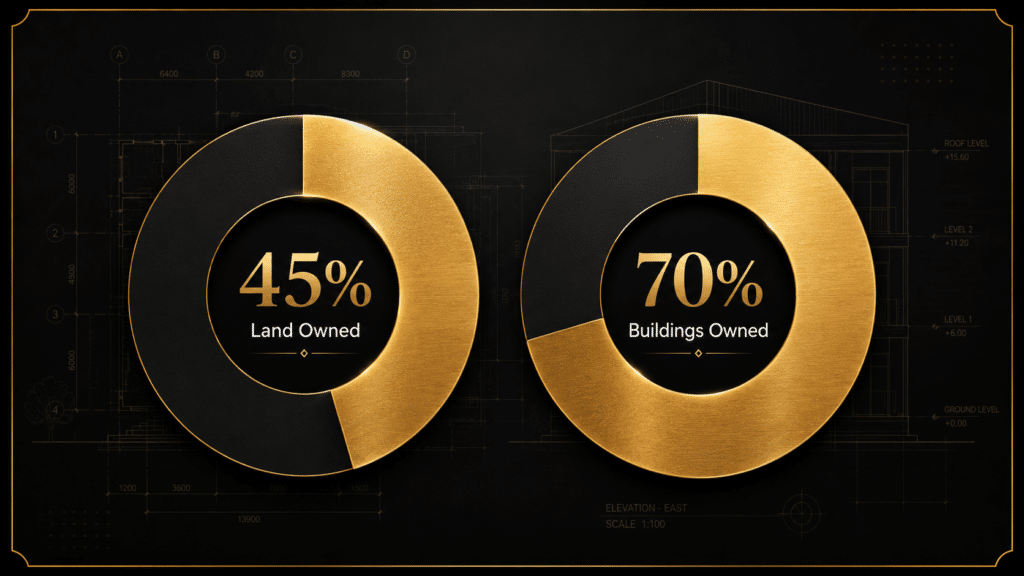
McDonald’s owns roughly 45% of the land and about 70% of the buildings at its restaurant locations, according to research on the company’s real estate footprint.
For locations where it doesn’t own outright, it typically holds long-term leases and then subleases to franchisees.
This structure gives McDonald’s leverage that goes beyond a typical landlord. If a franchisee underperforms, McDonald’s can replace them while retaining the property.
The brand recognition tied to the golden arches stays. The location stays.
Only the operator changes.
How Rent Creates Durable Margin And Leverage
Rent income is what makes McDonald’s financially resilient across economic cycles. Food sales fluctuate.
Consumer sentiment shifts. But a franchisee still owes rent whether it’s a record sales week or a slow one.
I think this is what most people miss when they look at McDonald’s financials. The stability you see in McDonald’s operating margins isn’t just operational efficiency.
It’s the structure of the revenue itself. Rent is sticky in a way that food revenue simply isn’t.
How Franchising Scales With Lower Capital Risk
Franchising lets McDonald’s grow its footprint without putting its own capital into every new location. That’s the core logic.
Franchisees fund the buildout, buy the equipment, hire the staff, and absorb the daily operational costs. McDonald’s expands its real estate and royalty base while keeping its own balance sheet relatively lean.
What Franchisees Fund And What Corporate Controls
Under a conventional franchise arrangement, franchisees invest in equipment, signage, seating, and decor. These are real costs, often running into the hundreds of thousands or even millions of dollars depending on the location.
McDonald’s, by contrast, owns or controls the underlying property. Corporate McDonald’s focuses on what it actually controls: brand standards, menu, marketing, and the terms of the franchise agreement.
Franchisees control employment, local pricing, and day-to-day operations within those guardrails. This split lets the system scale globally without McDonald’s having to manage tens of thousands of restaurants directly.
The Three-Legged Stool: McDonald’s, Franchisees, And Suppliers

McDonald’s describes its business as a three-legged stool: the company, its franchisees, and its suppliers. Each leg depends on the others.
Franchisees need McDonald’s brand and systems to attract customers. McDonald’s needs franchisees to operate locations it can’t run itself.
And suppliers need the scale of the entire network to build efficient operations around. This structure is also how McDonald’s maintains supply chain consistency across over 43,000 restaurants worldwide.
Suppliers know the standards. They know the volumes.
Hamburger University trains operators to execute the system with precision.
Why Local Ownership Supports Global Expansion
A locally-owned franchise has a different level of commitment than a corporate-managed outpost. The franchisee’s personal capital is on the line.
That tends to produce operators who are invested in performance in a way that a salaried manager simply can’t replicate at scale.
For international operated markets and developmental licensed markets, this local ownership model also helps McDonald’s navigate cultural and regulatory differences more efficiently.
Local operators understand their communities better than a distant corporate team ever could.
The Operating System That Makes Consistency Profitable
McDonald’s didn’t build a global empire on great food alone. It built a system designed to deliver the exact same experience millions of times a day, across a hundred countries.
The operational side of McDonald’s is, in many ways, the real product.
From The Speedee Service System To Modern Throughput
The Speedee Service System, launched by the McDonald brothers in 1948, was the original insight: treat a restaurant kitchen like an assembly line. Standardize every step.
Remove variation. Maximize throughput.
Ray Kroc took that concept and made it infinitely scalable. Today, that same logic runs through every upgrade McDonald’s makes, from AI-powered predictive maintenance on fryers to the layout of the drive-thru lane.
Every second saved per transaction across 43,000 restaurants is an enormous number compounded.
Menu Standardization, Order Accuracy, And Labor Efficiency
The Big Mac, the Quarter Pounder, McChicken, Happy Meals, fries, coffee, McCafe beverages: the menu stays recognizable on purpose. A narrow, well-executed menu means shorter training times, faster prep, and fewer mistakes.
Order accuracy is a bigger financial variable than most people realize. When you get a wrong order, it costs McDonald’s time, food, and potentially a customer.
Self-order kiosks and digital ordering have measurably improved accuracy at locations where they’ve been deployed. Less rework means lower cost per transaction.
Why Company-Operated Stores Still Matter
Corporate-owned restaurants aren’t just legacy holdovers. They serve a real function: testing.
New workflows, menu items, and tech integrations get trialed in company-operated restaurants before rolling out across the franchise network.
McDonald’s can’t afford to experiment on a franchisee’s business. It experiments on its own, then standardizes what works.
Digital, Loyalty, And Marketing As Growth Multipliers
McDonald’s has spent the last several years building a digital layer on top of its physical restaurant network. The goal is straightforward: turn anonymous transactions into known customers, and use that data to drive more frequent visits and higher average checks.
The McDonald’s App And Omnichannel Convenience
The McDonald’s app ties together mobile ordering, delivery, drive-thru, and in-store kiosk experiences into a single customer touchpoint. You can order ahead, pick up in the drive-thru, and redeem loyalty points without talking to anyone.
That convenience factor directly lifts visit frequency for regular customers. Delivery integration has added a channel that didn’t exist a decade ago.
Customers who wouldn’t drive to a McDonald’s will order through a delivery app, and that incremental sales volume flows through the royalty system just like any other transaction.
Personalization, CRM, And Loyalty Economics
McDonald’s loyalty program now has more than 175 million members, making it one of the largest in the restaurant industry.
Every transaction from a loyalty member tells McDonald’s what you order, how often you visit, and which offers actually move your behavior.
As noted in McDonald’s 2026 strategy analysis, that data feeds directly into marketing spend allocation and operational decisions at the store level.
Personalized offers drive repeat visits. Repeat visits drive comparable sales.
Comparable sales drive royalty income.
Accelerating The Arches And New Growth Bets
McDonald’s “Accelerating the Arches” strategy focuses on three core pillars: maximizing marketing, committing to its core menu, and expanding through digital and delivery.
The company has announced ambitious new targets tied to development, loyalty membership growth, and cloud technology.
CosMc’s, the spinoff beverage concept McDonald’s began testing, reflects the company’s interest in capturing more of the coffee and specialty drink segment that Starbucks has historically owned.
It’s a small bet in the context of McDonald’s overall scale, but it signals appetite for menu innovation beyond traditional QSR.
Competitive Positioning And Strategic Risks
McDonald’s sits at the top of the quick-service restaurant category by revenue and brand recognition, but the competitive landscape has shifted significantly over the past decade.
Fast-casual brands have raised consumer expectations, and legacy QSR competitors have become more aggressive.
Where McDonald’s Sits In The QSR And Fast-Casual Landscape
In the QSR category, McDonald’s primary competitors include Burger King (owned by Restaurant Brands International), Wendy’s (WEN), and Yum Brands’ portfolio of KFC and Taco Bell.
McDonald’s outsizes most of them in revenue and store count.
The more interesting competitive pressure comes from Chipotle and the broader fast-casual segment.
These brands compete on food quality perception and have attracted customers who want more than traditional fast food.
Subway competes primarily on footprint and price.
Starbucks is a competitor specifically in the breakfast and McCafe beverage segment.
A Focused SWOT Analysis
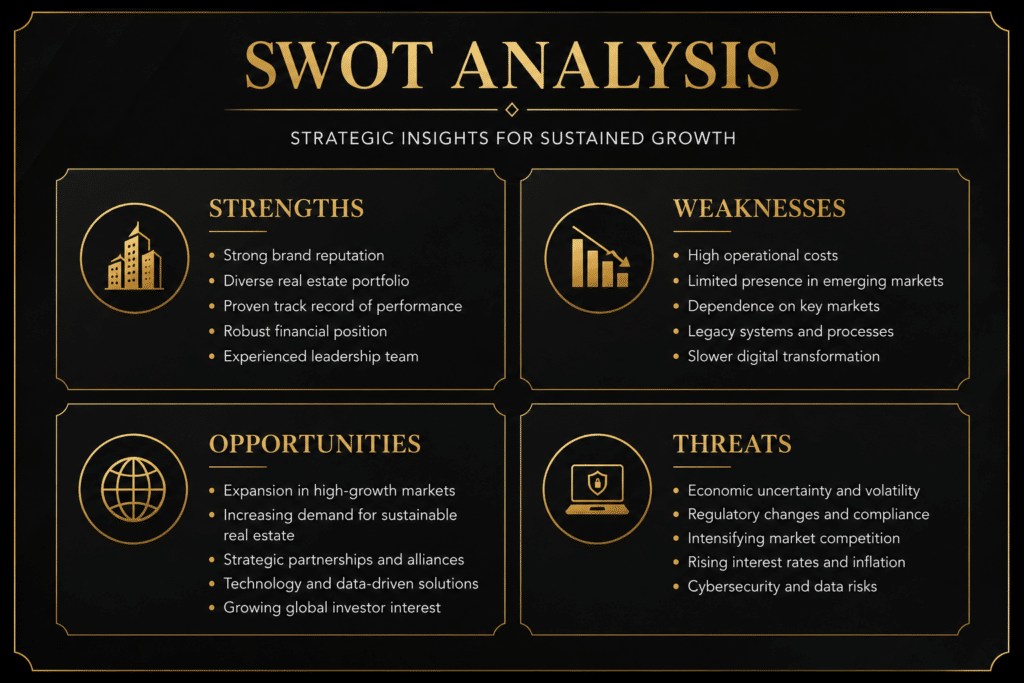
Strengths:
- Dominant brand recognition with the golden arches recognized globally
- Real estate portfolio provides income stability independent of food margins
- 95% franchised model creates highly efficient capital deployment
- Loyalty program with over 175 million members generating valuable customer data
Weaknesses:
- Perception of lower food quality compared to fast-casual competitors
- Franchise model limits direct control over customer experience
- Menu complexity has increased, adding operational pressure
Opportunities:
- Digital and delivery channels still growing as a share of total sales
- International markets, particularly in developmental licensed territories, offer long-term growth
- Menu innovation in beverages and breakfast could capture new customer segments
Threats:
- Rising labor costs in key markets pressure franchisee profitability
- Fast-casual and fast-food competition intensifying across all dayparts
- Regulatory risks around franchising, nutrition labeling, and labor classification
What Could Pressure The Model Over Time
The franchise model’s efficiency depends on franchisee profitability.
If franchisees can’t earn adequate returns, the system loses the operators it needs to function.
Rising food costs, minimum wage increases, and increased competition all compress franchisee margins.
McDonald’s real estate advantage is durable but not infinite.
Lease costs rise in strong real estate markets, and the company’s property portfolio requires ongoing capital investment to maintain and upgrade.
The model is resilient, but it’s not immune to macro pressure.
Frequently Asked Questions
How does McDonald’s actually make most of its money, food sales or something else?
Most profit comes from rent and royalties, not food sales. Franchisees pay a percentage of sales as royalties, plus rent on properties McDonald’s owns. This turns the business into a predictable real estate model.
Why is real estate such a big part of how the company operates?
McDonald’s owns or leases properties, then subleases them to franchisees at a markup. This creates a stable, recurring income stream independent of food sales volatility, making the company’s financials more resilient and predictable.
What’s the difference between a franchised restaurant and a corporate-owned one?
Franchised restaurants are run by independent owners using the McDonald’s brand. Corporate-owned locations are managed directly by the company, serving as testing grounds for new menu items, workflows, and technology before they are rolled out systemwide.
How do franchise fees, rent, and royalties work for restaurant owners?
Franchisees pay an upfront fee, ongoing royalties (usually 4-5% of sales), and rent. These streams flow to corporate regardless of restaurant performance, as detailed in this breakdown of how McDonald’s makes money.
Roughly how much can a franchise owner earn, and what affects that number?
Earnings vary by location, sales volume, and management efficiency. While high-traffic sites can be profitable, the combination of rent, royalties, and high initial investment means the margin for error remains thin for most operators.
If you mapped it out on a business model canvas, what would the key pieces be?
The McDonald’s business model canvas highlights franchisees and suppliers as partners, real estate as a key activity, and rent/royalties as primary revenue. The value proposition focuses on global consistency, affordability, and convenience at scale.

I spent years working in tech and digital publishing, where I saw how quickly industries, brands, and consumer behavior can change. I created Rich Digest to explore the business behind luxury, from iconic products and influential founders to pricing, scarcity, ownership, and brand strategy. My goal is to make the world of luxury business clear, interesting, and easy to understand.