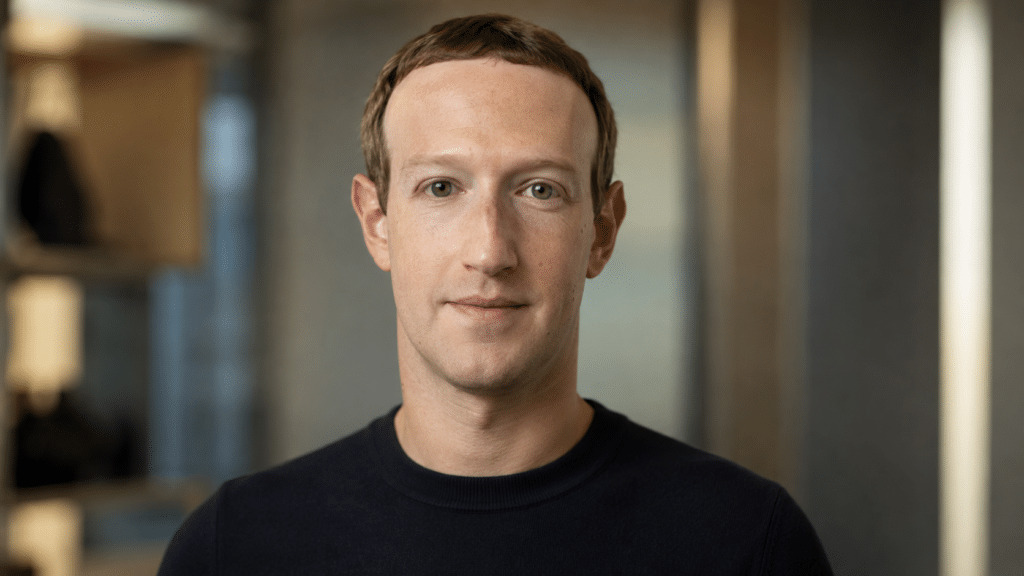
Mark Zuckerberg has been running one of the most powerful companies in the world since he was 19 years old. That’s not luck.
It’s the result of a very specific leadership approach that most business leaders either can’t replicate or wouldn’t want to.
What makes his style worth studying is how he combines structural control with genuine product obsession, and uses both to make bets that would get most CEOs fired.
His journey from building Facemash in a Harvard dorm room to leading Meta Platforms as one of the most influential technology leaders alive shows a pattern. He adapts.
He acquires. He ignores short-term pressure when he’s convinced he’s right about the long term.
And his dual-class share structure means no board can stop him from doing it.
This isn’t a hagiography. His model has real limits, and some of his calls have been genuinely costly.
But if you want to understand how founder control shapes a company’s strategy, Zuckerberg’s leadership journey is one of the clearest case studies available.
What His Leadership Looks Like In Practice
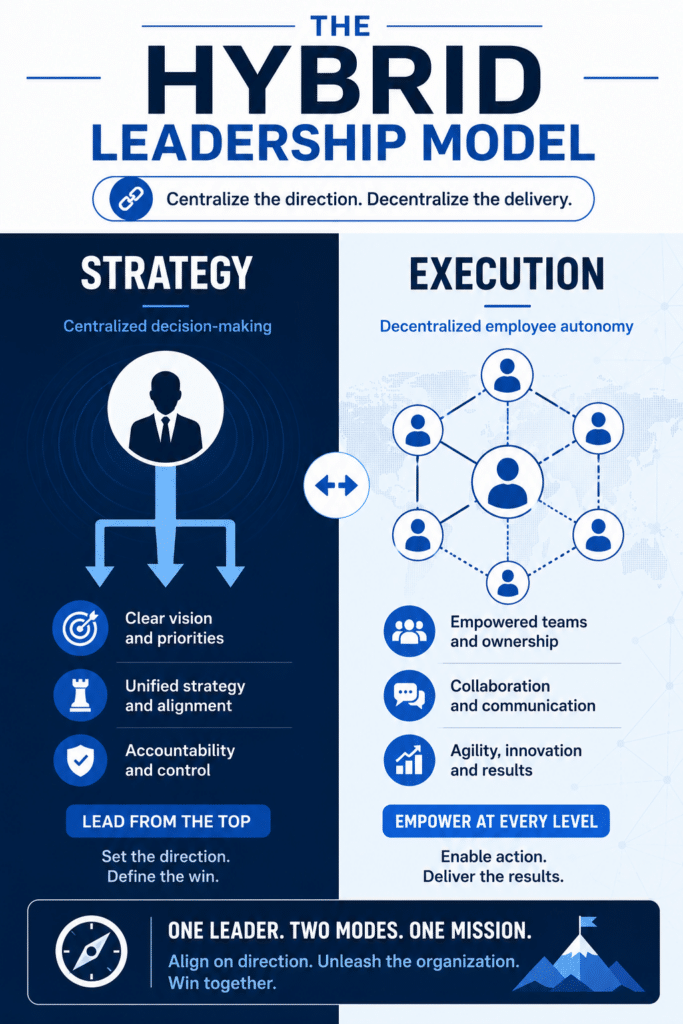
Zuckerberg’s leadership style doesn’t fit neatly into one box. He blends visionary thinking with operational depth, giving teams real autonomy while staying deeply involved in product decisions himself.
Why He Fits A Visionary Yet Hybrid Model
The cleanest label for his approach is a visionary leader who runs a hybrid model in practice.
He sets a long-term strategic vision, sometimes a decade out, and then works backward from it. The metaverse bet is the obvious example.
Most investors hated it. He funded it anyway.
At the same time, he’s not purely top-down. He eliminates unnecessary hierarchy.
His office walls are reportedly made of glass. He’s on record saying he doesn’t enjoy managing people in the traditional sense, preferring to stay close to the work rather than bureaucratic process.
The hybrid label fits because his leadership traits shift depending on what the situation demands. He can be autocratic on product direction and much more open on execution.
How Transformational Leadership Shows Up At Meta
Transformational leadership shows up most clearly in how he frames Meta’s mission.
According to an analysis of his leadership qualities, Zuckerberg consistently connects day-to-day work to a larger purpose around global connectivity and building new platforms.
He hires people who are better than him in specific areas, Sheryl Sandberg being the clearest example, and gives them real ownership.
That’s a core feature of transformational leadership: inspiring people to perform at a level beyond what they thought possible by tying their work to something bigger.
Where Laissez-Faire And Autocratic Tendencies Coexist
This is the interesting tension. On one hand, Meta has a culture of experimentation and employee autonomy where engineers are trusted to ship and iterate.
On the other hand, Zuckerberg has said directly that he doesn’t actually believe in delegating much.
As noted in reporting from Wall Street Waves, he told an interviewer: “I don’t actually believe in delegating that much.”
The laissez-faire culture applies to execution. The autocratic control applies to strategic direction.
Both can coexist when the CEO is also the founder with majority voting power.
The Moat Of Absolute Control
What separates Zuckerberg from most CEOs is structural. His control over Meta isn’t just cultural or reputational.
It’s baked into the company’s legal architecture, and that architecture changes every incentive in the building.
How The Dual-Class Share Structure Changes Incentives
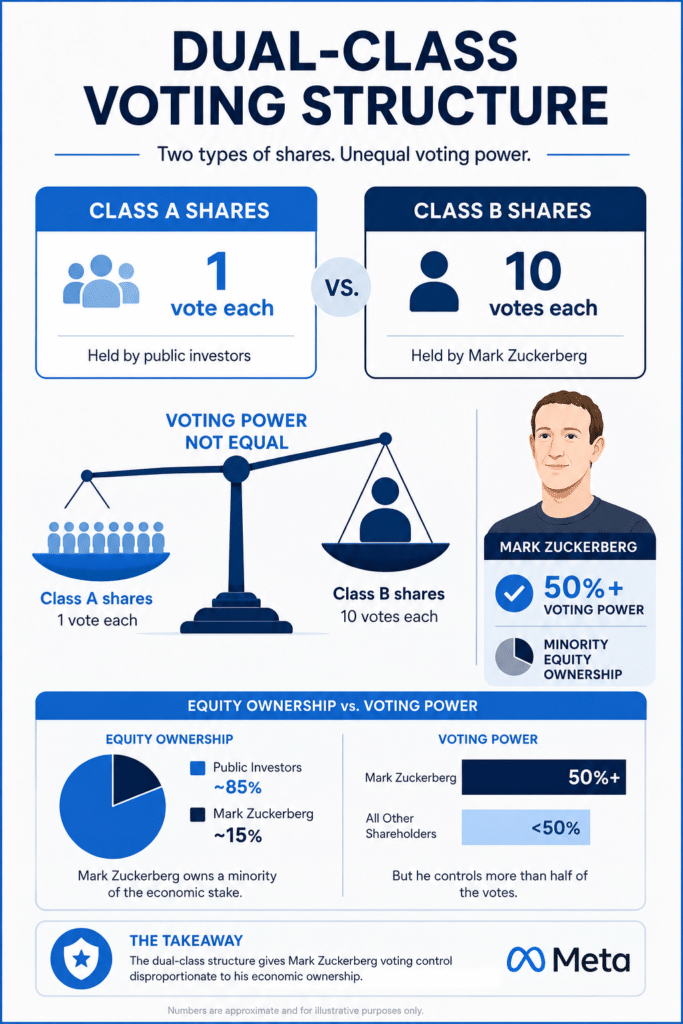
Meta uses a dual-class share structure where Zuckerberg holds Class B shares with significantly more voting power than the Class A shares available to public investors.
In practice, this means he controls the company’s strategic decision-making even if he owns a minority of the total equity.
This matters enormously. Most public company CEOs face constant pressure from activist investors and quarterly earnings expectations.
Zuckerberg doesn’t have to optimize for the next quarter. He can take risks that would cost another CEO their job, because no shareholder coalition can remove him.
The structure makes him, for practical purposes, un-fireable. That’s a moat in itself.
Why Founder Control Enabled Unpopular Long-Term Bets
The $1 billion acquisition of Instagram in 2012 was widely mocked at the time. Instagram had no revenue, a small team, and a product many saw as a niche photo filter app.
Wall Street didn’t love it. Zuckerberg bought it anyway, because he saw mobile-first social media threatening Facebook’s core app.
The same logic applied to the $19 billion WhatsApp acquisition in 2014 and the purchase of Oculus VR the same year.
These were long-term vision plays, not moves optimized for the next earnings call.
As outlined in Vectree’s breakdown of his strategic framework, his “Mission-First” philosophy prioritizes the 10-year roadmap over short-term market pressure.
A CEO without founder control almost certainly couldn’t have made those calls.
What The Mobile Pivot Revealed About Strategic Conviction
In 2012, Facebook was still largely a desktop product. Mobile was growing fast and Facebook’s mobile experience was poor.
Zuckerberg made the call to rebuild the company around mobile, even though it hurt short-term metrics and required significant internal disruption.
That pivot is now considered one of the smartest strategic decisions in tech history. It also would have been very hard to execute under normal public company governance.
Shareholders who were watching the stock drop during the transition could have forced a reversal. Founder control meant that didn’t happen.
How He Makes Big Product Calls
Zuckerberg’s product decisions aren’t purely intuitive. He runs a system that combines data-driven decision-making with direct engineering involvement, and he stays close enough to the product to make judgment calls that pure data can’t make for him.
Data-Driven Decision Making And A/B Testing
Meta is one of the most sophisticated A/B testing organizations in the world. Before any significant product change goes live at scale, it typically runs through experimentation cycles where different versions are tested on subsets of users and performance is measured against clear metrics.
Zuckerberg’s data-driven decisions approach means he expects teams to show evidence, not just intuition.
This creates a culture where product launches are built on user experience data rather than assumptions. It also means bad ideas get killed faster because the numbers are hard to argue with.
Rapid Iteration, Experimentation, And User Experience
The old motto “move fast and break things” wasn’t just a slogan. It described a real operating philosophy where shipping quickly, learning from real user behavior, and iterating rapidly was preferred over long development cycles.
Even as Meta has grown into a massive infrastructure company, the culture of experimentation has stayed embedded. Teams are expected to test, learn, and adjust.
Scalability concerns are real, but they don’t override the bias toward trying things.
Balancing Engineer Thinking With CEO Judgment
Zuckerberg is a trained engineer, and that background shapes how he reviews products. He asks technical questions most CEOs wouldn’t think to ask.
He can tell when an engineering trade-off is being hidden behind a business justification.
As noted in a piece on his mix of engineer and CEO thinking, this dual lens is rare.
It means his product decisions carry both strategic vision and technical credibility. Teams can’t easily bluff him on what’s actually hard to build.
The Fast Follower Playbook
One of the most misunderstood parts of Zuckerberg’s strategy is his willingness to copy. He’s not trying to be first.
He’s trying to win, and sometimes those are very different things.
Why Distribution Often Beats Being First
Snapchat invented ephemeral stories. TikTok popularized short-form vertical video in the West.
In both cases, the feature or format was genuinely new. Meta didn’t invent either of them.
But Meta had something the originators didn’t: billions of users already inside its apps. When you have that kind of distribution, you don’t need to be the innovator.
You need to recognize a real user behavior quickly and give your existing audience a version of it before they migrate elsewhere. That’s a different skill set, and Zuckerberg has built Meta’s culture around it.
How Meta Used Feature Copying To Defend Its Core Apps
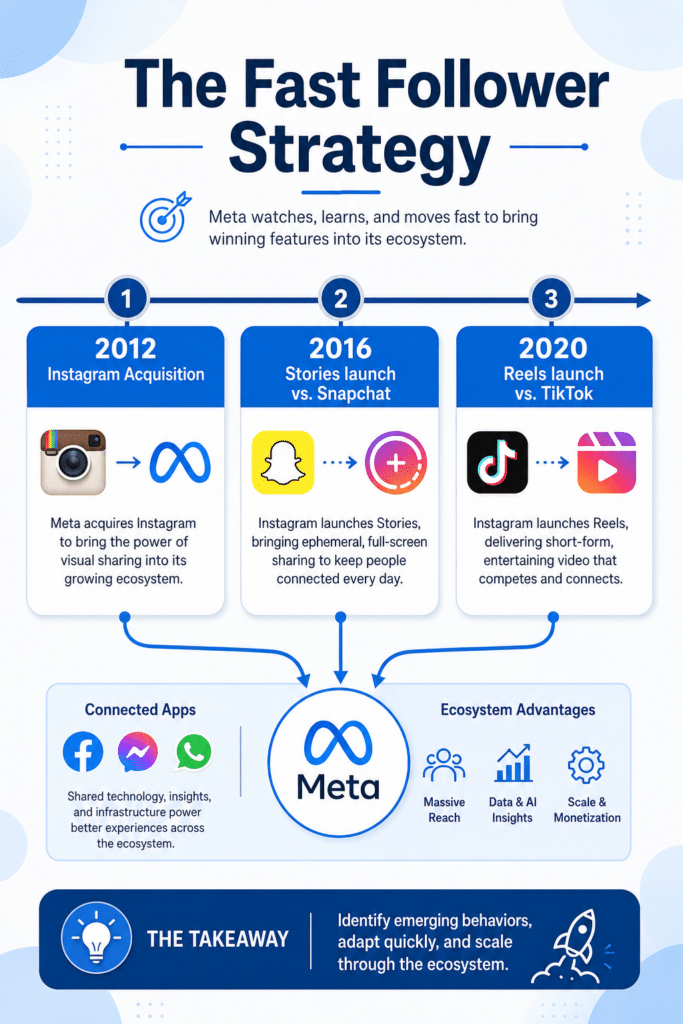
Stories launched on Instagram in 2016, directly replicating Snapchat’s core feature. Reels launched on Instagram in 2020, directly responding to TikTok’s growth.
In both cases, the strategic thinking was straightforward: if users want this behavior, they should be able to find it inside Meta’s ecosystem.
The innovation culture at Meta isn’t about being the most creative company in tech.
It’s about rapid iteration on what’s already working, applied at a scale competitors can’t match. That’s a legitimate competitive strategy.
The Logic Of Cannibalizing Your Own Products Early
The deeper insight from the fast follower playbook is about internal cannibalization. Zuckerberg has repeatedly shown a willingness to launch products that compete with his own existing products.
Instagram Reels competes for time that users might otherwise spend on Facebook. That’s fine with him.
The logic is that you’d rather have your users shift to a new product you own than lose them to a competitor. It requires real confidence to shrink one part of your own business deliberately.
Most organizations protect internal turf. Meta’s digital transformation playbook treats self-disruption as a survival tool.
Building New Platforms Through Bets And Acquisitions
Zuckerberg’s platform-building strategy has two modes: buying what he can’t build fast enough, and investing in entirely new technology categories before they reach mainstream adoption.
Instagram, WhatsApp, And Oculus VR As Strategic Moves
Each of Meta’s major acquisitions followed a clear pattern. Instagram was a mobile-first social product that threatened Facebook’s core.
WhatsApp was messaging at global scale, particularly in markets where SMS was expensive. Oculus VR was a bet on hardware and spatial computing before either was commercially viable.
These weren’t purely financial acquisitions. They were strategic acquisitions designed to either neutralize threats or establish early positions in emerging platforms.
The Instagram and WhatsApp deals in particular have been validated by how central both apps are to Meta’s revenue today.
From Virtual Reality To The Metaverse Pivot
The metaverse pivot, announced when Facebook rebranded to Meta Platforms in 2021, was Zuckerberg’s most expensive and most criticized long-term bet.
He committed tens of billions of dollars to virtual reality and augmented reality infrastructure, even as the core business was generating strong profits.
The criticism was real. Meta lost over $40 billion in its Reality Labs division in the years following the pivot.
But Zuckerberg’s position was consistent: the next computing platform after mobile would be spatial, and Meta needed to be building the infrastructure now rather than being caught flat-footed the way Facebook nearly was on mobile.
Why AI Became The Next Reallocation Of Capital
By 2023, it was clear the metaverse timeline was longer than originally projected.
Zuckerberg shifted capital toward artificial intelligence, declaring a year of efficiency internally while simultaneously investing heavily in AI infrastructure and open-source AI through Meta AI.
The move reflected the same logic as the mobile pivot.
Rather than waiting for AI to reshape social media from the outside, he accelerated Meta’s own investment.
The open-source strategy, releasing models publicly rather than keeping them proprietary, was also distinctive and positioned Meta differently from OpenAI and Google in the AI landscape.
Culture, Accountability, And The Limits Of His Model
Zuckerberg’s model has real strengths, but it also has documented failure modes.
Understanding both is what makes it actually useful as a leadership lesson.
Employee Autonomy And Empowerment Inside Meta
Inside Meta, employees have historically been given significant ownership over their work.
The culture rewards curiosity, experimentation, and shipping.
Psychological safety to try things and fail isn’t just a talking point; it’s embedded in how teams are evaluated.
Naomi Gleit, Meta’s longtime head of product, has spoken publicly about Zuckerberg’s commitment to continuous learning and how it shapes the company’s culture.
Employee empowerment works at Meta because it’s paired with clear mission alignment.
People know what they’re optimizing for.
Public Relations Crises And Regulatory Pressure
The Cambridge Analytica scandal in 2018 was the most significant public relations crisis in Meta’s history.
It exposed real gaps in how user data was being handled and led to congressional testimony, billions in fines, and sustained regulatory scrutiny across the US and Europe.
Data privacy and misinformation concerns have followed the company since then.
Content moderation at scale is genuinely hard, and Meta’s size means its failures are very public.
The accountability gap between Zuckerberg’s structural control and the platform’s social responsibility has been a consistent point of criticism.
What Leaders Can Learn Without Copying Everything
The lesson from his model isn’t that you should try to replicate his exact structure.
The dual-class share structure isn’t available to most leaders, and absolute founder control has costs as well as benefits.
What you can take from it is the underlying logic: know your long-term direction clearly enough to absorb short-term criticism for it, build systems that let you make decisions based on data rather than politics, and be willing to cannibalize your own products before someone else does it for you.
Those leadership lessons apply whether you control 51% of the votes or none of them.
Frequently Asked Questions
Is he more of an autocratic leader, or does he actually delegate a lot?
He leans autocratic on strategic direction but grants teams execution autonomy. While he avoids delegating major strategic calls, he empowers employees to manage day-to-day operations. This creates a culture where staff have ownership over their specific work but not the company’s fundamental priorities.
Would you call him a transformational leader, and why?
Yes. He connects Meta’s work to a mission beyond profit and has repeatedly reinvented the company rather than protecting the status quo. Transformational leadership is evident in his long-term bets and a culture that rewards intellectual curiosity over bureaucratic safety.
How does he keep people motivated when the pressure’s high?
He relies on mission clarity and intellectual challenge. By framing Meta’s work around global connectivity rather than just revenue, he motivates top talent. This environment attracts engineers and product thinkers who are intrinsically driven by solving difficult, large-scale technical problems.
What are the main traits people associate with his approach to running a company?
The most consistent traits are analytical thinking, risk-taking, and product obsession. He is known for intense focus and the willingness to make unpopular calls. These leadership qualities reflect a preference for strategic conviction and technical excellence over interpersonal warmth.
Is his style closer to laissez-faire, or does he stay hands-on day to day?
He is deeply hands-on, regularly running product reviews and staying close to engineering decisions. Unlike traditional executives, he remains involved in the core work. Laissez-faire elements only appear in the execution autonomy granted to teams, never in his absence from the strategic process.
What’s the “80% rule,” and how does it shape decision-making?
This principle suggests that waiting for perfect information costs more than acting on a strong signal. If you have 80% of the data needed, waiting for the rest is often too expensive. It reinforces Meta’s bias toward moving fast and learning from real-world feedback instead of internal deliberation.

I spent years working in tech and digital publishing, where I saw how quickly industries, brands, and consumer behavior can change. I created Rich Digest to explore the business behind luxury, from iconic products and influential founders to pricing, scarcity, ownership, and brand strategy. My goal is to make the world of luxury business clear, interesting, and easy to understand.