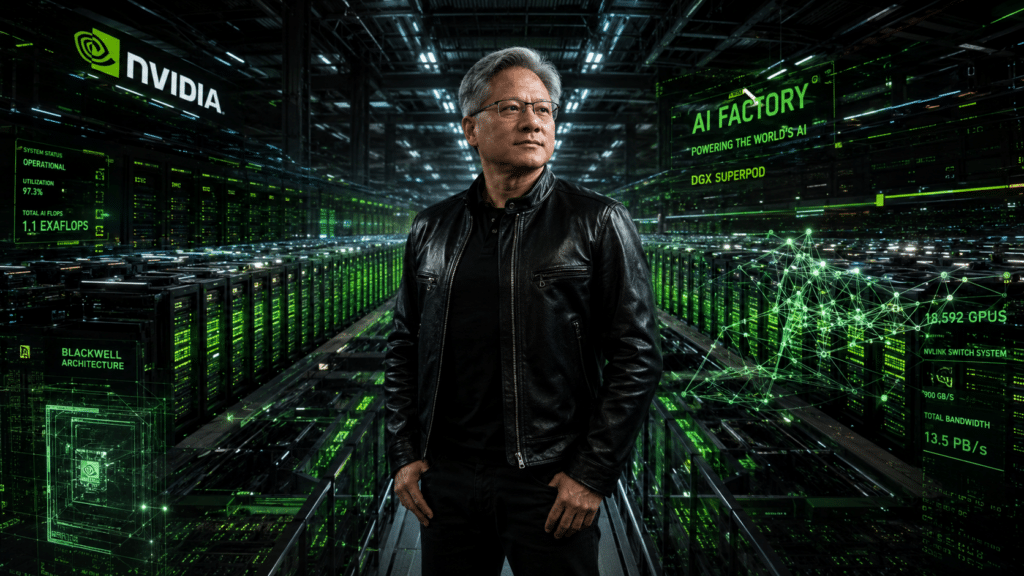
Nvidia is one of the most valuable companies ever built. The standard explanation barely scratches the surface.
Yes, artificial intelligence drove demand. Yes, the stock exploded.
But the real story is about how a chip company spent decades quietly building a platform that the entire AI industry now depends on.
Nvidia’s value comes from a rare combination. Its hardware fits AI perfectly, and its software has made developers dependent. This strategic position forces every major AI builder to pay a toll to get work done.
You are looking at a company that holds somewhere between 70% and 95% of the market for AI accelerator chips, depending on the segment. That is not just a product win.
It is a structural advantage built over many years. It has real reasons behind it.
The sections below break down exactly how Nvidia got here. They explain why the position is so hard to dislodge.
The Real Driver: AI Infrastructure Demand

Artificial intelligence is not just software. Training a large model like the ones behind ChatGPT requires processing trillions of data points through massive neural networks.
That requires serious compute hardware. Nvidia ended up at the center of that need.
Why AI Training And Inference Need Massive Compute
Training a generative AI model means feeding enormous datasets through millions of calculations, over and over, until the model learns patterns.
Inference, the process of running a trained model to answer your questions, is also compute-intensive at scale.
These workloads require hardware that can handle thousands of simultaneous calculations. That is not a CPU’s strength.
As noted in an analysis of GPU versus CPU performance, the Nvidia H100 GPU delivers 989 TFLOPS of TF32 Tensor Core performance, a figure that makes even the fastest CPUs look slow for AI tasks.
How Nvidia Became The Default Supplier For AI Chips
Nvidia was not simply in the right place at the right time. As far back as 2012, Nvidia chips powered AlexNet, the early neural network that became a foundational moment in deep learning research.
That first-mover position gave Nvidia years to refine its hardware and software stack before most competitors realized AI chips were a serious market.
When large-scale AI research from startups like OpenAI started ramping up in the mid-2010s, Nvidia was already the default choice for developers who needed GPU compute.
Why The AI Boom Turned Compute Into A Scarce Asset
When ChatGPT launched and the generative AI race began in earnest, demand for compute surged faster than supply could respond. Nvidia’s flagship chips went on months-long waiting lists.
Startups were renting compute by the hour just to train models.
Nvidia’s Q2 2026 revenue reached $46.74 billion, a 56% increase driven almost entirely by AI infrastructure demand. Compute became a scarce asset, and Nvidia controlled most of it.
Why GPUs Became More Valuable Than CPUs For AI
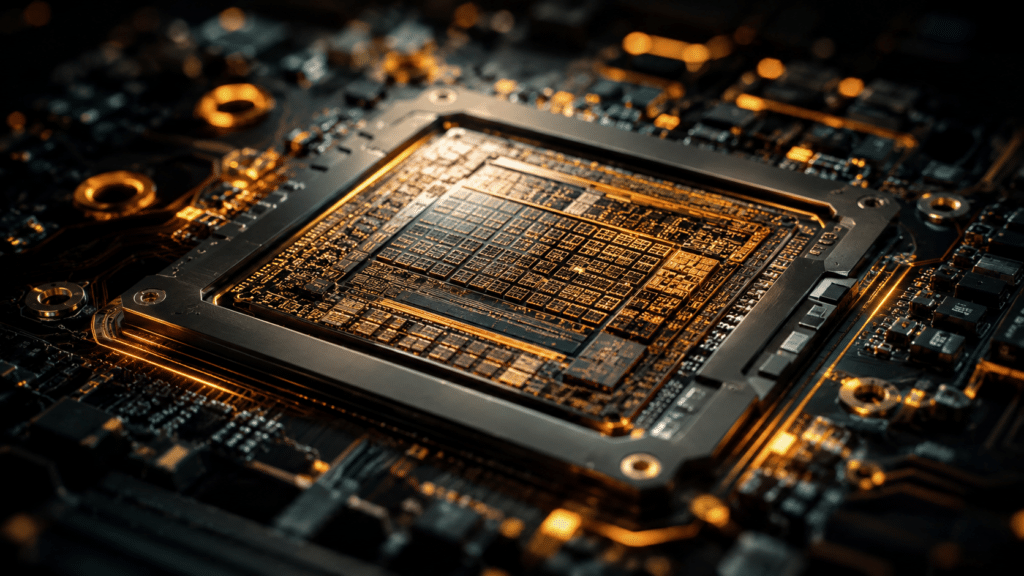
Most people think of a graphics processing unit as something that runs video games.
The deeper truth is that the architecture built for gaming turned out to be a near-perfect match for the math that powers machine learning.
How Parallel Processing Fits Modern AI Workloads
A CPU processes tasks sequentially. It is very fast at complex calculations done one at a time, which is what most traditional software needs.
AI training works differently. It requires thousands of simpler matrix multiplications happening simultaneously.
A GPU is designed for exactly that kind of parallelism. AI training relies on GPUs because the architecture handles massive parallel workloads that would bottleneck a CPU.
The match between GPU design and AI math is not a coincidence; it is why Nvidia’s hardware became indispensable.
From Gaming Graphics Cards To Data Center Compute
Nvidia built its reputation on graphics cards for gaming and professional visualization. That consumer market funded years of GPU research and drove constant improvements in parallel processing power.
When data center demand emerged, Nvidia already had the hardware architecture, the manufacturing relationships, and the engineering expertise to pivot.
The same parallel processing design that rendered game environments also turned out to run neural networks efficiently.
Why Graphics Cards Created An Unexpected AI Advantage
The gaming market gave Nvidia something competitors lacked: years of production scale and a developer community that already knew how to write code for GPU architectures.
When AI researchers needed a platform, Nvidia’s ecosystem was already there.
That transition from consumer graphics cards to data center compute was not inevitable. It required Nvidia to see the AI opportunity early and position its products toward it. The company did exactly that.
The Software Moat Behind The Hardware

Nvidia’s chips are fast, but fast chips alone do not explain why the company has 80% or more of the AI accelerator market. The real lock-in comes from software, specifically a programming platform called CUDA.
CUDA is the layer that sits between Nvidia’s hardware and every AI researcher, developer, and engineer who builds on it. It is why switching away from Nvidia is much harder than swapping chips.
How CUDA Locked In Developers
CUDA, which stands for Compute Unified Device Architecture, launched in 2006.
It gave developers a way to write programs that ran directly on Nvidia’s GPU hardware, unlocking parallel processing power for applications far beyond graphics.
Over the following decade and a half, millions of developers built tools, libraries, research papers, and production systems on top of CUDA.
As noted in a structural analysis of Nvidia’s competitive position, Nvidia built a switching cost so deep that competitors with equal or superior hardware cannot dislodge it.
Why Software Tools Increased Switching Costs
Every AI framework, from PyTorch to TensorFlow, is optimized to run on CUDA. Every library, every tutorial, every research paper assumes CUDA compatibility.
A developer who wants to move to a different chip vendor does not just replace hardware. They potentially rewrite or retune significant amounts of software.
The CUDA ecosystem is the core of Nvidia’s moat, not the hardware itself. That distinction matters enormously when you are trying to understand why the valuation is so high.
The Ecosystem Advantage Competitors Still Chase
AMD makes competitive GPUs. Google and Amazon have custom AI chips. But none of them have a software ecosystem with CUDA’s depth and reach.
Edward Wilford of tech consultancy Omdia put it simply: “Nvidia has done just a masterful job of making it easier to run on CUDA than to run on anything else.”
That ease-of-use advantage compounds over time. As Nvidia did not just build chips but built the entire AI economy, competitors are still chasing an ecosystem that took nearly 20 years to develop.
The Picks-And-Shovels Position In The AI Race
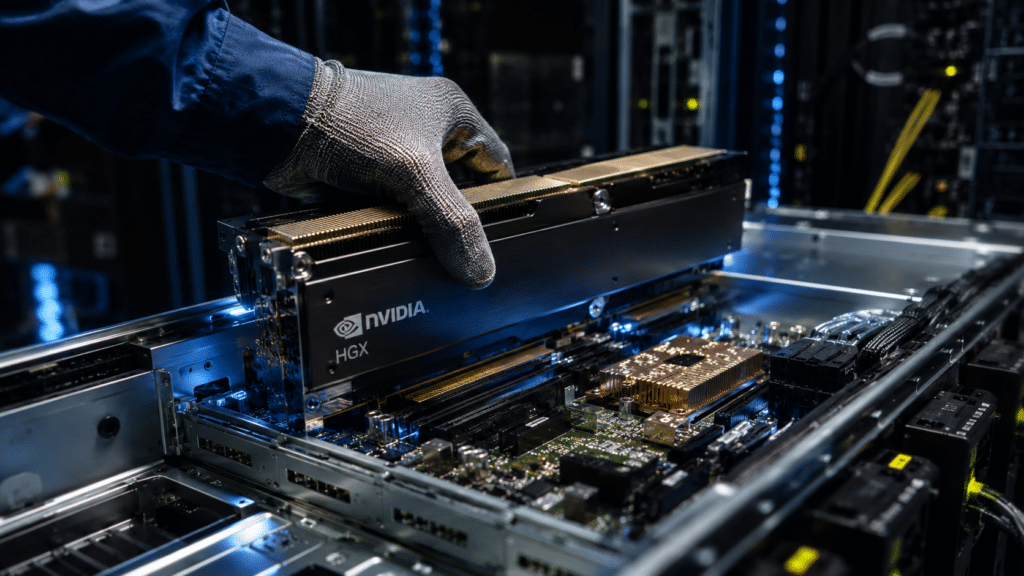
There is a classic investment idea about gold rushes: the people who reliably made money were not the miners but the people selling picks and shovels to the miners.
Nvidia is the picks-and-shovels provider for the AI boom, and its customer list is remarkable.
The company sells AI chips to Amazon, Microsoft, Google, Meta, and Apple. It supplies OpenAI and a long list of AI startups.
Instead of betting on which AI application wins, Nvidia collects from every player building anything meaningful.
Selling To Every Major AI Builder Instead Of Picking One Winner
Every major hyperscaler and most serious AI startups buy Nvidia GPUs. That breadth is strategically powerful. OpenAI needs chips to train GPT models. Google needs them for Gemini.
Meta needs them for its AI infrastructure. Microsoft Azure, Amazon Web Services, and Google Cloud all run Nvidia hardware to serve their enterprise AI customers.
Nvidia does not need to know which company wins the AI race.
As one investment analysis of Nvidia’s position puts it, the company sits at the heart of the AI transformation, powering the compute layer behind everything from chatbots to autonomous vehicles.
How Nvidia Benefits From Spending By Cloud And App Giants
When Microsoft announces a multibillion-dollar AI infrastructure investment, a significant share of that spending flows to Nvidia. The same is true for Amazon, Meta, and Google.
Capital expenditure announcements from the largest technology companies in the world effectively function as forward revenue guidance for Nvidia.
That relationship made Nvidia’s earnings reports a proxy for the entire AI spending cycle. Strong results from the cloud giants tend to mean strong demand for Nvidia chips.
The feedback loop is direct and measurable.
Why Platform Suppliers Often Capture More Value
In many technology waves, the platform layer captures more long-term value than individual applications built on top of it.
The operating system matters more than any single app. The cloud provider captures more than most SaaS companies running on it.
Nvidia’s role as an AI infrastructure provider puts it in that platform layer position. Every dollar spent on AI flows, in meaningful proportion, to Nvidia first.
Why Investors Rewarded The Company So Aggressively

Nvidia stock went from a respected tech name to one of the most talked-about investments in the world within about two years.
The stock price move reflects something specific about how markets price companies that appear to have durable, compounding advantages.
Investors were not just buying current earnings. They were buying the expectation that AI infrastructure spending would grow for years, and that Nvidia would capture the majority of it.
Revenue Growth, Margins, And Market Expectations
Nvidia’s financial results have repeatedly beaten already-high expectations. Revenue grew 56% year over year in Q2 2026, reaching $46.74 billion.
The company has forecast at least 42% revenue growth for the following year. These are not the numbers of a mature company; they are the numbers of a company in the middle of a demand surge.
Gross margins on Nvidia’s data center chips are extremely high, often north of 70%. That combination of rapid revenue growth and strong margins drives aggressive valuations.
How Nvidia Stock Became A Proxy For The AI Trade
By 2024, buying Nvidia stock became the simplest way for investors to express a bet on the AI boom. You did not need to pick which AI application would win. You just needed to believe AI infrastructure spending would keep growing.
Nvidia’s market value surpassed $4 trillion in 2025, fueled by surging GPU demand and data center growth.
It later became the first company to surpass a $5 trillion valuation, a milestone that reflects just how concentrated investor expectations became around AI infrastructure.
What The Valuation Says About Future Demand
Nvidia’s forward price-to-earnings ratio has hovered around 28 times earnings. This is actually modest compared to many high-growth tech companies at similar revenue growth rates.
The valuation reflects market belief that AI spending will compound for years, not just quarters.
Jensen Huang forecast $1 trillion in orders for Nvidia’s most sophisticated AI chips through 2027. This is driven by the explosion of AI adoption.
Whether that forecast proves accurate will determine if the current valuation looks smart or stretched.
What Could Slow The Story Down

Nvidia’s position is strong, but it is not bulletproof. Several real challenges could reduce the company’s dominance over the next few years.
Understanding these risks helps you see where the limits of the advantage actually are.
The biggest threats come from customers building their own alternatives. There is also rising competition from specialized chipmakers and the cyclical nature of infrastructure spending itself.
Custom Chips From Big Tech
Amazon, Google, and Meta are all investing in proprietary AI chips. Amazon has its Trainium and Inferentia chips. Google has its TPUs. Meta is developing custom silicon for its AI workloads.
These companies are Nvidia’s largest customers today. But they have strong financial incentives to reduce their dependence on any single supplier.
If custom chips become good enough for a meaningful share of their workloads, it reduces the total addressable market for Nvidia’s products.
Rising Competition From Broadcom And Others
Broadcom is emerging as a serious competitive threat in custom AI chip design. Rising competition from Broadcom and other chipmakers is real, and it is growing.
AMD continues to improve its AI GPU lineup and has been gaining some traction with cost-sensitive buyers.
The competitive pressure does not need to overtake Nvidia to matter. It just needs to erode margins or market share enough to change the growth trajectory investors have priced in.
Execution Risk, Cyclicality, And Valuation Pressure
Infrastructure spending is cyclical. The same companies spending heavily on AI chips today could pull back if returns on AI investment disappoint or macroeconomic conditions tighten.
Nvidia also faces geopolitical risk, including export restrictions to China that have already reduced revenue.
Valuation pressure is real too. When a company is priced for perfection, even a small miss against expectations can trigger a sharp correction.
Nvidia has already experienced a period where more than $1 trillion was erased from its market value during a panic-driven sell-off. This shows how volatile the expectations game can be.
The Bigger Lesson In Platform Strategy

Nvidia’s rise is not just a story about being in the right industry at the right time. It is a story about how long-term strategy can create advantages that look obvious in hindsight but were far from certain when the bets were made.
Jensen Huang and his team made choices a decade or more before the AI boom. These choices positioned the company perfectly when demand arrived.
How Long-Term Positioning Created A Decade Of Advantage
Nvidia did not pivot to AI after ChatGPT launched. The company invested in AI-targeted hardware and developer tools years before the market validated those bets.
CUDA launched in 2006. Nvidia chips powered AlexNet in 2012. The advantage you see today was being built quietly for over a decade.
The strategy executed to perfection came from consistent investment in both hardware performance and developer ecosystem. These investments compounded over time.
Why Switching Costs Matter More Than Hype
The companies that build lasting value tend to focus on switching costs, not just performance. Switching costs are what make customers stay even when a competitor offers something similar.
CUDA is the most important switching cost Nvidia ever built.
It is worth asking how many other technology investments have created that kind of structural lock-in. The answer is not many.
Operating systems, cloud platforms, and a small number of developer tools have managed it. CUDA belongs on that list.
What Jensen Huang Got Right Early
Jensen Huang recognized early that deep learning was not just a chip problem. It was a full-stack computing problem.
That insight drove Nvidia to invest in software, developer tools, and ecosystem partnerships alongside hardware.
Most competitors focused on the chip alone. Nvidia focused on making its chip the easiest and most capable platform to build on.
That difference—between selling a product and building a platform—is the core lesson of Nvidia’s business case.
Frequently Asked Questions
What does Nvidia actually do to make so much money?
Nvidia designs semiconductors, primarily GPUs, that are used to train and run artificial intelligence models. Its data center segment generates the majority of its revenue, selling chips to cloud companies, AI startups, and enterprises that need compute power for machine learning workloads.
Why has Nvidia’s stock price climbed so fast lately?
The stock price climbed because Nvidia’s revenue grew at extraordinary rates as AI infrastructure spending surged across the industry. Investors recognized that Nvidia was the primary supplier to every major AI builder, making it a direct beneficiary of the entire AI buildout.
How did Nvidia become such a big player in AI and data centers?
Nvidia had been investing in AI-targeted hardware and its CUDA software platform since the mid-2000s. When demand for AI compute exploded after 2022, Nvidia already had the best chips, the deepest developer ecosystem, and the most production-ready hardware, giving it a significant head start over competitors.
Why is Nvidia valued so much higher than AMD?
AMD makes competitive GPUs but lacks the software ecosystem depth that Nvidia has built around CUDA. Millions of developers, frameworks, and production systems are optimized for Nvidia hardware, creating switching costs that AMD has not been able to overcome even when its chips are technically competitive.
Is Nvidia currently the most valuable company in the world?
Nvidia became the first company to surpass a $5 trillion market capitalization, reaching that milestone in late 2025. Its valuation has fluctuated, as any high-growth stock does, but it has consistently ranked among the top one or two most valuable companies in the world since the AI boom accelerated.
What are the biggest risks that could hurt Nvidia’s valuation?
The biggest risks include large customers like Amazon, Google, and Meta building their own custom AI chips to reduce dependence on Nvidia. Rising competition from Broadcom and AMD is another risk. Export restrictions could limit sales to China. The cyclical nature of infrastructure spending is also a concern if AI investment returns disappoint.

I spent years working in tech and digital publishing, where I saw how quickly industries, brands, and consumer behavior can change. I created Rich Digest to explore the business behind luxury, from iconic products and influential founders to pricing, scarcity, ownership, and brand strategy. My goal is to make the world of luxury business clear, interesting, and easy to understand.