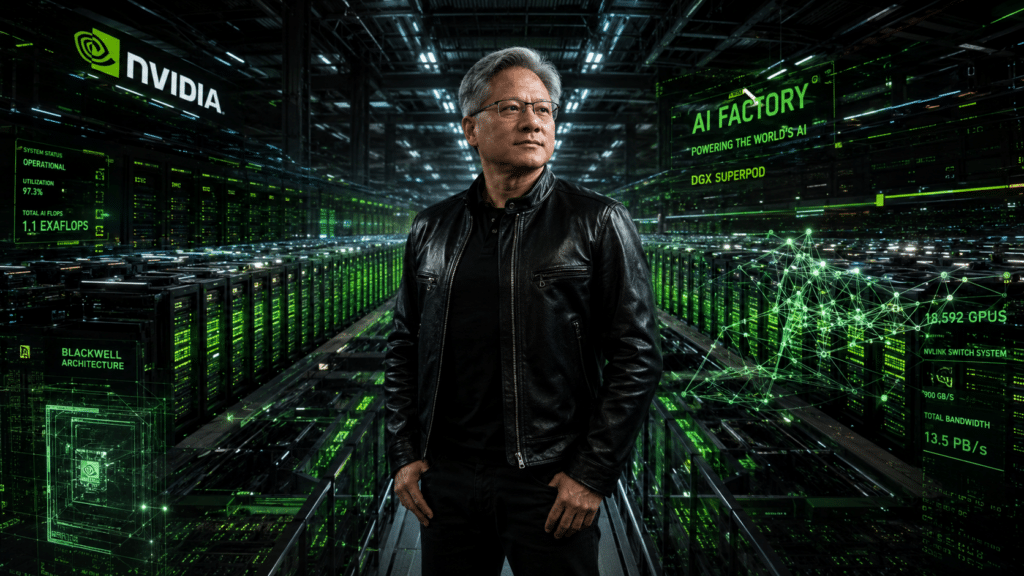
If you want to understand why Jensen Huang became the defining face of the AI era, you don’t start with his net worth or his leather jacket.
You start with a decision Nvidia made in 2006 that almost nobody outside of academia noticed.
That decision, the bet on CUDA, set the stage for everything that followed.
It’s one of the clearest examples in recent business history of how patience and positioning can compound into dominance.
Huang didn’t get lucky when ChatGPT launched.
He’d been building the foundation for over a decade.
And the way he talks about what Nvidia is building makes complex technology feel concrete and urgent, which is rarer than it sounds.
This is a case study in infrastructure, communication, and long-term thinking.
Why Nvidia Won The AI Infrastructure Layer First
Nvidia’s dominance in AI didn’t happen overnight.
It was built on early technical bets, the specific advantages of GPU architecture for machine learning, and a demand surge that turned a niche research tool into the backbone of a global industry.
The CUDA Bet Before The Market Cared
In 2006, Nvidia launched CUDA, a programming platform that let developers use Nvidia GPUs for general-purpose computing tasks beyond graphics.
At the time, the ai chip market had almost no demand for this.
The researchers who found it useful were a small group training early neural networks.
That’s the part worth sitting with.
Nvidia invested in software infrastructure for a customer base that barely existed yet.
CUDA made it dramatically easier for researchers to run parallel computations on Nvidia hardware.
When deep learning started gaining traction in the early 2010s, that head start wasn’t just convenient.
It was structural.
Why GPUs Became The Default Engine For AI Models
Training an AI model requires running millions of small matrix calculations at the same time.
CPUs handle tasks sequentially.
GPUs handle thousands of them in parallel, which is exactly what training deep neural networks demands.
Nvidia’s hardware was already designed for parallel workloads.
CUDA made it accessible.
By the time OpenAI and Google were scaling up, the path of least resistance pointed directly at Nvidia chips.
Switching costs matter here.
Researchers had built workflows around CUDA.
Frameworks like PyTorch and TensorFlow were optimized for Nvidia hardware.
Choosing a competitor meant rebuilding from scratch.
From ChatGPT Hype To Structural Demand
When ChatGPT launched in late 2022, public interest in AI exploded.
But for Nvidia, this wasn’t a sudden windfall.
It was the visible payoff of a long buildup.
The demand that followed wasn’t speculative.
Every major cloud provider, every AI lab, and most large enterprises started racing to build infrastructure.
As noted in a report on Nvidia’s growth, Huang forecasted global AI infrastructure spending could reach $3 to $4 trillion by end of decade.
That’s not hype.
That’s capital allocation at scale.
How Huang Turned Chips Into AI Factories

Huang didn’t just sell hardware.
He reframed what the hardware was for.
The shift from “chip company” to “AI infrastructure platform” is one of the more deliberate positioning moves in modern tech.
The Five-Layer View Of The Market
Huang describes AI as a five-layer stack: energy, chips, infrastructure, models, and applications.
Each layer depends on the one below it.
The layers break down like this:
- Energy: Powers the data centers and compute operations
- Chips: The GPUs that do the actual computation
- Infrastructure: Cloud platforms, data centers, and networking
- Models: The large language models and other AI systems trained on top
- Applications: The products and tools that reach end users
Nvidia sits at layers one through three directly, and influences layers four and five through its developer ecosystem.
That’s a wide surface area.
Why Data Centers Became Intelligence Production Sites
Huang rebranded the data center as an AI factory, a place where data goes in and intelligence comes out.
The analogy isn’t just marketing.
It changes how companies think about their infrastructure budgets.
If a data center produces intelligence the way a factory produces goods, then compute spending is a productive investment, not an IT cost.
That reframe gives CFOs a different mental model for approving large capital expenditures.
The Shift From Hardware Vendor To Platform Company
According to coverage of Nvidia’s GTC 2026 keynote, Nvidia no longer talks like a chip company.
It talks like an infrastructure company building the operating system for the AI economy.
That shift matters because platform companies earn recurring influence.
Hardware vendors get replaced.
Platforms get built around.
The Communication Advantage That Made Him Credible
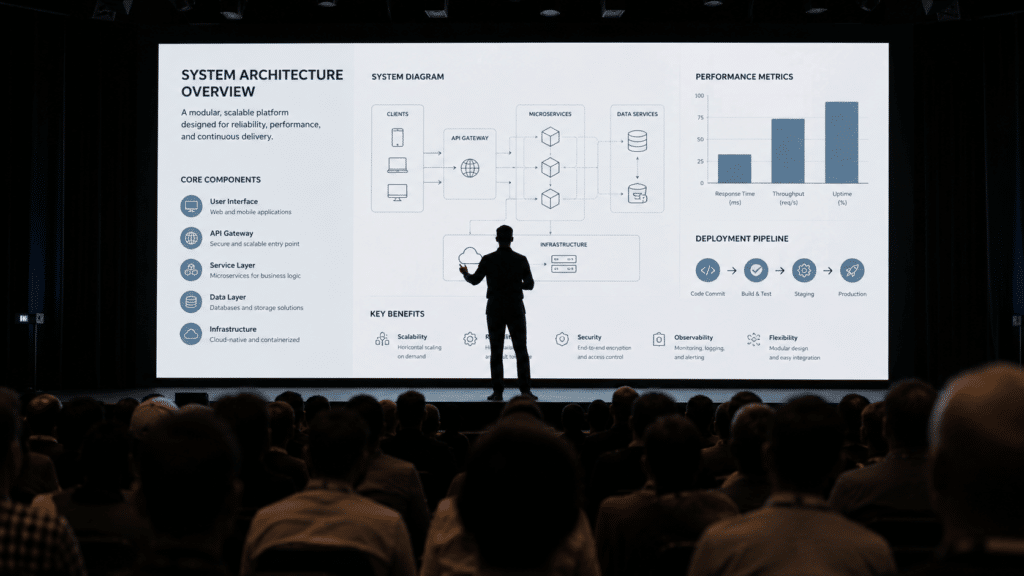
Huang’s technical credibility is real, but what separates him from other chip executives is how he communicates.
He makes a genuinely hard topic feel graspable without making it feel dumbed down.
Why Nvidia CEO Jensen Huang Sounds Different From Other Tech Leaders
Most tech CEOs speak in acronyms or swing to the opposite extreme with vague inspiration.
Huang does something different.
He builds mental models and walks you through them step by step.
Watch any of his keynotes and you’ll notice he starts with first principles.
What is computation?
What does intelligence require?
Why does this architecture solve that problem?
According to an analysis of his communication style, this approach of breaking down complexity is deliberate and consistent.
Consistency, Simplicity, And The Black Jacket Effect
The leather jacket is a minor detail that signals something real.
Huang has worn roughly the same look for years.
It’s a small signal of consistency that mirrors how he communicates: no reinvention, no persona shifts, no sudden pivots in messaging.
His framing of AI as the next industrial revolution has been consistent across Davos appearances, GTC keynotes, and press interviews.
That consistency builds trust faster than novelty does.
How He Made A Complex Market Legible
Huang has a talent for giving abstract ideas a physical shape.
“AI factory” is a great example.
Most people understand what a factory does.
Attaching that word to AI infrastructure gives investors, journalists, and policy makers a frame they can work with.
I think this is underrated as a business skill.
Being the person who names the category, and names it in a way that sticks, gives you enormous influence over how the market understands itself.
What His AI Story Says About Work And Reindustrialization

Huang’s vision for AI isn’t limited to software.
He keeps pointing at physical infrastructure, manufacturing capacity, and the return of industrial-scale building in the West.
Automation Without The Simplistic Layoff Narrative
The easy version of the AI-and-jobs story is: robots take your job, you suffer.
Huang pushes back on that.
As reported by TechCrunch, he’s argued that AI is creating an enormous number of jobs rather than simply eliminating them.
His position is more nuanced than most: AI augments workers, raises their productivity, and creates demand in adjacent roles.
The workers most at risk, in his framing, are those who refuse to learn how to work alongside AI tools.
Why AI Also Creates Demand In Engineering And Skilled Trades
Building AI infrastructure at scale isn’t just a software job.
You need data center construction, power grid upgrades, cooling systems, and chip manufacturing facilities.
All of that requires engineers, electricians, project managers, and skilled tradespeople.
According to discussions at Stanford’s GSB, Huang has framed AI leadership as a trigger for reindustrialization that brings high-skilled manufacturing back to the West.
Factories, Power, And The Return Of Industrial Capacity
Huang has called the current moment the largest infrastructure buildout in human history.
That’s a big claim, but the capital flowing into data centers, chip plants, and power generation supports it.
This isn’t just about software companies getting bigger.
It’s about physical capacity being built at scale.
Factories, transmission lines, semiconductor fabs.
The AI economy has a very large material footprint.
Beyond Chatbots: The Bigger Markets He Keeps Pointing To
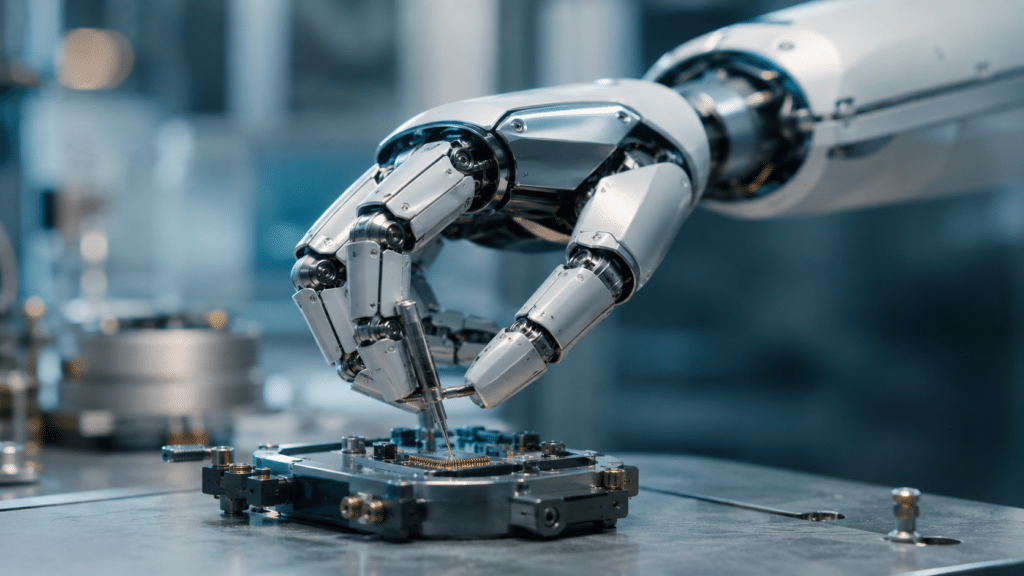
Huang has been consistent about one thing: chatbots are not the destination.
They’re the first visible application of a much broader platform shift.
Robotics And The Physical World
AI moving into physical systems is the shift Huang talks about most when he describes where the industry is heading next.
Robots that can perceive, reason, and act in unstructured environments represent a different class of application than software agents.
Nvidia’s investment in robotics platforms reflects this view.
The same GPU infrastructure that trains language models also trains the neural networks that give robots spatial awareness and motor control.
Self-Driving Cars As Embodied AI
Self-driving vehicles are one of the clearest examples of what Huang calls physical AI, intelligence that acts in the real world rather than generating text on a screen.
Nvidia has been supplying compute to autonomous vehicle programs for years.
As noted in coverage of Huang’s GTC keynotes, physical AI is one of the four stages of AI evolution he maps out, moving from perception to generation to agency to embodiment.
Drug Discovery, Open Source, And Industry-Specific Models
AI’s impact on drug discovery is real and growing.
Models that can predict protein folding, simulate molecular interactions, or identify drug candidates compress timelines that used to take years.
Huang also consistently points to open-source AI models and industry-specific applications as key vectors of AI adoption.
Open models lower the barrier for smaller organizations and accelerate deployment across healthcare, finance, and scientific research.
The Real Lesson In Patience, Positioning, And Power

What’s most instructive about Jensen Huang’s story isn’t the scale of what Nvidia became.
It’s the sequence of decisions that got it there.
Why Long-Term Platform Bets Beat Short-Term Hype
The CUDA investment looked like an expensive distraction in 2006.
It became a structural moat by 2016 and an insurmountable advantage by 2023.
That’s a 17-year payoff window.
Most companies can’t hold a conviction that long because quarterly earnings pressure forces short-term optimization.
As explored in a piece on Nvidia’s long-term thesis, Huang’s patience isn’t passive.
It’s strategic, holding a vision long enough for the world to prove you right.
How Taiwan, Supply Chains, And Scale Shaped The Story
Nvidia doesn’t manufacture its own chips.
It designs them and relies on TSMC in Taiwan for fabrication.
That relationship with one of the world’s most advanced chip foundries gave Nvidia access to cutting-edge manufacturing without building its own fabs.
The AI infrastructure buildout that Huang keeps describing depends heavily on that supply chain.
Taiwan’s role in global chip production is both a competitive advantage for Nvidia and a geopolitical pressure point worth watching.
What You Can Learn From Huang Without Copying Him
You probably can’t replicate Nvidia’s position.
The specific combination of CUDA timing, GPU architecture fit, and supply chain relationships isn’t a playbook you can apply wholesale.
What you can borrow is the structure of the thinking:
- Pick an infrastructure layer, not just a product
- Build for the customers who don’t exist yet
- Stay consistent long enough that the market comes to you
I’ve noticed that the businesses that age best tend to be the ones that picked a foundational bet early and had the discipline not to abandon it when it looked slow.
Huang’s story is a clean example of that pattern.
Frequently Asked Questions
How did he become one of the most influential people in modern computing?
Huang co-founded Nvidia in 1993 and made a series of long-term bets, most notably the 2006 CUDA platform, that positioned Nvidia as the essential infrastructure layer for AI. When deep learning and generative AI scaled up, Nvidia was already the default choice because of its software ecosystem and hardware advantages. His ability to communicate a clear vision of where computing was heading reinforced his influence beyond the chip industry.
What’s his estimated net worth, and how did he build it?
As of 2025 and into 2026, Jensen Huang’s net worth is estimated in the range of $100 billion or more, driven primarily by his stake in Nvidia. He built it through decades of equity ownership in Nvidia as the company grew from a graphics chip startup into one of the world’s most valuable companies. The AI boom accelerated that value significantly as Nvidia’s market capitalization surged past $3 trillion.
How old is he, and where did he grow up?
Jensen Huang was born on February 17, 1963, making him 63 years old as of early 2026. He was born in Tainan, Taiwan, and moved to the United States as a child, eventually attending Oregon State University and later Stanford, where he earned his master’s degree in electrical engineering.
What nationality is he, and what’s his background?
Huang is an American citizen of Taiwanese descent. He immigrated to the United States from Taiwan as a child and built his career in the American semiconductor industry. His background combines an engineering education in the U.S. with deep roots in the Taiwanese tech ecosystem, which shaped Nvidia’s manufacturing relationships with TSMC.
Who is he married to, and what does his wife do?
Jensen Huang is married to Lori Mills Huang, whom he met while they were students at Oregon State University. Lori has worked at Nvidia in various roles over the years and has been a consistent part of his personal and professional life throughout Nvidia’s growth.
Does he have kids, and what’s known about his family (like his daughter)?
Jensen and Lori Huang have two children. Their daughter, Madison Huang, has been publicly associated with the family but largely stays out of the spotlight. The family has maintained a relatively private profile given the level of public attention Huang receives as one of the most prominent CEOs in the tech industry.

I spent years working in tech and digital publishing, where I saw how quickly industries, brands, and consumer behavior can change. I created Rich Digest to explore the business behind luxury, from iconic products and influential founders to pricing, scarcity, ownership, and brand strategy. My goal is to make the world of luxury business clear, interesting, and easy to understand.