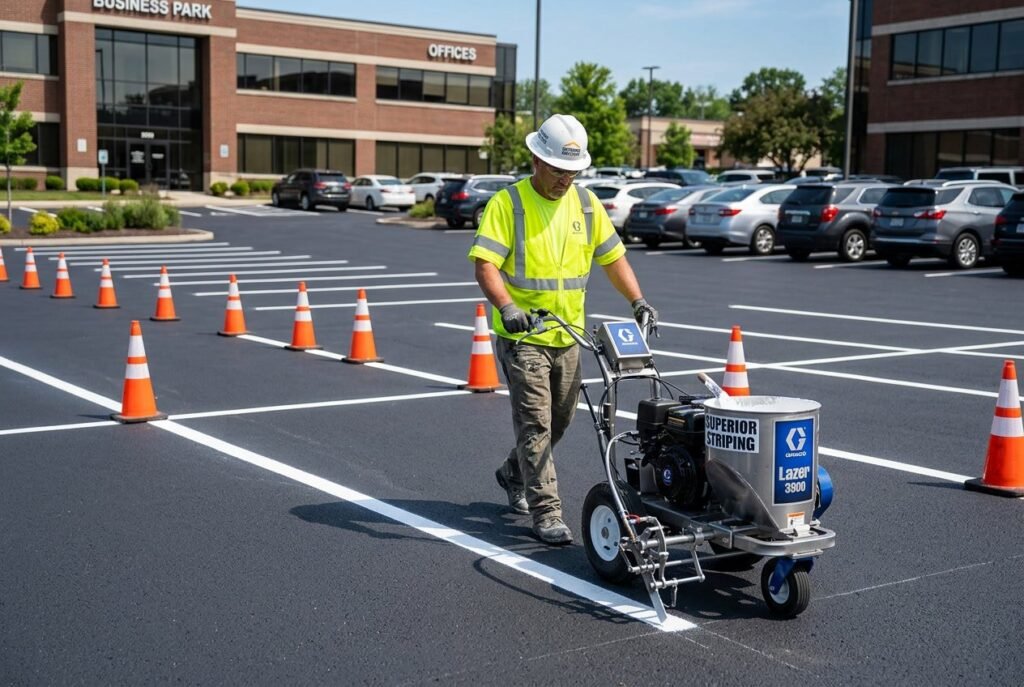
Every shopping center, office building, and apartment complex you pass needs fresh parking lot lines every few years. This regular maintenance creates a steady, reliable stream of work for any local striping company.
A parking lot striping business paints lines, arrows, and handicap symbols on asphalt and concrete surfaces. You help commercial properties maximize their parking space and stay compliant with safety regulations.
Because you can start with a basic striping machine and a few stencils, it’s widely considered one of the best low-cost business ideas with high profit in the commercial maintenance space.
The job combines outdoor physical work with running your own business. You’ll measure parking spaces, paint clean lines, and help properties stay safe and organized.
This overview walks you through what striping professionals do on a daily basis, who needs their services, and what it takes to succeed in this field.
What Is a Parking Lot Striping Business?
A parking lot striping business paints lines and markings on parking lots to create organized spaces for vehicles. You use special equipment to apply paint or other materials to pavement surfaces. This creates clear parking spaces, traffic lanes, arrows, and handicapped zones.
The work involves pavement marking that helps drivers know where to park and how to move through the lot safely. Your parking lot striping services are a vital part of pavement maintenance that helps businesses stay organized and meet local rules.
What you do in a line striping business:
- Paint fresh lines on new parking lots
- Refresh faded markings on existing lots
- Mark handicapped spaces following ADA rules
- Create fire lanes and no-parking zones
- Add arrows and directional markings
- Paint custom stencils for reserved spots
Your parking lot line striping work serves different types of customers. Shopping centers need clear markings for customer parking. Schools want safe drop-off zones. Offices need employee parking layouts. Hospitals require accessible spaces for patients.
The equipment you use includes striping machines that spray paint in straight lines. You also need stencils for symbols and letters. Most jobs use specialized paint designed for outdoor surfaces that can handle weather and traffic.
This type of business focuses on making parking areas functional and safe. Property owners hire you to maximize their parking space and follow local regulations. Your work helps prevent confusion and accidents in busy parking areas.
What Does a Line Striping Contractor Actually Do?
You’ll spend most of your time painting lines on asphalt and concrete surfaces. The job involves applying traffic paint to create parking spaces, directional arrows, crosswalks, and handicap symbols. You’re basically organizing chaos and making parking lots safe and functional.
Before you even touch paint, you need to handle surface preparation. This means cleaning the pavement with blowers and pressure washers to remove dirt, oil, and debris. If there are oil spots, you’ll treat them so the paint actually sticks.
Many striping professionals also offer related services like sealcoating, crack filling, and pothole repair. Investing in sealcoating equipment allows you to earn more per job and provide a one-stop solution for customers.
The actual painting process involves:
- Measuring and laying out the parking lot layout using chalk lines and tape
- Using striping machines to apply paint in straight, even lines
- Adding symbols with stencils for ADA spaces and fire lanes
- Applying two coats for durability
You’ll work with different paint types depending on the job. Oil-based paint lasts longer but takes more time to dry. Eco-friendly paint options are growing in popularity as more property managers want sustainable choices.
Most jobs take just a few hours, and many striping companies work overnight or during off-hours to avoid disrupting businesses. You’ll also need to stay current with ADA requirements and local regulations to keep your clients compliant with the law.
Who Hires a Line Striping Contractor?
You’ll find customers for your striping business across many different industries. Commercial property owners make up a large part of your potential client base.
Shopping centers and retail stores need regular striping to keep their parking areas looking clean and organized. Office buildings hire stripers to maintain professional appearances for their tenants and visitors.
Property management companies often sign maintenance contracts to keep multiple properties in good condition throughout the year. Facility managers also rely on these services to maintain safety standards.
Schools and universities need striping services for their parking lots and campus roadways. These institutions typically require work during summer breaks when fewer people are on campus.
Municipalities and government agencies hire striping professionals for public parking areas, streets, and recreational facilities. Airports need specialized striping for their complex parking structures and drop-off zones.
Hospitals and medical centers want clear markings to help patients and emergency vehicles navigate their lots safely. Hotels and entertainment venues like stadiums or amusement parks need striping to handle large volumes of traffic.
Industrial and warehouse facilities also need parking lot striping for employee parking and loading zones. Inside these buildings, warehouse floor marking helps keep forklift traffic and pedestrians separated for safety. Restaurants and fast-food chains require drive-through lane markings and customer parking spaces.
Many of these clients prefer working with contractors who offer maintenance contracts. These agreements provide regular restriping services to keep markings visible and compliant with regulations.
Property managers especially like maintenance contracts because they simplify budgeting and ensure their properties stay in good condition year-round.
Some clients need one-time projects while others want ongoing relationships. Building a mix of both types helps you create steady income for your business.
What Problems Does a Parking Lot Striping Business Solve?
A parking lot striping business helps property owners fix several key problems. Without clear markings, parking lots become chaotic and unsafe for drivers and pedestrians.
Safety and Organization Issues
Faded or missing lines make it hard for drivers to know where to park. This leads to poor spacing between vehicles, blocked fire lanes, and confused traffic flow. Fresh striping creates order and reduces the risk of accidents.
Compliance Requirements
Property owners need to meet ADA compliance standards for their parking areas. This includes proper markings for handicap spaces with the right size and location. Without these markings, businesses face potential fines and legal issues.
Property Value and Appearance
A parking lot with worn-out stripes looks neglected. This gives customers a bad first impression before they even enter the building. Clean, bright lines make the entire property look more professional and well-maintained.
Key Problems You’ll Address:
- Unclear parking boundaries that cause disputes between vehicles
- Missing or incorrect handicap accessible spaces
- Faded markings that create safety hazards
- Non-compliant layouts that put property owners at risk
- Poor traffic flow that causes congestion and frustration
- Lack of designated areas for loading zones, fire lanes, and special parking
By offering parking lot striping services, you help businesses avoid these headaches. Your work ensures their lots stay safe, compliant, and attractive to customers.
What Is the Work Like Day-to-Day?
Your typical day starts early. Many parking lot striping jobs happen in early mornings or overnight to avoid disrupting business hours.
You’ll spend time preparing surfaces by cleaning and removing old paint or debris. This makes sure your lines stick properly and look clean. Then you’ll measure and mark layouts using chalk or string to ensure everything is straight and meets code requirements.
Your main tasks include:
- Operating striping machines to apply paint or thermoplastic
- Measuring parking spaces and marking layouts
- Setting up safety cones and barriers
- Cleaning and maintaining equipment after each job
Safety gear is important throughout your day. You’ll wear high-visibility vests so drivers can see you easily. Depending on the job, you might also need hard hats, safety glasses, and reflective clothing.
Equipment maintenance is a regular part of the work. You’ll clean your striping machines, check paint levels, and make sure everything works properly. Taking care of your tools helps them last longer and prevents breakdowns during jobs.
You’ll often work with a team to finish projects on schedule. Some jobs take just a few hours while larger parking lots might need a full day or more. The work is physical since you’re standing, walking, and moving equipment around most of the time.
Weather affects your schedule too. Rain or extreme heat can delay jobs since paint needs dry conditions to cure properly.
Who Is a Good Fit for a Parking Lot Striping Business?
This business works well if you like working outdoors and don’t mind physical activity. You’ll spend most of your time on your feet in parking lots, so comfort with manual labor matters.
People who thrive in this business often have:
- Basic measuring and layout skills
- Attention to detail for straight lines
- Comfort working alone or with a small crew
- Willingness to work nights and weekends when lots are empty
You don’t need years of training or special certifications to get started. Many successful striping business owners learned the trade through online courses and hands-on practice. If you can follow instructions and work carefully, you can learn the technical skills.
This business appeals to entrepreneurs who want lower startup costs compared to other trades. You can research how to start a line striping business and decide if you want to be a sole proprietorship, partnership, or a limited liability company.
Current contractors in related fields make great candidates. If you already handle sealcoating, asphalt repair, or property maintenance, adding striping gives you another service to offer your existing customers.
You might not be a good fit if you:
- Prefer indoor work
- Need a steady 9-to-5 schedule
- Dislike repetitive tasks
- Can’t handle seasonal income fluctuations (in northern climates)
The work requires patience and precision. Rushed jobs show mistakes easily, so you need a personality that values doing things right over doing them fast. You should also feel comfortable talking to property managers and business owners since you’ll need to market your services directly to them.
Pros and Cons of Running a Parking Lot Striping Business
Starting this type of business comes with real advantages like low startup costs and flexible scheduling, but you’ll also face challenges such as physical demands and weather-related work limitations.
Pros
The startup costs for a parking lot striping business typically range from just $62 to $35,923, making it one of the more affordable businesses to launch. You won’t need expensive equipment or a fancy office space to get started.
You’ll have complete control over your schedule and workload. You can choose which clients to work with and decide how many projects to take on each week. This flexibility lets you balance work with your personal life in ways traditional jobs don’t allow.
The business model is straightforward and easy to understand. You paint lines on parking lots and get paid for it. Customers tend to stick around because parking lots need regular maintenance, giving you a predictable income stream.
Your earning potential isn’t capped by an hourly wage. The more efficiently you work and the more clients you serve, the more money you make. Plus, you’ll get plenty of physical activity during your workday, which keeps you active and healthy.
The demand for professional striping services stays strong even during economic downturns. Businesses need safe, well-marked parking areas regardless of the economy. Scalability is built into this business—you can start solo and expand by hiring additional crews as you grow.
Cons
The work is physically demanding. You’ll spend long days on your feet, often in hot weather, bending and walking for hours. This can be tough on your body over time.
Weather directly impacts your ability to work. Rain, extreme heat, or cold temperatures can force you to reschedule jobs, which means unpredictable income during certain seasons.
You’ll need liability insurance and general liability insurance to protect yourself from claims if someone gets hurt or property gets damaged. Commercial auto insurance covers your work vehicles, and commercial property insurance protects your equipment. These expenses add up and cut into your profits.
You’ll need to check local regulations to see if you need a specific contractor license in your area. You also need to apply for an EIN from the IRS to open a business bank account. Finding consistent clients takes time and effort as you build your reputation.
How to Succeed as a Line Striper Contractor
Success in the striping industry starts with a solid plan. When you start a parking lot striping business, you need a clear business plan that outlines your services, target customers, and growth goals.
Your parking lot striping business plan doesn’t need to be complicated, but it should map out how you’ll attract and keep customers.
Marketing strategies make the difference between struggling and thriving. Focus on building a professional online presence with before-and-after photos that showcase your work quality. These photos prove your skills to potential clients better than any sales pitch.
Key actions for building your reputation:
- Create a Google Business Profile so local customers can find you
- Target property managers and facility directors who make hiring decisions
- Ask satisfied customers for referrals and online reviews
- Network at local business events to meet potential clients
Customer retention keeps your business stable. Since most commercial properties need fresh striping every 1-2 years, staying in touch with past clients creates repeat business. Send friendly reminders when their lots are due for maintenance.
Using software like Jobber or Housecall Pro can help you manage your schedule and invoicing professionally. Keeping accurate financial statements is also important to track your profitability as you grow. Quality work and professional systems will help your reputation grow.
Building relationships with property owners creates long-term success. Show up on time, communicate clearly, and deliver what you promise. When you start a line striping business, your reputation becomes your most valuable asset.
Frequently Asked Questions
Striping businesses require specialized equipment and knowledge to get started. Most beginners want to know about earnings potential, equipment costs, and how to avoid common mistakes when starting a parking lot striping business.
You can charge $4 to $8 per parking space for standard stalls. Some premium markets or complex jobs reach $15 to $20 per stall.
A typical job for a 30 to 50 stall lot ranges from $425 to $1,200. Most jobs average around $850 to $1,000. Larger commercial properties can generate jobs worth $6,000 or more.
Your actual earnings depend on your pricing strategies and how many jobs you complete. Many contractors charge 25 to 50 percent premiums for after-hours work. Night and weekend jobs let you service busy locations without disrupting daily operations.
Industry professionals report earning around $50 per hour for striping work. Gross profit margins typically range from 30 to 60 percent for owner-operated businesses that manage costs carefully.
Your main tool is a line striper, also known as a striping machine. You can choose between walk-behind models or ride-on machines.
Walk-behind models work well for smaller lots and cost less initially. Ride-on machines become necessary for larger commercial projects because they increase speed and reduce fatigue.
You also need measuring tools like a 300-foot measuring tape and a measuring wheel. Chalk lines and marking paint help you establish layouts before final striping. Traffic paint comes in latex or solvent-based options, with water-based paints drying faster and oil-based options lasting longer.
Essential striping equipment includes stencils for handicap symbols, arrows, and lettering. Traffic cones protect wet paint and manage lot access during work. High-visibility safety vests keep you visible to drivers during early morning or evening jobs.
Start by measuring the square footage and assessing layout complexity. More complex layouts with angled spots, islands, and various stall sizes take more time to complete. New layouts cost 20 to 50 percent more than restriping existing lines.
Your paint type affects material costs. Water-based paint is least expensive but can freeze. Thermoplastic is most durable but costs the most.
Factor in accessibility and time of day when setting prices. Properties requiring night or weekend work typically pay premium rates. Optional services add value to your quote.
Handicap accessibility spaces cost $25 to $40 each and require blue paint. Custom stencils, fire lane markings, and directional arrows increase your total project value.
Material costs typically run $0.40 to $1.00 per stall. Add your time, equipment depreciation, and desired profit margin to determine competitive pricing.
Paint flow issues cause the most frustration for striping machines. Your machine can clog when paint sits too long or if you use the wrong viscosity. Clean your equipment thoroughly after each job to prevent buildup.
Uneven line width happens when you don’t maintain consistent walking speed. Practice on a test surface before tackling paying jobs. Walk at a steady pace and let the machine do the work.
Striping machines can also have spray pattern problems. Check your nozzles regularly for wear or damage. Replace worn parts immediately because they affect line quality.
Cold weather affects paint flow and drying time. Water-based paint can freeze in your machine overnight. Store your striping machine in a temperature-controlled area during colder months.
Not measuring properly ranks as the top mistake. You need to carefully measure and mark your layout before painting. Standard parking stalls are 18 feet long and 9 feet wide, with 24 feet between the back of each stall for drive lanes.
Skipping surface preparation leads to poor paint adhesion. Clean the pavement surface before striping. Remove dirt, oil, and loose debris so paint bonds properly.
Using too little paint creates faint lines that fade quickly. Apply paint at the manufacturer’s recommended thickness. Thin lines save money upfront but cost you reputation and callbacks.
Working on wet or damp surfaces causes paint failure. Wait until pavement is completely dry before striping. Moisture prevents proper bonding and reduces line lifespan.
Not practicing with your equipment before real jobs shows in your work quality. Spend time learning how your line striping machine handles. Test different walking speeds and paint settings on practice surfaces.
You can buy stencils from parking lot equipment suppliers and online retailers. Pre-made stencils come in standard sizes for handicap symbols, arrows, directional markings, and numbers.
Reusable plastic stencils last for multiple jobs and provide crisp, professional markings. Position your stencil flat against the pavement and spray paint evenly across the opening. Hold edges down with weights on windy days.
Custom stencils let you create specialized markings for specific clients. Many suppliers offer custom stencil creation for business logos, reserved parking designations, or unique directional markers.
The law requires handicap-accessible parking for businesses and commercial establishments. Your handicap stencils must meet ADA size and placement requirements. Position handicap symbols in the center of accessible stalls with proper blue paint.
Arrow stencils help direct traffic flow through parking lots. Number stencils work for parking space assignments in apartment complexes and office buildings. Keep a variety of commonly used stencils in your equipment inventory.