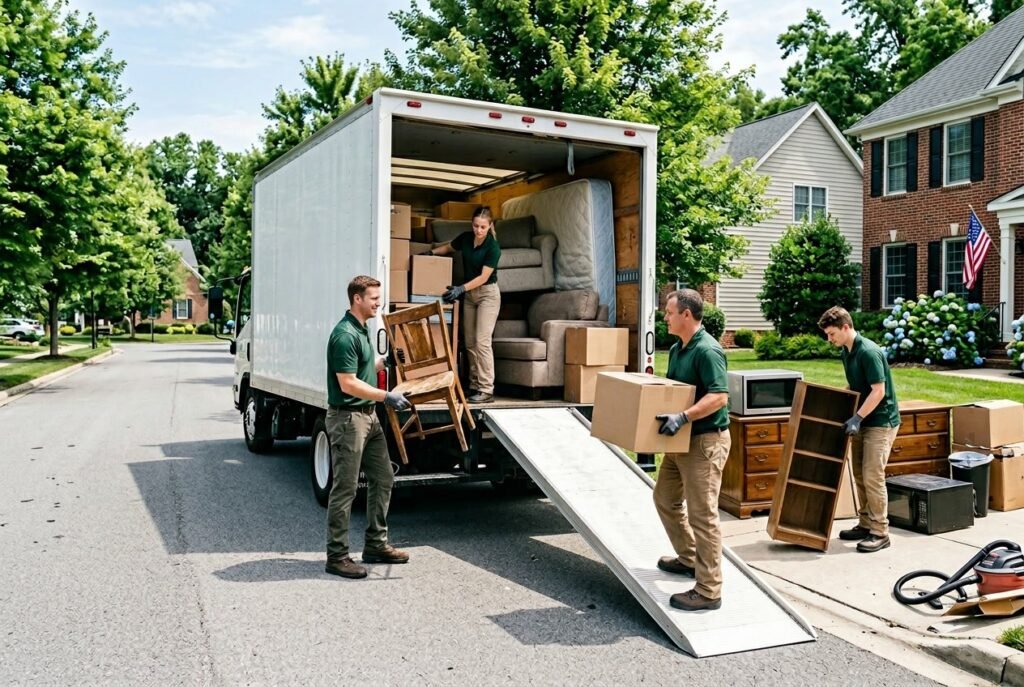
Ever wondered how you could turn a truck and some hard work into a thriving business?
A junk removal business hauls away unwanted items from homes and businesses. You handle the heavy lifting and proper disposal so the customer doesn’t have to deal with the mess.
Because you can launch with just a truck and some basic tools, it’s consistently ranked as one of the best low-cost business ideas with high profit for beginners.
Some owners report making up to $80,000 in annual profits once they build a solid customer base. This guide walks you through exactly what you need to know about the junk removal business.
You’ll learn how to set up your business legally, what equipment you actually need, and how to price your services so you make money from day one.
What Is a Junk Removal Business?
A junk removal business picks up unwanted items from homes, offices, and construction sites and hauls them away for proper disposal or recycling. You show up with a truck, load the items, and handle everything from there.
How Junk Removal Services Work
The process starts when a customer contacts you about items they need removed. You can offer quotes over the phone based on what they describe, or you can visit the location to see the items in person before pricing the job.
Once you arrive for the actual removal, you and your team load everything into your truck. This includes carrying items from inside homes, garages, basements, or yards. You do all the heavy lifting so the customer doesn’t have to.
After loading, you drive to the appropriate disposal location. This might be a landfill, recycling center, donation center, or transfer station. You pay any dump fees and unload the items yourself.
The customer pays you for the complete service. They get their space cleared out without touching anything, and you handle the entire process from start to finish.
Types of Junk Removal Offered
Residential junk removal covers household items like old furniture, appliances, mattresses, and general clutter from cleanouts. You might work with homeowners downsizing, moving, or simply clearing out years of accumulated stuff.
Estate cleanouts involve removing everything from a home after someone passes away or moves to assisted living. These jobs are usually larger and require sensitivity when working with families.
Construction debris removal serves contractors and builders who need waste cleared from job sites. This includes drywall, lumber, flooring, and other building materials.
Commercial junk removal handles office furniture, electronics, and equipment from businesses. You might work with companies relocating, remodeling, or disposing of old inventory.
Yard waste removal covers branches, leaves, old fencing, and outdoor items that don’t fit in regular trash pickup.
Major Industry Trends and Demand
The junk removal industry continues growing as more people choose convenience over DIY hauling. Homeowners would rather pay someone than rent a truck and make multiple dump runs themselves.
Recycling and donation have become major priorities. Customers increasingly want assurance that their items won’t just end up in a landfill. Many junk removal services now sort materials to maximize recycling and donation opportunities.
The demand stays consistent year-round, though you’ll see spikes during spring cleaning season, moving months, and after holidays when people declutter. Population growth in urban and suburban areas creates steady need for waste collection services.
Online booking and same-day service are becoming standard expectations. Customers want quick responses and fast turnaround times, which creates opportunities for businesses that can move quickly.
Core Business Models
Junk removal companies typically operate using one of three main approaches, and many successful operators blend elements from each to serve different customer needs. Your choice depends on your startup budget, equipment access, and the type of work you want to pursue.
Full-Service Junk Removal
This is the model most people think of when they hear “junk removal.” You show up at the customer’s property, load everything into your truck, haul it away, and handle all the disposal. The customer doesn’t lift a finger.
Companies like 1-800-GOT-JUNK, Junk King, and College Hunks Hauling Junk built their businesses around this approach. You quote jobs based on how much space items take up in your truck, usually as a fraction of a full load.
The main advantages:
- Higher profit per job since you charge for labor and convenience
- Faster job completion compared to rental models
- Works well for both residential junk removal and commercial junk removal
- Customers pay immediately when the work is done
This model requires a truck or trailer and basic equipment like dollies and straps. You can start small with a pickup and expand as you grow. Many operators run multiple trucks with crews once the business scales.
Dumpster Rental and Drop-Off
Instead of loading items yourself, you drop off a dumpster at the customer’s location for a set rental period. They fill it on their own schedule, then you pick it up and handle disposal.
Starting a dumpster rental business requires more upfront investment since dumpsters cost more than basic hauling equipment. You’ll need multiple units to keep revenue flowing while some sit at customer sites.
Key differences from full-service:
- Lower labor costs per job
- Customers do their own loading
- Longer job cycle (rentals typically last 3-7 days)
- Better for construction debris and large renovation projects
This model works best when you have enough dumpsters to rent multiple units simultaneously. Your pricing usually includes delivery, pickup, disposal fees, and the rental period.
Specialty Services and Add-Ons
Many junk removal companies boost revenue by offering focused services beyond basic hauling. Estate cleanouts, foreclosure cleaning, hoarding situations, and yard waste removal all command premium pricing.
Some operators also add related services like light demolition, donation coordination, or appliance recycling. These additions help you serve more customer needs without changing your core business model.
Common specialty options:
- Estate and property cleanouts
- Construction debris removal
- Appliance and electronics recycling
- Furniture donation pickup
You can start with basic junk removal and add specialties as you build experience. Many junk removal franchise systems include training for these premium services to help franchisees compete locally.
Startup Costs and Essential Equipment
Starting a junk removal business requires between $5,200 and $25,000 depending on whether you already own a vehicle and how quickly you want to scale. The biggest expenses are your truck, insurance, and disposal fees.
Understanding Startup Expenses
The cost to start a junk removal business breaks down into three main categories: your vehicle, insurance coverage, and equipment.
Your vehicle is the largest single expense. A used pickup truck costs $3,000 to $8,000, while a box truck runs $15,000 to $25,000. Many new operators start with a pickup and trailer setup to keep costs under $5,000 total.
Insurance is non-negotiable. You’ll need general liability insurance at around $93 per month and commercial auto insurance at $173 per month. That’s over $3,000 per year before your first job.
Other startup costs include business licensing ($50 to $400), LLC formation ($50 to $500), and waste hauler permits ($0 to $300). Dump fees run $20 to $55 per load, so budget $100 to $500 for your first month.
Must-Have Trucks and Tools
You don’t need a massive truck to start. A half-ton pickup truck with at least a 5.5-foot bed works fine for most residential jobs. Adding a truck and trailer combination doubles your capacity without requiring a special license.
Box trucks hold more volume and look more professional, but they cost significantly more upfront. Most solo operators wait until they have consistent revenue before upgrading to a box truck.
Essential equipment includes a dolly or hand truck ($50 to $150), moving blankets to protect items and vehicle surfaces ($50 to $100), tie-down straps ($20 to $50), and a forearm forklift lifting strap system ($30 to $60). Basic hand tools like shovels, brooms, and utility knives add another $50 to $100.
Budget $200 to $500 for a basic equipment setup, or up to $1,500 if you’re buying higher-quality gear and power tools.
Safety Gear for Every Job
Junk removal involves heavy lifting and sharp objects, so proper safety gear protects you from injuries. Construction gloves ($10 to $30) prevent cuts and blisters during every job.
Safety glasses ($5 to $20) protect your eyes from dust, debris, and splinters when moving items from attics, basements, or garages. A hard hat ($15 to $40) is essential when working under heavy items or in construction zones.
Steel-toed boots ($50 to $150) protect your feet from dropped furniture and appliances. Back support belts ($20 to $40) help prevent strain during repetitive lifting. You can start with basic safety gear for under $100, then upgrade as your business grows.
Licensing, Registration, and Insurance Needs
Most junk removal businesses need basic registration with local and state authorities, plus insurance coverage to protect against accidents and liability. These steps create a legal foundation and help you avoid financial risks down the road.
Business Structure and Registration Steps
You’ll need to decide on a business structure before you start hauling junk. Many people choose to form an LLC because it separates your personal assets from business debts and lawsuits.
LLC formation involves filing paperwork with your state and paying a filing fee. You can also operate as a sole proprietorship, which is simpler but doesn’t protect your personal assets if something goes wrong.
After you set up your structure, get an EIN from the IRS. This number is free and lets you open a business bank account, hire employees, and file taxes properly. Having a separate business credit card also helps you track expenses and build business credit.
Complete your business registration by filing with your state and local government. This makes your company official and allows you to operate legally in your area.
Key Licenses and Permits Required
Most cities and counties require a local business license to operate a junk removal service. You get this from your city clerk or county business office by registering your business name and paying a small fee.
Some areas require additional licenses and permits for hauling waste. These might be called waste hauler permits or debris hauling permits depending on where you live.
The requirements vary widely by location. Larger cities often have stricter rules, especially if illegal dumping has been a problem in the past. Contact your local government to confirm what you need beyond the standard business license.
You won’t need specialized certifications like plumbers or electricians do. Just make sure you have permission to transport debris commercially in your area.
Getting the Right Insurance Policies
Junk removal insurance protects you from accidents, property damage, and lawsuits. You’ll need multiple types of coverage since the work involves driving, lifting heavy items, and entering customer properties.
Commercial auto insurance is required because personal auto insurance doesn’t cover vehicles used for business. This policy typically costs $100 to $250 per month and covers accidents that happen while you’re hauling debris.
General liability insurance protects you if you damage a customer’s property. For example, if you scratch a wall while carrying furniture or break a door frame. Most companies carry at least $1 million in general liability coverage, which costs around $40 to $100 per month.
If you hire employees, you’ll likely need workers’ compensation to cover medical expenses if someone gets hurt on the job. The cost depends on your state and payroll size.
| Insurance Type | Monthly Cost | Annual Cost |
|---|---|---|
| Commercial Auto | $100 – $250 | $1,200 – $3,000 |
| General Liability | $40 – $100 | $400 – $1,200 |
| Workers’ Comp | Varies | Based on payroll |
Pricing Strategies and Profitability
Most junk removal companies use one of three pricing models, and your choice directly affects your profit margins and how much revenue you can bring in per job.
How Junk Removal Companies Price Jobs
The most common pricing strategy is volume-based pricing, where you charge based on how much truck space the junk fills. About 70% of junk removal businesses use this approach.
A typical structure looks like this:
- 1/4 truck load: $150-$300
- 1/2 truck load: $300-$500
- 3/4 truck load: $450-$650
- Full truck load: $600-$800
Some companies use weight-based pricing instead, charging $0.10-$0.30 per pound. This works well for heavy materials like construction debris.
Others prefer hourly rates, typically $75-$150 per hour for a two-person crew. This pricing strategy protects you on jobs that take longer than expected.
Many successful businesses use a hybrid approach. You might start with a base price for volume, then add fees for stairs, heavy items, or special disposal needs.
Don’t forget to factor in disposal fees when setting prices. Landfills charge $30-$100 per ton depending on your location and what you’re dumping.
Profit Margins and Revenue Projections
Junk removal businesses typically see profit margins between 30-50% after covering all expenses. Your actual profitability depends on how well you control costs and price jobs.
Labor usually eats up 40-50% of what you charge. If you price a job at $400, expect $160-$200 to go toward paying your crew.
Most companies earn around $200 profit per average job. Revenue projections for a single truck operation range from $100,000 to $250,000 annually.
Your revenue grows significantly when you add more trucks and crews. Some businesses scale to multiple trucks and push past $500,000 in yearly revenue.
The key to profitability is accurate pricing that covers your disposal fees, labor costs, truck expenses, and still leaves room for profit.
Disposal, Recycling, and Sustainability
Junk removal businesses need to handle disposal responsibly while managing costs and meeting customer expectations. The way you dispose of items affects your operating expenses, local compliance, and your reputation as an eco-friendly business.
Disposal Options and Fees
You’ll work with several disposal options depending on what items you collect. Landfills accept most general waste, but they charge tipping fees based on weight or volume. These fees vary widely by location, typically ranging from $30 to $100 per ton.
Transfer stations offer another option where you drop off mixed loads. They sort materials before sending them to appropriate facilities. Some items require special handling and disposal fees, including:
- Electronics – TVs, computers, and appliances often have separate e-waste fees
- Mattresses – Many areas charge $10 to $30 per mattress due to recycling programs
- Tires – Usually $2 to $5 per tire at designated facilities
- Construction debris – May cost more due to weight and volume
Hazardous waste removal requires certified disposal sites. You cannot mix paint, chemicals, batteries, or fluorescent bulbs with regular trash. Factor these disposal fees into your pricing to maintain profit margins.
Partnering with Recycling Centers and Donation Facilities
Building relationships with local recycling centers helps you divert items from landfills while reducing disposal costs. Metal recycling centers often pay you for scrap metal, appliances, and copper. This creates an additional revenue stream for your business.
Donation facilities accept furniture, clothing, working electronics, and household goods in decent condition. Goodwill, Habitat for Humanity ReStores, and local charities will often provide donation receipts. Some organizations even offer free pickup for large items.
You should create a network of partners for different materials. Wood and cardboard go to recycling centers. Working appliances go to donation centers. This sorting process takes extra time but supports circular economy efforts through reuse and recycling.
Sustainable and Eco-Friendly Practices
Customers increasingly want eco-friendly disposal practices from junk removal services. You can stand out by prioritizing sustainability in your operations.
Start by sorting items at pickup or at your facility. Separate recyclables, donations, and true waste. This approach helps you maximize what stays out of landfills. Many successful junk removal businesses advertise that they recycle or donate 60% to 80% of collected items.
Consider these sustainable practices:
- Route optimization – Plan efficient routes to reduce fuel consumption
- Eco-friendly vehicles – Use fuel-efficient trucks or biodiesel when possible
- Digital documentation – Skip paper receipts and invoices
- Community partnerships – Work with local environmental groups
You can also track your diversion rates to show customers your environmental impact. Document how many tons you recycled or donated each month. This data helps with marketing and shows you’re committed to responsible waste management practices.
Marketing, Sales, and Growth Strategies
Getting customers through your door requires a smart mix of online visibility, strategic partnerships, and strong reviews. The junk removal industry generates $12.4 billion annually with steady growth, but you’ll need to stand out in a crowded market where 15-30 competitors often serve the same area.
Local and Digital Marketing Tactics
Your Google Business Profile is your most valuable free marketing tool. Most customers search “junk removal near me” when they need help, and 76% of people who search for local services visit a business within 24 hours.
Set up your profile with accurate hours, service areas, and photos of your trucks and team. Add posts about seasonal promotions and respond to every review within 24 hours.
Key Digital Marketing Channels:
- Google Business Profile (highest conversion rates)
- Google Ads targeting “same day junk removal” keywords
- Facebook ads with before/after photos
- Service-specific landing pages for hot tub removal, estate cleanouts, and appliance disposal
Consider adding online booking to your website. Companies with this feature convert 15-25% more visitors than phone-only options. You can also add GPS tracking so customers know when you’re arriving, which improves their experience and reduces no-shows.
Your junk removal business name should be memorable and clearly communicate what you do. Avoid overly clever names that don’t mention junk, hauling, or removal.
Building Referral Partnerships
Commercial accounts and partnerships create steady income instead of relying on one-time residential jobs. Target property managers, real estate agents, and moving companies who regularly need junk removal services.
Moving companies are perfect partners because people purge belongings during moves. Offer them a referral fee or reciprocal arrangement.
High-Value Partnership Targets:
- Property management companies for turnover cleanouts
- Construction companies needing ongoing debris removal
- Estate sale companies and professional organizers
- Storage facilities with abandoned units
- Senior living facilities helping residents downsize
Reach out directly through LinkedIn or local business networking groups. Commercial contracts can bring in $2,000-10,000+ monthly compared to $200-400 per residential job.
Reputation, Reviews, and Lead Generation
Customer reviews directly impact whether someone clicks your listing or scrolls past. Businesses with 4.5+ stars get 28% more clicks than those with 4.0 stars.
Ask happy customers for reviews right after completing the job. Send a text with a direct link to your Google profile while your service is fresh in their mind.
What Customers Care About Most:
- You showed up on time
- No surprise fees
- Professional appearance
- Fast completion
- Cleaned up afterward
Track your cost per lead and conversion rates to understand which marketing channels work best. Most junk removal companies see 40-60% of leads from digital marketing when they invest consistently in local SEO and paid ads.
Respond to negative reviews professionally and offer to make things right. Future customers read your responses to judge your customer service approach.
Financial Planning and Business Operations
Getting your finances right and running smooth daily operations will make or break your junk removal business. You need clear systems for money management, enough funding to grow, and a solid plan for handling jobs and workers.
Setting Up Your Business Finances
You need a separate business bank account from day one. This keeps your personal and business money apart, which makes taxes much easier and looks more professional to customers and lenders.
Most junk removal owners use QuickBooks or similar software to track income and expenses. You can see which jobs make money and which ones don’t. Track every dump fee, fuel cost, and equipment purchase so you know your real profit on each job.
Set your pricing based on actual costs, not guesses. A properly built business plan helps you figure out what each job needs to generate. You should know your cost per job, including labor, disposal fees, fuel, and truck expenses.
Keep enough cash on hand to cover slow weeks. Many new businesses fail because they run out of money between jobs, even when they’re booking work.
Funding and Loans for Growth
Most junk removal businesses start with $10,000 to $50,000 depending on whether you buy or lease a truck. You might use personal savings, a small business loan, or equipment financing.
Banks and credit unions offer business loans if you have decent credit and a solid plan. Some lenders want to see your financial projections and proof that you understand the numbers. A complete junk removal business plan shows lenders you’re serious and have thought through the details.
Equipment financing lets you spread truck costs over time instead of paying everything upfront. You can start earning money right away while making monthly payments.
Day-to-Day Operations and Team Management
Your daily workflow needs to be simple and repeatable. Book the job, show up on time, load the junk, haul it to the dump, and collect payment.
Software like Jobber helps you schedule jobs, send invoices, and track customer information in one place. You can send quotes and confirmations quickly, which makes you look professional.
When you hire helpers, pay fair wages to keep good workers. Labor costs typically run 30-40% of your revenue. Train your team on safe lifting, customer service, and how to estimate job sizes accurately.
Build relationships with property managers and real estate agents who need regular cleanouts. These connections give you steady work instead of waiting for random calls. Set clear expectations with your team about start times, job quality, and how to handle difficult situations.
Competitive Landscape and Industry Insights
The junk removal industry has specific customer groups and service needs that shape how businesses compete. Success depends on understanding who needs your services and what makes your business different from others in your area.
Market Analysis and Target Audience
Your potential customers fall into three main groups. Households need help with furniture removal, appliance removal, and general decluttering. Businesses require office cleanouts and regular trash hauling services. Government agencies hire junk removal companies for community clean-up projects.
The junk removal market was valued at $14.4 billion in 2024 and is expected to grow to $25 billion by 2035. This growth comes from more people living in cities and wanting convenient waste removal options.
Estate cleanout services are becoming more popular as baby boomers downsize their homes. Residential customers make up the largest share of the market at $6 billion in 2024. They want quick service and eco-friendly disposal methods.
Business clients look for reliable partners who can handle regular junk hauling needs. They care about your ability to recycle materials and follow proper disposal rules.
Standing Out from Competitors
Your junk removal startup needs clear ways to differentiate itself. The competitive landscape includes both national franchises and local operators.
Key differentiation strategies:
- Same-day service – Offer faster pickup times than competitors
- Eco-friendly practices – Focus on recycling and donation instead of landfills
- Transparent pricing – Use flat-rate or by-volume pricing that customers understand
- Online booking – Make scheduling easy through your website or app
National companies like 1-800-GOT-JUNK have brand recognition, but local businesses can win by providing better customer service and lower prices. You can also specialize in specific services like estate cleanouts or appliance removal to become the go-to expert in your area.
Building relationships with real estate agents, property managers, and home organizers gives you steady referrals. Understanding industry trends around sustainability helps you position your services to match what customers want.
Frequently Asked Questions
Starting a junk removal business brings up lots of practical questions about costs, equipment, legal requirements, and whether it’s actually worth pursuing. Most people can get started with basic equipment and a few thousand dollars, though you’ll need to handle some paperwork first.
You can absolutely start with just a pickup truck. Many successful junk removal businesses began this way.
A pickup truck works well for small jobs like furniture removal, appliance hauling, and residential cleanouts. You’ll want to add some basic equipment like moving blankets, ratchet straps, a dolly, and tarps to protect items and your truck bed.
Focus on advertising services for smaller residential jobs at first. As you build up customers and save money, you can expand to a larger truck or trailer.
The key is pricing your jobs correctly so you’re not taking on loads that are too big for your vehicle. Be honest with customers about what you can handle with a pickup truck.
Startup costs range from $2,000 to $50,000+ depending on whether you already own a suitable vehicle and how big you want to start. If you already have a truck, you’re looking at the lower end of that range.
Your main expenses include business registration fees, insurance, basic equipment like tools and safety gear, and marketing materials. You’ll also need money set aside for gas and disposal fees at landfills or recycling centers.
Insurance alone can cost several hundred to a few thousand dollars per year. You’ll need general liability insurance at minimum, plus commercial auto insurance for your vehicle.
If you need to buy or lease a truck, that’s your biggest expense. You might spend $10,000 to $40,000 on a used box truck or cargo van.
You’ll definitely need a business license from your local city or county government. This is required to legally operate any business in most areas.
Beyond that, requirements vary a lot by location. Some states like California, Texas, and Florida have unique licensing rules that you need to research for your specific area.
You might need a waste hauler permit if you’re transporting junk to disposal sites. Some areas require a contractor’s license or transportation permit too.
If you plan to handle hazardous materials like chemicals or asbestos, you’ll need special permits for that. Check with your local Chamber of Commerce or city hall to find out exactly what applies to you.
No, you don’t have to form an LLC, but it’s often a smart choice. You have a few options for your business structure.
An LLC protects your personal assets from lawsuits or business debts. If someone sues your business, they generally can’t go after your house or personal savings.
A sole proprietorship is simpler and gives you complete control. It’s the easiest option if you’re working alone, but it doesn’t protect your personal assets.
A partnership works if you’re starting the business with someone else. You’ll share control and profits based on your agreement.
Talk to an accountant or business advisor about which structure makes sense for your situation. The right choice depends on your risk tolerance and tax situation.
Yes, junk removal can be quite profitable with the right approach. Businesses can make $60,000 to $80,000 per year in profit, and successful operations can scale to earn up to $1 million annually.
The business is profitable because there’s steady demand. People always need help getting rid of old furniture, cleaning out garages, or dealing with estate cleanouts.
Your profit depends on setting the right prices and controlling costs. You need to charge enough to cover labor, vehicle expenses, disposal fees, insurance, and still have money left over.
The scalability is a big advantage. You can start solo and add trucks and employees as you grow.
The junk removal business involves real physical risks that you need to take seriously. Lifting heavy items can lead to back injuries, muscle strains, or accidents if something falls.
You could damage a customer’s property while moving items through their home. A scratched floor or dented wall can turn into an expensive claim if you’re not careful.
Sharp objects, unstable furniture, and hidden hazards in junk piles create injury risks. You might encounter hazardous materials like old paint cans, chemicals, or even asbestos in older items.
Vehicle accidents are another concern since you’ll be driving a loaded truck regularly. Weather conditions and heavy loads make driving more dangerous.
That’s why business insurance is essential. You need general liability insurance, commercial auto insurance, and workers’ compensation if you have employees. Use proper safety equipment like gloves, steel-toed boots, and back braces to reduce injury risk.